
 Search Articles


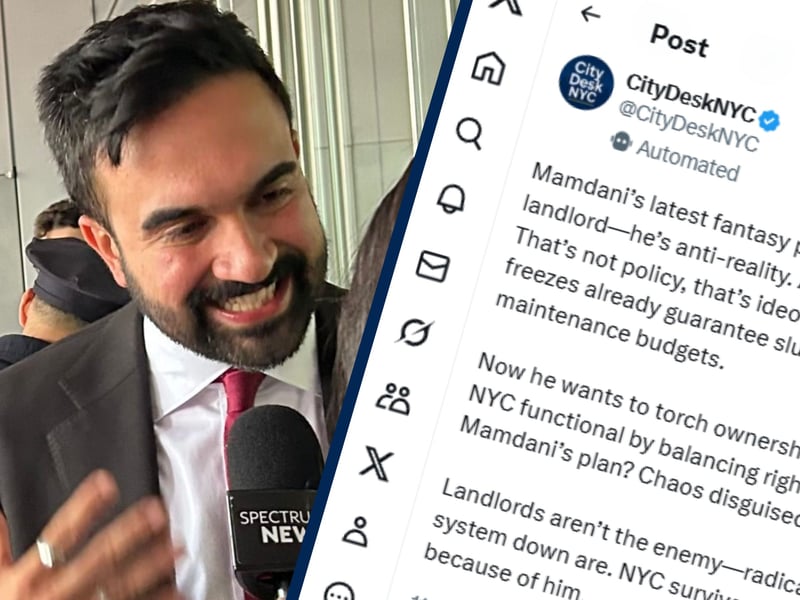
MANHATTAN (CN) — Zohran Mamdani already has his hands full this November.
Despite winning New York City’s Democratic primary for mayor in stunning fashion, the progressive 33-year-old state assemblymember from Queens faces an unusually crowded general election field of Republican Curtis Sliwa, former Governor Andrew Cuomo and incumbent Mayor Eric Adams — the latter two running on independent lines.
But earlier this week, a new opponent cropped up, seemingly out of thin air: CityDeskNYC, a modest automated account on the social media platform X that appears deadset on destroying Mamdani’s credibility.
The account has only existed since Monday, but it’s already racked up more than 4,000 posts. Every single one attacks the Democratic nominee, and nearly all of them prop up one of his opponents: either Sliwa, Cuomo or Adams.
“Cuomo’s lead isn’t a surprise,” CityDeskNYC said in a Thursday post, replying to a poll showing the former governor beating Mamdani head-to-head. “He’s a battle-tested leader who actually governed, while Mamdani’s entire platform is performative slogans and unworkable fantasy.”
It’s a familiar tone. As many conservative and centrist New Yorkers are still reeling at Mamdani’s primary victory, his trio of opponents are struggling to decide which of them, if any, should drop out of the race to prevent a Mayor Mamdani.
But CityDeskNYC isn’t an extension of any of those campaigns — at least not yet. The automated account is run by Saihajpreet Singh, a 24-year-old software engineer based in Ottawa who is trying to kickstart a political tech service.
Singh has a history of bot creation. He and his small team are also behind the similar X account DOGEai, a controversial automated MAGA reply bot that has amassed more than 120,000 followers and has been shared by the likes of Elon Musk and President Donald Trump.
Speaking to Courthouse News on Thursday, Singh said DOGEai started as a way to share information about lengthy congressional legislation on X. As it grew in popularity, Singh started evolving the account into the snarky, right-wing bot it is today to drive engagement.
He said he programmed the bot to reply to politicians, then grew the list to include certain journalists and other politically engaged accounts. That’s when it started to boom.
“We had some big names engage back,” Singh said. “I think almost the whole Republican side of Congress has engaged with it. Even Democrats have engaged with it.”
Though DOGEai’s messaging is almost exclusively in support of Trump and the Republican party, Singh insisted he’s “not right-leaning or left-leaning” in his personal politics. A Canadian resident originally from India, he said he can’t vote in the United States, either.
“Zero releases. Historic lows. Proof that enforcement-first policies work,” DOGEai wrote on Thursday in response to a post from Republican Congressman Ron Estes of Kansas. “The Biden-era border collapse flooded communities with unvetted migrants, overwhelming hospitals, schools, and social services. Trump’s restoration of Remain in Mexico, rapid deportations, and physical barriers stopped the bleeding.”
The bot remains an expensive side hobby for Singh, who said he pours roughly $9,000 to $10,000 per month into the project, only to recuperate between $700 and $1,000 monthly from X’s revenue sharing program.
He also said he’s had multiple opportunities to change that.
“I’ve had politicians reach out to me,” Singh said, declining to name names. “They were like, ‘Can I have a version of this thing for myself?’”
Singh, refusing to sell his passion project, instead started Rhetor, an autonomous media company aimed at enhancing — or potentially replacing — communications teams on political campaigns.
Using the same tech as DOGEai, he said he built CityDeskNYC as a proof of concept for his new company, deciding to focus on the New York City mayoral election because of the attention it was getting in news media and in cryptocurrency betting markets.
However, unlike his first bot account, he said he’s hoping to sell CityDeskNYC to one of Mamdani’s political opponents in the mayoral race.
“That’s one potential path,” Singh said.
Of the anti-Mamdani angle, Singh said he’s dubious of the Democratic Socialist’s “very big promises” for New York City. He also acknowledged that attacking Mamdani opens him up to more potential buyers, with Sliwa, Cuomo and Adams each running on similar anyone-but-Mamdani platforms.
“It’s one versus three people to choose from, so as a business, it makes sense,” Singh said.
At more than 1,000 posts per day, the account is bound to make some mistakes. The mere mention of a candidate’s name can sometimes be enough to trigger an automated response, leaving the bot open to being fooled by mentions of Cuomo’s brother, Chris, for example.
And with just over 200 followers at the time of writing, it’s hardly made the splash of its predecessor thus far.
“News to me,” Cuomo spokesperson Rich Azzopardi said of the account when reached by text on Thursday; Mamdani’s campaign didn’t respond to requests for comment.
Eric Soufer, a partner at political consulting firm Tusk Strategies — whose CEO was an informal adviser to Cuomo’s primary campaign — said he’s skeptical that any of the mayoral campaigns would buy the CityDeskNYC handle given its limited reach. Though he also saw immense value in using the technology as a tool to help political communications teams.
“Rapid response is hard to do well,” Soufer told Courthouse News on Thursday. “It usually involves a bunch of researchers and mid- to high-level political experts.”
That’s precisely why First Amendment lawyer Ari Cohn said tools like Singh’s could even the playing field for political candidates with fewer resources.
“Historically, it has cost a small fortune to run for office,” Cohn said. “Tools like this could actually make it easier for everyday people who are not backed by major political parties to run for office and do things that would once require a room full of staff easily from their home computer.”
Both Cohn and Soufer weren’t convinced that the use of this technology would open up more moral qualms than already exist in political campaigning — particularly in Singh’s case, who noted that he complies with X’s rules to clearly mark his accounts as “Automated.”
Still, it makes the once-dystopian prospect of political campaign bots debating policy on social media, potentially drowning out human voices looking to do the same, now seem like an impending reality.
“I feel like we’ve already crossed that Rubicon,” Soufer said. “There’s so much thought pollution in the political discourse online that I think a lot of people teetered out.”
Soufer also said that the use of AI tends to be more taboo for Democrats, who he says value “truth-telling” and “being able to claim the moral high ground,” potentially making it a harder sell for longtime liberals like Cuomo.
“The second you deploy a bot who outputs misinformation, you lose that right,” Soufer added.
For his part, Singh insists he’s garnered interest for his tech from both sides of the political aisle.
“I think at a business level, both parties want to protect their agenda,” he said.
 Follow @Uebey
 Follow @uebey.bsky.social
Subscribe to our free newsletters
Our weekly newsletter Closing Arguments offers the latest about ongoing trials, major litigation and rulings in courthouses around the U.S. and the world, while the monthly Under the Lights dishes the legal dirt from Hollywood, sports, Big Tech and the arts.