
 Search Articles


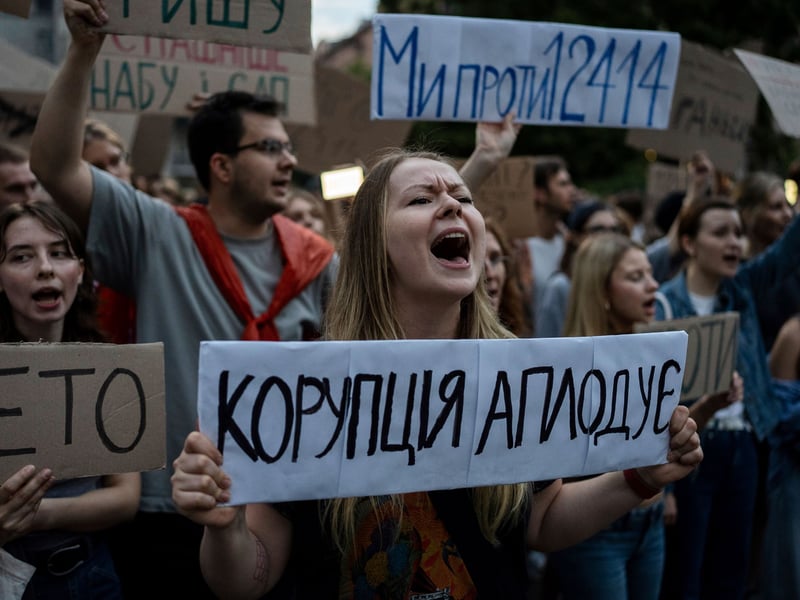
KYIV, Ukraine (AFP) — Ukrainian President Volodymyr Zelenskyy on Wednesday defended legislative changes removing the independence of two key anti-corruption bodies, sparking the first major protests in Ukraine since the start of Russia’s invasion.
The bill passed on Tuesday is the latest in a series of moves criticized by Ukrainian anti-corruption activists. They warn that growing government pressure threatens Ukraine’s reforms and ambition to join the European Union.
Zelenskyy has rejected the criticism, saying the law was needed to root out alleged Russian influence in anti-corruption institutions — a charge denied by activists.
“We all share a common enemy: the Russian occupiers,” Zelenskyy said after meeting with top law enforcement and anti-corruption officials.
“And defending the Ukrainian state requires a strong enough law enforcement system — one that ensures a real sense of justice,” he added.
The law places the National Anti-Corruption Bureau of Ukraine (NABU) and Specialized Anti-Corruption Prosecutor’s Office (SAPO) under the direct authority of the prosecutor general, who is appointed by the president.
After meeting with Zelenskyy, NABU and SAPO repeated their criticism of the changes and said “unambiguous legislative steps are required to reinstate the guarantees revoked by parliament.”
Prosecutor general Ruslan Kravchenko told journalists he maintained his independence.
“Society, law enforcement agencies and parliament can only judge me by my actions in the future,” he told journalists. “I can sign my name in blood if it helps.”
‘Gift to Putin’
The adoption of the law by Parliament on Tuesday sparked demonstrations in Kyiv, the first major protest in the Ukrainian capital since Russian troops invaded in 2022.
More than 1,000 took part despite martial law banning large gatherings.
Some fear that a political crisis over the legislation could work in Russia’s favor by undermining unity in the country.
“This is a gift to Putin,” Oleksandra Matviichuk, head of the Centre for Civil Liberties that was awarded the Nobel Peace Prize, said of the law.
Kremlin spokesman Dmitry Peskov said there was “a lot of corruption,” answering a question about the protests in Kyiv.
Zelenskyy signed the law on Tuesday as protesters were massed in front of the Ivan Franko theatre, where they projected a message reading “Veto the Law.”
The news was met with anger from protesters, who vowed to gather again on Wednesday evening.
“We all hear what society is saying,” Zelenskyy said on Wednesday, promising to “resolve existing issues.”
While the government says the law will make the anti-corruption agencies function better, its critics say it consolidates power in Zelenskyy’s hands and allow government meddling in high-profile graft cases.
EU ‘step back’
Kyiv’s partners reacted with alarm, worrying the move would undermine anti-corruption reforms key to Ukraine’s bid to join the European Union.
European Commission head Ursula von der Leyen has demanded “explanations” from Zelenskyy over the change, the EU said Wednesday.
“President von der Leyen conveyed her strong concerns about the consequences of the amendments,” said a spokesman.
“The dismantling of key safeguards protecting NABU’s independence is a serious step back,” EU Enlargement Commissioner Marta Kos said.
NABU began work in 2015, as Kyiv sought to bring the country closer to Europe after a 2014 pro-European revolution.
Since its inception, the agency has uncovered widespread graft, including among figures in Zelenskyy’s administration.
On Monday, law enforcement conducted large-scale raids at NABU, detaining one employee on suspicion of spying for Russia.
Transparency International’s Ukraine office called the raids an “attempt by the authorities to undermine the independence of Ukraine’s post-Revolution of Dignity anti-corruption institutions.”
Transparency International ranked Ukraine 105th out of 180 countries in its “corruption perceptions index” in 2024, up from 144 in 2013. Higher numbers indicate higher levels of corruption on its index.
The raids followed proceedings against one the country’s top activists, Vitaliy Shabunin, who was brought to court for alleged fraud and draft-dodging.
Some of Shabunin’s allies have denounced the case as politically motivated retribution for an investigation into the president’s inner circle, including former minister Oleksiy Chernyshov.
It also comes as the government rejected the appointment of the head of the Bureau of Economic Security, citing alleged connections with Russia, a decision heavily criticized by Ukrainian civil society.
—
By Agence France-Presse
Subscribe to our free newsletters
Our weekly newsletter Closing Arguments offers the latest about ongoing trials, major litigation and rulings in courthouses around the U.S. and the world, while the monthly Under the Lights dishes the legal dirt from Hollywood, sports, Big Tech and the arts.