
 Search Articles


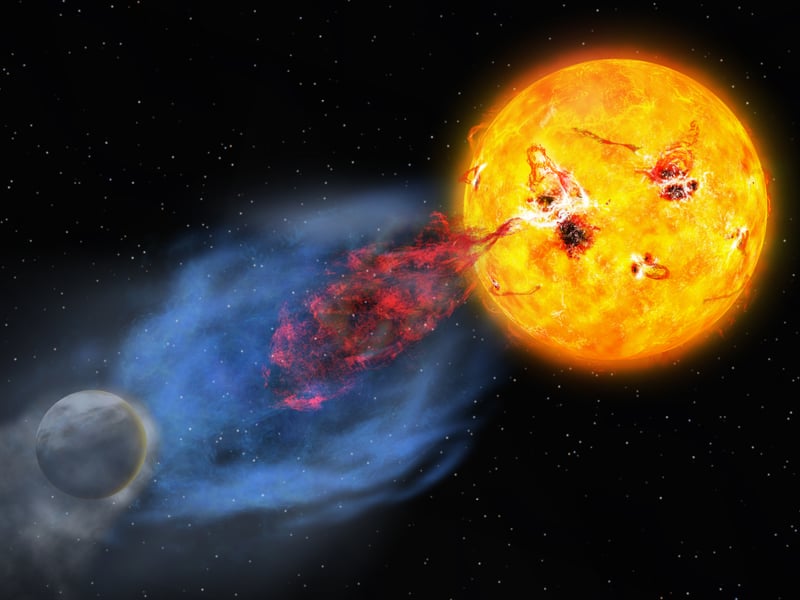
(CN) — Astronomers studying a young sun-like star have found the first evidence of massive, multi-temperature plasma eruptions — explosions similar to those the sun still produces today but on a far more intense scale.
The findings, published Monday in the journal Nature, suggest that our early sun may have blasted frequent, high-energy “coronal mass ejections,” that could have stripped away or reshaped the atmospheres of the young Earth, Mars and Venus.
“What inspired us most was the long-standing mystery of how the young sun’s violent activity influenced the nascent Earth,” said Kosuke Namekata, an astronomer at Kyoto University and one of the study’s lead researchers, in a press release. “By combining space- and ground-based facilities across Japan, Korea and the United States, we were able to reconstruct what may have happened billions of years ago in our own solar system.”
Coronal mass ejections are immense blasts of plasma that erupt from a star’s outer atmosphere, often alongside bright flares.
When directed toward Earth, these eruptions can trigger auroras, disrupt satellites and, on rare occasions, damage power grids.
In the early solar system, astronomers say they may have done something much bigger: helping shape young planetary atmospheres and possibly contributing to the chemistry that made life possible.
To study what that might have looked like, researchers observed a young star called EK Draconis, located about 111 light-years away. It’s considered a “solar analogue,” meaning it offers a glimpse of what our sun looked like around 100 million years into its life.
The team used the Hubble Space Telescope to capture ultraviolet light from hot plasma while three ground-based observatories in Japan and Korea recorded visible-light emissions from cooler gas. The synchronized observations allowed scientists to watch a stellar eruption unfold across multiple temperatures for the first time.
Their results revealed a two-phase event: a burst of hot plasma, about 100,000 degrees Kelvin, shot out of the star at up to 550 kilometers per second, followed roughly 10 minutes later by cooler gas moving at 70 kilometers per second.
The hot component carried far more energy, suggesting that early-sun eruptions could have generated shock waves and energetic particles capable of transforming or eroding primitive atmospheres.
“The success of this study came from international teamwork and precise coordination between space- and ground-based observatories,” Namekata said.
According to researchers, the discovery helps explain how such ejections may have shaped the early habitability of planets.
Previous models and lab experiments indicate that such outbursts could drive the formation of greenhouse gases and organic molecules. Both are essential for life to emerge, but too many coronal mass ejections could also strip away a planet’s atmosphere, as may have happened to Mars.
“Theoretical and experimental studies support the critical role that strong CMEs and energetic particles can play in initiating biomolecules and greenhouse gases,” the team wrote in the study. “Therefore, this discovery has major implications for understanding planetary habitability and the conditions under which life emerged on Earth, and possibly elsewhere.”
Until now, scientists had only detected cooler coronal mass ejection material with ground-based telescopes. The hotter plasma, which actually powers the ejection’s energy, had never been seen directly in a young, sun-like star.
Researchers say the new results provide evidence of both hot and cool plasma being ejected from such a star, showing that the early sun was likely much more active than scientists once thought.
“We were happy to see that, although our countries differ, we share the same goal of seeking truth through science,” Namekata said.
Subscribe to our free newsletters
Our weekly newsletter Closing Arguments offers the latest about ongoing trials, major litigation and rulings in courthouses around the U.S. and the world, while the monthly Under the Lights dishes the legal dirt from Hollywood, sports, Big Tech and the arts.