
 Search Articles


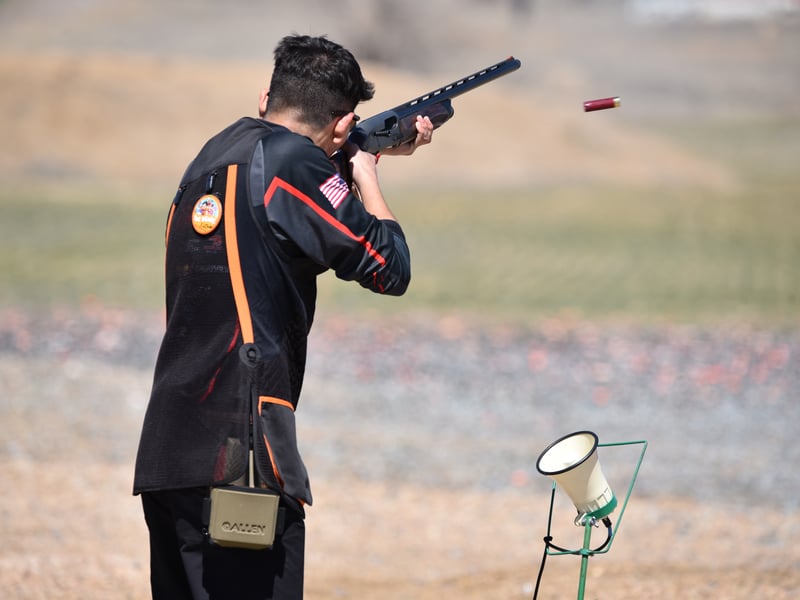
BRIGHTON, Colo. (CN) — When Nathan Duran was a sophomore in high school, he encountered an unusual problem.
Duran had discovered a love and knack for trap shooting — but Brighton High, the school he attended 30 minutes north of Denver, did not have a team.
In an era of school shootings, it was hard to imagine anyone in charge would sign off on a shotgun team. Duran couldn’t even visit the USA Clay Target League website on school computers, since they blocked any gun-related content.
Trap shooting is a marksmen sport in which participants shoot at a four-inch clay projectile known as a “pigeon.” In youth trap, the pigeon travels at 44 miles an hour, and athletes must hit it from more than 16 yards away.
While developed to mimic duck hunting, trap is more akin to golf with a shotgun. During a visit to a Colorado range on a recent Sunday, marksmen were similarly silent so that everyone could concentrate on the tiny orange target in the sky.
With the thrill of hitting his first mark fresh on his mind, Duran was not going to give up on this without at least giving it a shot. In the spring of 2021, he pitched the idea to assistant principal Jennifer Minor.
“The answer is always ‘no’ unless you ask,” Minor said, recalling the day Duran first approached her.
Minor was familiar with trap shooting long before she got to Brighton High. Growing up as an Army brat, she often went hunting with her dad. For her and her husband’s first wedding anniversary, they went trap shooting.
For a school in a city that contains more farmland than high-rises, it wasn’t hard to convince her that a shooting team made sense. Besides, Duran came prepared.
“Nathan was very calculated,” Minor said, swiveling in her office chair after the season ended in October. “The way that he approached it, how could you say no to that? He was like, ‘This is why it’s safe, and this is how we’re going to do it.’ He had it all planned out.”
In the spring of 2021, Minor asked the school IT team to change the internet security settings so she could access the national clay league website and put up her own.
With the school board’s approval, Minor began coaching the school’s first team at Colorado Clays, a nearby shooting range run by the state wildlife agency. In the two years since, Brighton High School’s trap shooting team has grown to encompass seven coaches and 50 athletes, including many of the state’s top marksmen and women.

Minor’s desk at Brighton High is surrounded by photos of her kids. She keeps pictures not only of her three biological children, but also of the dozens of students she has connected with on the job.
On the back of her office door, where she often gazes if she’s not on the computer, she now displays three years of increasingly crowded trap team photos.
Duran succeeded in starting the trap team — but the intense interest from other students caught even Minor off-guard. “I didn’t realize that it would be so popular,” Minor said, “and so supported by the community.”
At Brighton High School and beyond, the breakout popularity of trap shooting represents a reversal of fortunes for the sport. While the pastime had fallen out of favor in recent decades, it was once a popular and common extracurricular American activity, especially in traditionally rural parts of the country like Colorado.
When Denver South High School was built in 1926, architects included a rifle range in the basement, as was common at the time. Today, that range holds a museum operated by the alumni association.
As American norms around firearms changed, trap shooting became less popular. “Nothing about what’s happened since 1999 going forward encourages anybody to want to have robust school-shooting teams,” David Yamane, a sociology professor at Wake Forest University, said in an interview, referring the steady drip of school murders since the Columbine High School massacre in Littleton, Colorado, 24 years ago.
With mass shootings an almost-daily occurrence, many Americans are more likely to associate firearms with tragedy than with sporting. “The Grand American trap shooting competition doesn’t make the news anywhere, except maybe in Illinois where it happens,” Yamane said. “Normal aspects of guns are not newsworthy, and so they tend to be forgotten.”
In a phone interview, Yamane said enjoying and participating in trap shooting might make someone more inclined to want to own a firearm and thus more attuned to the politics around firearms — a pattern sociologists call downstream politicalization. Still, he stressed that only a minority of gun owners are actively involved in Second Amendment issues.
“I don’t think that anything that happens with guns in the United States can be entirely divorced from politics — that’s the reality — but there are certainly people who are involved in trap shooting, who love trap shooting, and are apolitical,” Yamane said. “I don’t think anybody who’s coaching a trap shooting team is trying to actively win kids over to the gun-rights cause.”
Rather than the politics of gun ownership, many trap-shooting teams instead grapple with more practical concerns, like access to ranges and affordability.
Sports shotguns range from a few hundred dollars to a few thousand — with the flashiest shotguns rivaling the price of a new car. Teams rely on donations from local businesses, but political groups like Rocky Mountain Gun Owners and the National Rifle Association Foundation can also be found pitching their tents at championship events.
Cynics might see such NRA sponsorships as an attempt by the gun lobby to influence-peddle in schools — but John Nelson, president of the USA High School Clay Target League distinguishes between the political arm of the NRA and its endowment foundation. “Some people will say we’re associated with the NRA and we’re out holding picket signs, but that’s not what we do,” he said in a phone interview.
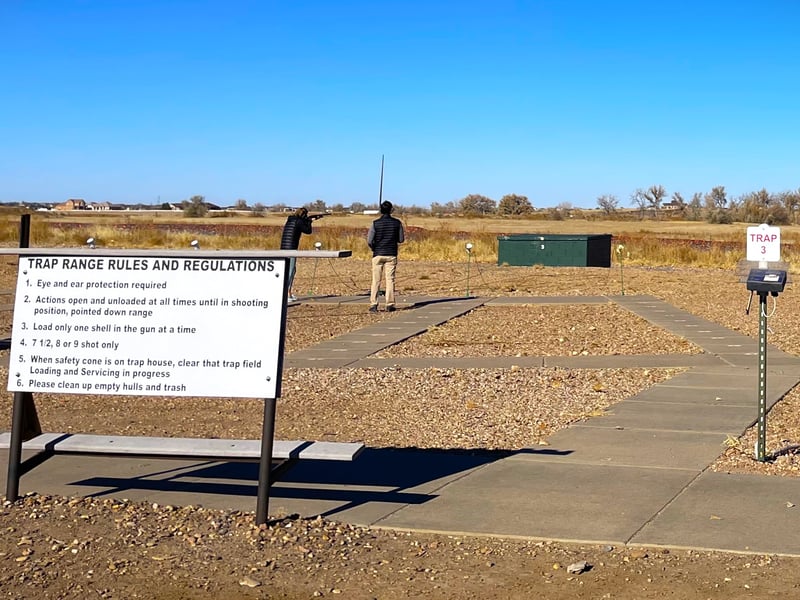
As the national league’s president, Nelson is used to answering difficult questions. From his experience, the topic of safety is a good starting point on which to build common ground. The trap league’s slogan — “safety, fun, marksmanship — in that order” — reflects its claim of being the safest sport in America, with zero reported injuries. Every coach and athlete must attend safety classes, and every season starts with range safety day.
The league started at a kitchen table in 2001, when Nelson’s friend Jim Sable shared that he was among the youngest people at the Plymouth Gun Club in Plymouth, Minnesota. That didn’t bode well for the future of the sport: Sable was retired.
Nelson, who has a background in marketing, started surveying residents to gauge whether there would be interest in a league. “If you want to reduce the average age of participants, who’s the audience that you have to search for? Kids,” Nelson explained. “Where do you find kids? In schools.”
Young people have indeed shown interest in the sport, as the league’s booming membership numbers show. The USA High School Clay Target League grew from six teams and 60 athletes in 2009 to 49,337 students spread across 1,647 teams this year. By 2025, the league aims to have 100,000 participating students nationwide.
According to an internal survey, 40% of students on trap teams don’t participate in other sports. Without trap, Nelson figures those students would have no extracurricular activities at all.
It’s not just athletes getting in on the action. Cutting across cafeteria cliques, trap shooting draws in students from traditional sports like football, wrestling and soccer but also from other extracurriculars like farming and band clubs. Some grew up hunting with their parents and were already familiar with guns before joining. Others had never seen a shotgun before or had only handled one in video games.
Nelson thinks a few factors help explain the sport’s surging popularity. With good eyes and young reflexes, most kids are quick to pick up trap shooting — though as with all sports, patience, persistence and practice are key.
Besides, “a kid does not have to be the fastest or the tallest or the strongest or even the right gender to participate,” Nelson said. “Everyone is included.” Unlike other sports where the top athletes get the most game time, everyone has the same number of clays and shells.
“The true difference between top performers and those that aren’t is the six inches between their ears,” Nelson said. “It’s you against a 44-mile an hour clay target flying through the air.”
Whatever the reasons, trap shooting is catching on with young people — bringing a whole batch of new faces into the once-fading sport.
At Eagle Ridge Academy in Brighton, trap coach Josh Contreras likes watching his students progress. There’s one girl who went from shooting six to hitting 37 out of 50 targets, and a boy who recently celebrated hitting his tenth target.
“He’s like, ‘Where did my clay go?’ And I was like, ‘You turned it to dust,’” Contreras recalled in an interview as he sat under a large oak tree outside his office. “Those kinds of things make me happy: Seeing the kids smiling when they finally get it dialed in and they’re hitting the clays.”
Like many others now overseeing trap teams, Contreras has a background in sports shooting. While serving in the Air Force, Contreras joined the skeet team — a marksmen sport with targets thrown from two different houses at two different heights.
He and his sons started the Eagle Ridge team after seeing a USA Clay Target League ad on Instagram. Contreras worried at first about getting pushback from school staff. Instead, he said they’ve encouraged him.
“We have the benefit of our principals being scouts, so they grew up shooting, they know what the sport is about, and as long as we’re safe and responsible, we can have a team,” Contreras said. “I always feel like sports is a great gatherer of people.” Their team had 13 kids last spring. This fall, 33 signed up.
At Brighton High, Duran didn’t know what to expect when he first started the school’s team. He put his phone number on flyers around school and braced himself for calls.
He got some tough questions at first, “like parents saying, ‘How does a kid do this? What are the procedures?’” he said. But more than skeptics and gun critics, he’s mostly encountered what he describes as skittish people with “a healthy fear of the unknown.” He tries to break down barriers by inviting them to the range.
He recalled one teacher who pressed him in class when he talked about the team.
“She was someone who did not agree with it,” Duran, now 17, recalled in an interview, looking at home in Minor’s office. “I actually talked to her after class, and I said, ‘You know what, I’d love for you to come out and see it.’ And now she’s out there every weekend.”
These days, Duran regularly hits a perfect 50 out of 50 targets at the range. He hopes to continue the sport in college. As he nears the last semester of his senior year, he considers starting the team his biggest accomplishment. To others who want to start, join, or coach a team, he offers three simple words of advice: “Take the risk.”
 Follow @bright_lamp
Subscribe to our free newsletters
Our weekly newsletter Closing Arguments offers the latest about ongoing trials, major litigation and rulings in courthouses around the U.S. and the world, while the monthly Under the Lights dishes the legal dirt from Hollywood, sports, Big Tech and the arts.