
 Search Articles


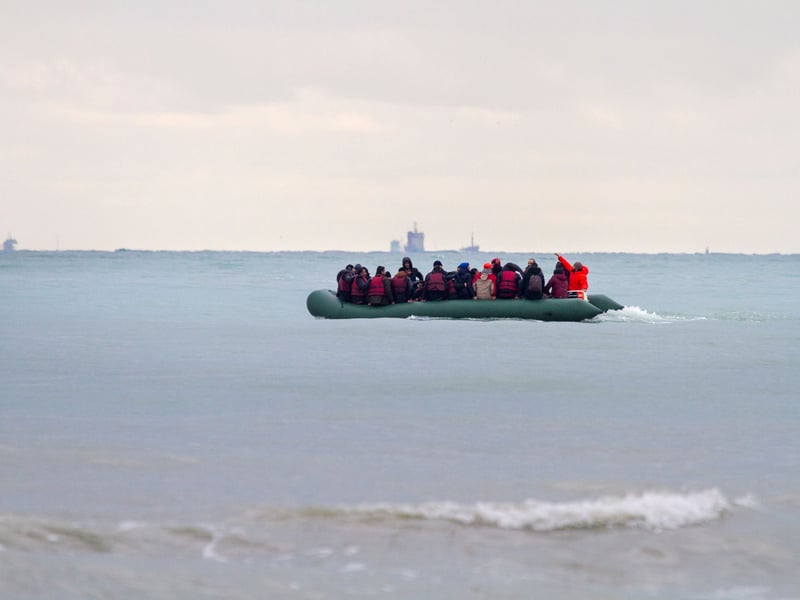
MANCHESTER, England (CN) — The United Kingdom has detained dozens of people crossing the English Channel who will be returned to France within weeks, under an agreement between the two countries.
The number of people crossing the channel in small boats has surpassed 50,000 since the Labour Party came to power last summer.
Under the deal, the U.K. will deport a certain number of people who arrive by small boat and accept an equal number of asylum-seekers already in France who pass security checks in exchange.
The government says the plan will stop the crossings and disrupt human smuggling gangs.
“This focus is very much on illegalized migration,” said Ala Sirriyeh, a sociologist at Lancaster University who studies the criminalization of migration. “While this policy is unlikely to deter people from moving or make any difference to the numbers of people arriving in Britain, it seems designed to give the public a sense that there is order and control.”
The “one in, one out” arrangement was announced in mid-July during French President Emmanuel Macron’s state visit to the U.K., alongside Prime Minister Keir Starmer.
“It is designed to supposedly bring order to a chaotic asylum system,” Sirriyeh said. “It also focuses on the smugglers as the source of blame, allowing the government to appear tough while also ostensibly showing care for the lives of people attempting these journeys.”
Why an increase in crossings?
Sirriyeh said focusing on smugglers “shifts attention from the state policies that force people to attempt dangerous routes for migration.” She added that since the 1990s, countries have restricted authorized routes of migration and settlement, with people “impelled to travel in different ways.”
The number of people arriving in the U.K. via small boats in the first half of 2025 has increased 48% compared to the same period last year.
Between 2018 and 2024, citizens of six countries made up the vast majority of people crossing in small boats: Afghanistan, Albania, Eritrea, Iran, Iraq and Syria.
Last year, 73 people died attempting the journey, more than in the previous six years combined, according to The Migration Observatory.
Legal routes to claim asylum in the U.K. have narrowed in recent years. The government has ended schemes for people from certain conflict zones and limited refugee resettlement to a small number of cases under specific country programs, such as those for Ukraine and Hong Kong residents.
Outside these schemes, there is no way to apply for asylum from abroad. One consequence of Brexit was that the U.K. left the Dublin Regulation, which allowed some asylum claims to be transferred between EU states, removing another mechanism for people to reach Britain through formal channels.
The Dublin Regulation “had a deterrent effect that policy makers in the previous government overlooked,” said Thom Brooks, a professor of law and government at Durham University.
“It was not noticed because overall irregular migration was comparatively small with a minority of new arrivals returned,” Brooks said. “But as I predicted, when new arrivals could not be returned, this removed the need for clandestine entry and numbers rose sharply.”
Brooks likened it to prosecutions: “If everyone knows they might be convicted, this can have a deterrent effect even if not all are convicted. But when this was stopped, small boats took off.”
He said one of the Conservatives’ main mistakes was revealed in a 2017 parliamentary reply to Lord Richard Rosser, which showed the government didn’t assess the impact of quitting the EU returns system before implementing Brexit.
Perception and reality
Small boat crossings have come to dominate political debate despite representing a small share of overall migration.
In a recent survey, 47% of respondents were in favor ending immigration and deporting recent arrivals. Yet this is based on the false belief that most immigration to the U.K. is illegal.
Jimmy from Manchester captures one half of the nation’s mood. “It’s becoming a joke how many illegals are coming in with no identification and getting benefits and hotels paid by us, the taxpayers,” he said.
Kelly, a supporter of the right-wing Reform UK party, said, “Soon there will be no males left in their own country, just women and children,” before adding, “I fear my children’s future.”
Records show that 96% of people who moved to Britain last year arrived legally through work, study or family visas.
Only 4% entered irregularly, most by dangerous small boat crossings. The asylum approval rate for those arrivals is 68%, according to The Migration Observatory.
“This is because the political rhetoric and reporting is so focused on the small boat crossings, without any wider context about who these people are and the history of state immigration policies that would explain why this is happening,” Sirriyeh said.
“We hear very little about any other kind of migration, so people assume this must be on a large scale to get such coverage,” she added.
Terms like “legal” and “illegal” obscure the process of laws and policies that have been created to classify immigrants and forms of migration. “People have been illegalized,” Sirriyeh said. “The term illegal suggests criminality and that is going to make people fearful.”
Asked about the consequences of asylum-seekers arriving on boats classified as illegal, despite international refugee law recognizing people may have to cross borders irregularly, Brooks said, “This was made within the context of providing a deterrence … If someone could not apply on entry, then they would not embark on the journey. A problem with this logic is that this framing didn’t lead to fewer arrivals.”
Bubbling tensions and unrest
Concerns about irregular migrants, and the distortion about general immigration, have been amplified by high-profile, far-right incidents.
The summer riots of 2024, the largest in England in more than a decade, followed a mass stabbing at a dance class in Southport in which three children were killed.
False claims spread online that the suspect was a Muslim asylum-seeker.
The unrest included racist attacks, arson, looting and attempts to set fire to hotels housing asylum-seekers. Police made 1,840 arrests.
Other protests have targeted asylum-seeker accommodation this year, including in Epping, east London, and London’s Canary Wharf.
“The conflation of migration with crime and security can make people fearful,” Sirriyeh said. “Many young British people today are descendants of people who have migrated to Britain. I worry how the negative rhetoric about migration, and the racialized dynamics of this, impacts on their sense of belonging.”
The British government has promised to close down all hotels housing asylum-seekers by 2029, saving $1.4 billion each year. Chancellor Rachel Reeves has also pledged $270 million to “cut the asylum backlog, hear more appeal cases and return people who have no right to be here.”
It hasn’t announced any plans to open new legal routes for asylum seekers. It is banking on its new policies to deter people from attempting the dangerous 21-mile channel crossing.
However, as Sirriyeh notes, without the opening of safe routes, many are likely to continue to risk the unpredictable journey.
Courthouse News reporter James Francis Whitehead is based in England.
 Follow @jayfranklinlive
Subscribe to our free newsletters
Our weekly newsletter Closing Arguments offers the latest about ongoing trials, major litigation and rulings in courthouses around the U.S. and the world, while the monthly Under the Lights dishes the legal dirt from Hollywood, sports, Big Tech and the arts.