
 Search Articles


WASHINGTON (CN) — Despite still-shifting political winds less than 24 hours after polls closed on Election Day, the Senate is all but certain to be under GOP control come January — and with it the mandate to aggressively pursue what could be a consequential push by President-elect Donald Trump to confirm friendly judicial nominees.
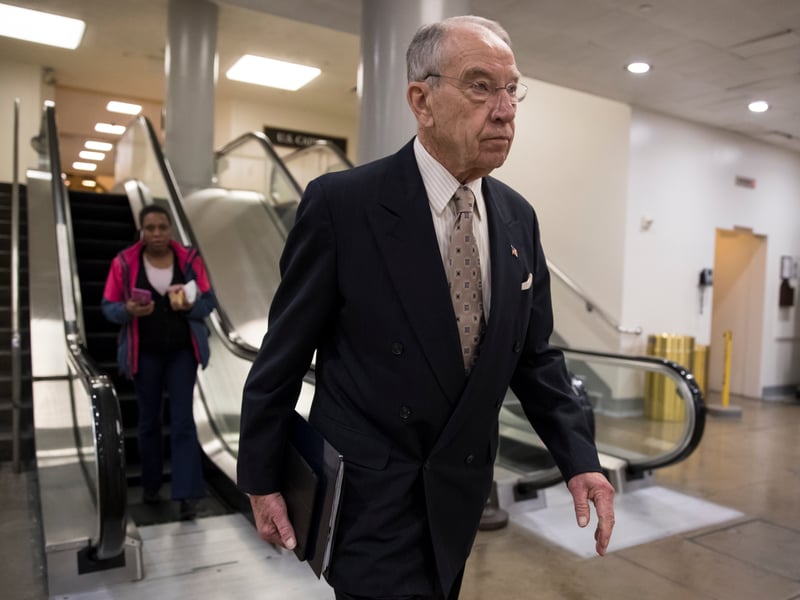
That effort will rely heavily on the all-important Senate Judiciary Committee, with its task as the first line of defense for White House court appointments. Iowa Senator Chuck Grassley is likely to once again take the reins of the panel in the next Congress.
In a Wednesday post on X, formerly Twitter, the Senate’s oldest serving member said he would work to “restore law & order” in the upper chamber’s new Republican majority, pointing specifically to his potential Judiciary Committee chairmanship.
“We will hit the ground running on Jan. 3,” Grassley wrote.
It won’t be Grassley’s first rodeo as head of the Judiciary Committee. A long-serving panel member, he was chair during Trump’s first term in office. During his tenure, Grassley angered Democrats by stepping away from a longstanding chamber tradition which allowed senators to disapprove of White House judicial nominees in their home states.
The Iowa Republican stopped honoring the process, known as blue slipping, for Trump’s circuit court appointments. He argued at the time that blue slips should not be considered “veto power” for home-state senators and contended that there was less reason to defer to a single senator on circuit court nominees, because their jurisdictions cover multiple states.
Now, under the current Senate Judiciary Committee chair Dick Durbin, Democrats continued that trend, arguing that they would not follow a different set of rules to coddle the Republican minority. Democrats did, however, allow GOP senators to submit blue slips for federal court nominees.
In recent months, lawmakers from both sides of the aisle including Durbin and Republican North Carolina Senator Thom Tillis have suggested that the committee could return to “regular order,” and once more consider blue slips for circuit court judges.
But with a Republican Senate around the corner, it remains an open question whether Grassley will continue ignoring blue slips for appellate nominees or if he will seek reconciliation, said Carl Tobias, chair of the University of Richmond School of Law.
“It’s not impossible,” said Tobias, pointing out that both Republicans and Democrats have each had four years to ignore blue slips. “Now is a perfect opportunity, if Grassley is amenable — and it’s all at the discretion of the chair.”
A spokesperson for Grassley’s office told Courthouse News Wednesday that the Iowa Republican “takes a traditional approach” to the blue slip precedent in line with the majority of past Judiciary Committee chairs. Grassley encourages “meaningful involvement” from the White House and home-state senators on nominees, the spokesperson said.
As a returning chairman, the Iowa senator brings a “checkered history” to the Judiciary Committee, Tobias observed. On the one hand, Grassley is an experienced panel member and a seasoned committee leader with some capacity for bipartisanship.
“He has pretty good staff who I think work pretty well with Democrats and the Democratic staff, so there’s some upside there,” said Tobias.
But Grassley was also the vanguard of Trump’s judicial agenda during his first term and is likely to serve a similar purpose again, he added. Further, the Iowa Republican played an instrumental role in slow-walking court nominees from then-President Barack Obama in 2015 and 2016 — part of a concerted GOP effort to hamper the former president’s agenda.
Republicans, meanwhile, will be eager to kickstart President-elect Trump’s own judicial nominations when they take over the Senate in January. But any hope of surpassing the 234 or so confirmations he tallied during his first term in office appears slim.
That’s partly thanks to the fact that President Joe Biden appears set to leave office with few outstanding judicial vacancies. The Senate appears likely to confirm a handful of pending appellate and federal court nominees, and if things hold, Biden will end his term with just one vacancy in the Third Circuit Court of Appeals.
The Biden White House is eager to finish strong on judicial nominees, said Tobias.
“It’s a big part of Biden’s legacy,” he said. “I think they are going to push hard, and there’s no reason not to at this point. They are probably energized by the fact that the more they confirm, the fewer vacancies Trump will have.”
The lack of current vacancies, however, doesn’t mean that the second Trump administration will not have new judgeships to fill. More than 150 jurists from federal and circuit courts across the country are currently eligible to take senior status — meaning they will soon retire and leave a vacancy on the bench.
That figure includes many current judges appointed by Democratic administrations, which could give the Trump White House a chance to replace retiring jurists with more conservative appointments.
And while Senate Democrats have long touted their own efforts to reach bipartisan consensus on some of the Biden administration’s nominees, Tobias said he was skeptical that Republicans would extend a similar courtesy as they begin bringing forward the Trump administration’s first court picks next year.
“Why should they?” he asked. “Why would they?”
 Follow @BenjaminSWeiss
Subscribe to our free newsletters
Our weekly newsletter Closing Arguments offers the latest about ongoing trials, major litigation and rulings in courthouses around the U.S. and the world, while the monthly Under the Lights dishes the legal dirt from Hollywood, sports, Big Tech and the arts.