
 Search Articles


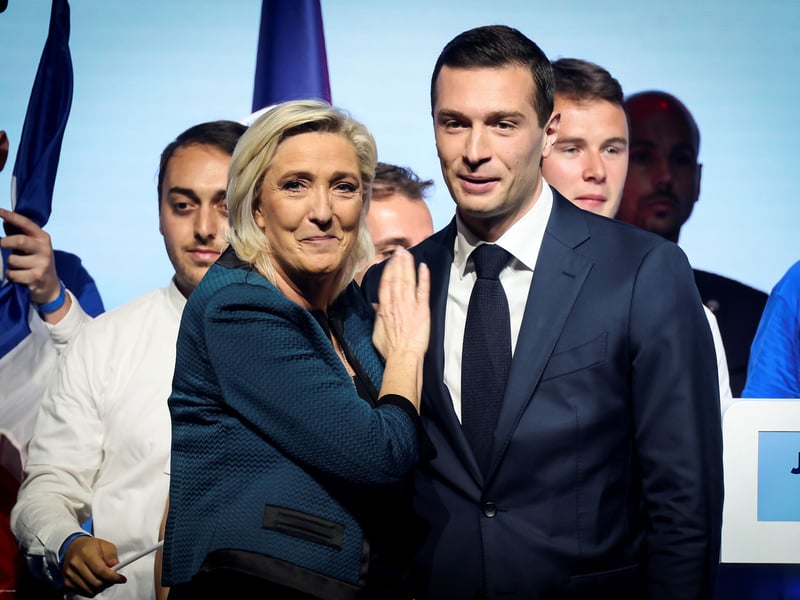
MARSEILLE, France (CN) — France’s far-right leader Marine Le Pen is giving Donald Trump the cold shoulder after publicly courting the president for years.
While other extreme-right groups are publicly supporting the new administration, Le Pen has distanced herself from Trump and ordered other members of her party to do the same.
Experts argue Le Pen’s stance represents an era of growing legitimacy for her National Rally, known as RN, which had been considered a fringe, extremist group for decades. Now, Le Pen is laying the groundwork for a potential presidential win in 2027 — a realistic possibility.
A December poll by Ifop showed Le Pen rising in the polls; if the elections were held today, she’d be first to qualify for the second round with roughly 37% of votes, an increase since September.
“If she wants to claim to govern and defend the interests of France, she cannot appear as someone who’s in the immediate proximity of Donald Trump, especially since Trump has a very aggressive discourse toward Europe,” Olivier Costa, a political scientist and director at the Center for Political Research at Sciences Po, told Courthouse News.
“There, she’s obligated to have more moderate positions, to find a balance between her desire to rejoice in the victory of Trump, who shares many of her ideas, but also to appear as someone who defends the interests of the country," he said.
Le Pen wasn’t present at Trump’s inauguration in Washington on Monday, but numerous RN officials were quietly in attendance. Although she reportedly did not receive a personal invitation, Patriots of Europe, the third biggest bloc of the European Parliament, was invited; theoretically, as members of the group, Le Pen and Bardella could have gone. Lower profile members attended instead.
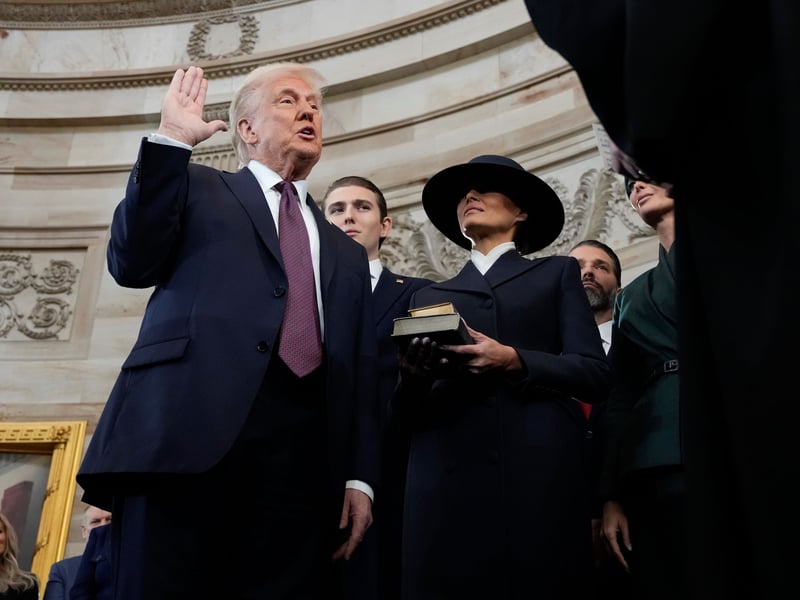
When Trump won the U.S. presidential election in 2016, Marine Le Pen said “Congratulations to the new President of the United States Donald Trump and the American people, free! MLP.”
In 2017, Le Pen lingered in the Trump Towers for hours, reportedly with hopes of meeting the president. She didn’t, and French headlines nailed her for it. The same year, Bardella said Trump’s victory represented the liberation of Americans from a belligerent and corrupt system. On social media channels, the RN blasted messages of support for the administration for years.
Then, in 2024, the RN banned its lower-ranking members from speaking about the American presidential election on social media. In November, Le Pen’s reaction to Trump’s win was noticeably more tactical.
She wrote: “I wish Donald Trump every success in his new presidency of the United States. American democracy has clearly expressed itself and Americans have freely chosen the president they have chosen. This new political era that is beginning must contribute to the strengthening of bilateral relations and the pursuit of constructive dialogue and cooperation on the international scene.”
Luc Rouban, a senior research fellow at Sciences Po Paris, told Courthouse News: “Trump was marginal in the United States, she was marginal in France; now, Trump is no longer marginal at all in the United States, and she is no longer marginal in France either.”
He continued, “So she’s perhaps also positioning herself as someone who aspires to be head of state in France, therefore she’s taking a certain distance and not showing a form of allegiance or obedience to Trump — so things have changed.”
In recent years, Le Pen has been running an unofficial normalization campaign to rebrand the RN away from the former National Front of her father, Jean-Marie Le Pen.
The party has long been associated with extremist, xenophobic rhetoric; experts argue that the RN’s coldness toward Trump reveals that Marine Le Pen is succeeding in turning the party mainstream and covering her bases for a potential presidency.
The contrast is made starker by Éric Zemmour, the leader of the extreme-right Reconquête! — which is significantly farther right than the RN with a fraction of the following — who wasn’t shy about attending Trump’s inauguration.
In the days leading up to Jan. 20, Zemmour posted a slew of videos on X; in one, he clinked glasses with members of the future administration at a cocktail party, thanking them. In another, Zemmour posed in pictures with American Republicans at a bar, addressing their kindness.
“On the one side we have the RN, which is a party that is on the verge of power, and on the other side, Reconquête!, which is really a minority populist party,” Costa said. “So they don’t have the same objectives, the same problems, the same interests — the RN was very cautious with regard to Trump’s campaign and his election.”
Costa argues that Zemmour’s overt enthusiasm reveals a lack of realistic presidential ambitions, and moreso, a desire to boost the legitimacy of a fading party. He could be hopeful that someone like Elon Musk could throw his party a similar bone as he did with Germany’s AfD, after Musk recently livestreamed an interview with the extreme-right political leader on X.
“Zemmour and Reconquête! are on a very libertarian position, which is a bit like the former National Front of Jean-Marie Le Pen — much more deregulation, much less state, much more freedom of civil society. But it’s very weak numerically, and Zemmour is very peripheral today in French political life,” Rouban said.
This runs in contrast to Le Pen, who is covering her tracks in the case of a win. The RN is no longer a splinter faction of France’s right-wing political spectrum, but controls one of the three biggest governing blocs of parliament.
“So if we imagine that Ms. Le Pen goes to see Donald Trump, treats him nicely and politely, and then comes into power for the next presidential elections — and Trump raises customs duties to 50% on all French products — people will ask Marine Le Pen for explanations, saying, ‘But what did you do with Trump, who is killing French agriculture or the French luxury industry or whatever?’" Costa said.
 Follow @lilyradz
Subscribe to our free newsletters
Our weekly newsletter Closing Arguments offers the latest about ongoing trials, major litigation and rulings in courthouses around the U.S. and the world, while the monthly Under the Lights dishes the legal dirt from Hollywood, sports, Big Tech and the arts.