
 Search Articles


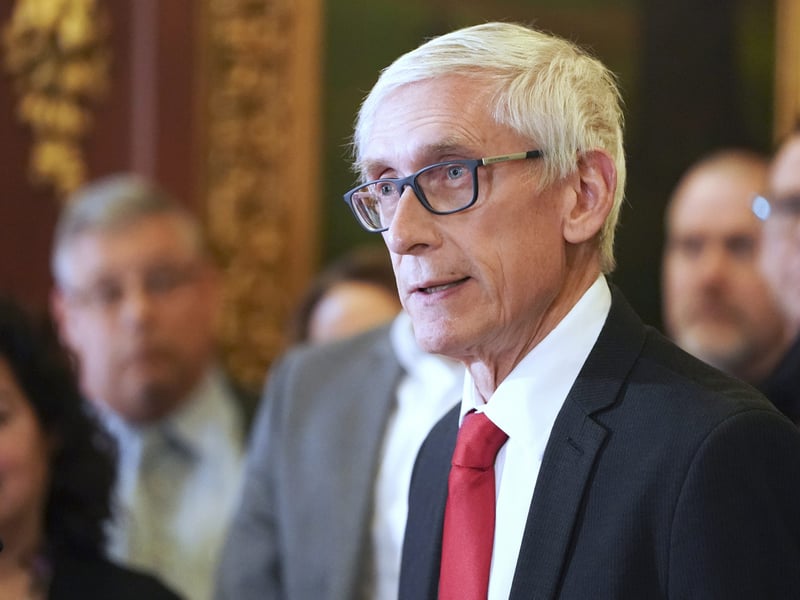
MADISON, Wis. (CN) — Justices of the Wisconsin Supreme Court on Wednesday puzzled over the extent of the governor’s partial veto powers after he modified a school funding limit increase to extend it by 400 years.
The Wisconsin Legislature, in its 2023-2025 budget bill, approved a two-year limit on schools’ power to raise money by increasing tax levies in their respective districts. But when the measure crossed Governor Tony Evers’ desk, he struck several digits, whole words and a dash to change the end date of the bill to the year 2425.
The state Senate voted to override the veto two months after it was published. However, state law requires the state Assembly to vote, too, and the body did not convene.
Hearing taxpayers’ challenge to Evers’ partial veto, justices found it laughable to give school districts the power to adjust property taxes without voter approval for more than four centuries.
“The 400 years marker is absurd,” Justice Ann Walsh Bradley said. However, the justice went on to say that the petitioner’s argument may be equally absurd.
The petitioners say Evers used an illegal maneuver by striking individual numbers to create a completely new year. They point to the Wisconsin Constitution, which prohibits striking individual letters in a bill to create a new word — known as a “Vanna White veto,” after the iconic Wheel of Fortune host — and argue that striking numbers and dashes amounts to the same thing.
“I find your argument equally absurd, and I don’t care how many legal theories you put behind it. Even a 4-year-old child knows that a letter is not the same as a number,” Bradley said firmly. As the governor noted in his response, the court in 1988 addressed letters and numbers separately in Wisconsin Senate v. Thomson .
In their second argument, however, the petitioners found their footing. They argued that Evers’ veto was also unconstitutional because the governor failed to approve part of the bill as the language demands, and instead added 400 years to it, usurping legislative powers. Of this, the court was more supportive.
The taxpayers asked the court to create a narrow date rule prohibiting the governor from extending dates in appropriation bills.
Assistant Attorney General Colin Roth, representing the governor, pushed back. Roth argued that the Legislature could have simply written the law differently, or omitted it from the biennial budget bill entirely, to avoid Evers’ veto.
To this, Justice Brian Hagedorn raised an eyebrow, and Chief Justice Annette Kingsland Ziegler cut in.
“It’s starting to feel like the sky is the limit,” Ziegler said, sounding exasperated. “Perhaps today we are at a fork in the road. Should we, today, take a clear stance?”
Hagedorn lamented how loose Wisconsin’s partial veto rules are, essentially giving the governor the power to create new laws himself by carving them out of approved legislation before him for approval.
“We have a kind of mess, and when legal scholars look over our case law, they think it is absolutely crazy — and it is,” Hagedorn said.
Evers’ attorney also noted that many governors before Evers have used similar vetoes without challenges. The digit veto was invented by former Governor Patrick Lucey in the 1970s, he said, and upheld by the court in Thomson and many other challenges against almost every governor since then.
He said the standard created in 2020 in Bartlett v. Ever s, which says that if what’s left after a partial veto is a complete and workable law, then it has legal footing, should be the only consideration in deciding this case.
If the high court decided the governor cannot extend dates, Roth said, his office would be back in court frequently. “As much as I enjoy being here with you all, I don’t want to argue partial veto cases all day every day,” Roth joked.
But the justices seemed to think the current test may not be enough as governors get increasingly brazen with their editing.
If the court decides in favor of the governor, the Legislature can still create an amendment and reinstate the two-year sunset for the school funding measure. However, some kind of ceiling on executive partial veto powers seems likely.
Scott Rosenow of WMC Litigation Center represented the petitioners.
 Follow @desdev5
Subscribe to our free newsletters
Our weekly newsletter Closing Arguments offers the latest about ongoing trials, major litigation and rulings in courthouses around the U.S. and the world, while the monthly Under the Lights dishes the legal dirt from Hollywood, sports, Big Tech and the arts.