
 Search Articles


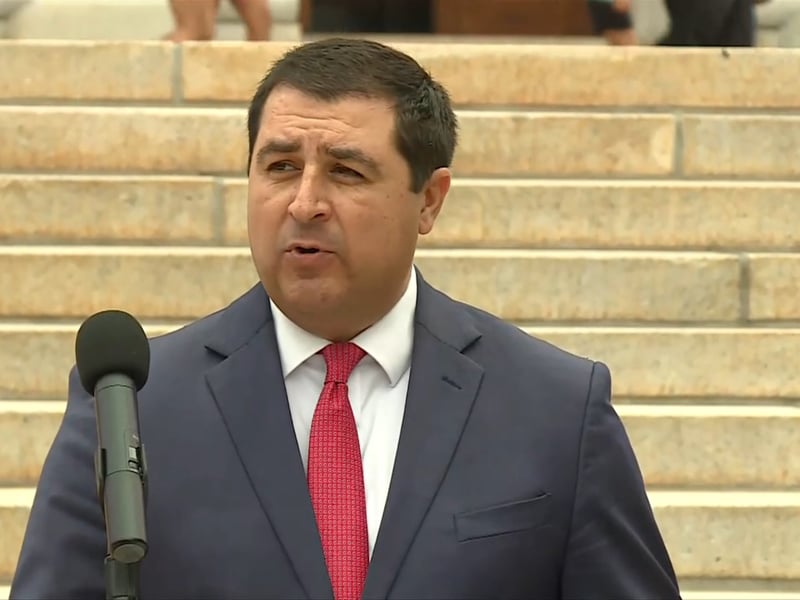
WAUKESHA, Wis. (CN) — Wisconsin’s appellate court reversed on Monday a lower court ruling that sided with state Democrats, and ruled to grant the state Legislature the final word on civil settlements involving the state, a task which had been under the purview of the attorney general for nearly 200 years.
In 2018, the Wisconsin Legislature, steered by a Republican majority, pushed through a package of bills meant to limit the powers of the then-incoming Governor Tony Evers and Attorney General Josh Kaul significantly in a novel, overnight lame-duck session that resulted, in part, in an act that gives the power for final approval of civil settlements to the Republican-controlled Joint Committee on Finance instead the attorney general.
The language of this law, passed by Republicans after Kaul, a Democrat, was elected but before he took office, orders the attorney general to present his proposed plan for any civil action to the committee for approval or renegotiation.
Kaul and Evers — joined by the Wisconsin Department of Justice and Department of Administration Secretary Kathy Blumenfeld — filed a complaint in 2021 claiming that the act violates the separation of powers doctrine when applied to two categories of civil actions: civil enforcement actions brought under statutes that the attorney general is charged with enforcing — such as environmental or consumer protection laws — and civil actions that the state DOJ prosecutes on behalf of the executive branch like breach of contract suits.
In a major win for Wisconsin Democrats, Dane County Circuit Court Judge Susan Crawford agreed with the plaintiffsin 2022 that the law is a legislative overreach into the vested powers of the executive branch. She ruled that the hybrid challenge, which is a blanket constitutional challenge to a law when applied in certain ways, violated constitutional separation of powers.
On appeal, however, Judge Maria Lazar ruled Monday that the state DOJ failed to meet the high burden of proof for a hybrid challenge and reversed the decision.
“The powers in question here are not core powers of the executive branch, but rather shared between the executive and the Legislature,” Lazar said in her opinion. “The DOJ has failed to meet its heavy burden of establishing that the statute is unconstitutional in every application within the two categories of cases it identifies.”
Arguing on behalf of the Legislature in June 2023, attorney Misha Tseytlin of the law firm Troutman Pepper had pointed to the state Supreme Court’s confirmation of the law’s constitutionality based on the vested interest of the committee to monitor large lawsuits.
“When you have a settlement – we’re talking about big dollars, opioid settlement, $400 million, tobacco settlement, over $1 billion, to throw out some hypotheticals – that’s a source of income for the state," he said.
The appeals court agreed and determined that settlements in at least some of the cases handled by the state DOJ involve the Legislature’s power to decide how state funds are allocated, throwing a wrench into the plaintiff’s argument that there aren’t any constitutional applications in those two categories.
“Because we have concluded that the Legislature has a legitimate institutional interest via its power of the purse in at least some settlements in the two categories of cases, there is a sufficient basis to uphold the constitutionality of § 165.08(1) in the face of this challenge,” Lazar said in the ruling.
The foundation of this decision is the precedent set by the Wisconsin Supreme Court in SEIU v. Legislature , which the state DOJ asked the appellate court to ignore in favor of the dissenting opinion in that case as the lower court had. However, Lazar said that the lower court erred in relying on the dissenting opinion which calls for an “unduly burdensome” standard of review.
Even if the court had adopted that standard, however, Lazar says that the plaintiffs failed to prove even that it suffered any true burden. In a brief, the state DOJ claimed that the law strangled the attorney general’s effectiveness because it “lacks confidentiality and real time authorization.” However, the agency failed to offer any concrete examples.
Lazar further noted in her opinion that the state DOJ conceded that it could not recall any civil matters which it had declined to prosecute due to the approval process with the Legislature, and therefore the law presents no burden at all to the powers of the executive branch.
In a dissenting opinion, Judge Lisa Neubauer argues that the majority failed to patrol the boundaries that separate the branches, instead allowing the Legislature to command the executive.
“The act gives the Joint Finance Committee exclusive and unreviewable power to accept, reject or renegotiate the terms under which lawsuits in these two categories are resolved,” Neubauer said. “Because that state of affairs is intolerable under our Constitution, I respectfully dissent.”
Kaul and Evers were unable to be reached for comment at the time of publishing.
Before the plaintiff’s initial complaint in the lower court, the committee created a settlement approval process complete with a checklist to identify which civil actions warranted action. The checklist was brief, only asking whether the appropriation of settlement funds is in question or if the matter is time sensitive to weigh its involvement. However, the state DOJ refused to use this process which may have expedited approval by the committee.
 Follow @desdev5
Subscribe to our free newsletters
Our weekly newsletter Closing Arguments offers the latest about ongoing trials, major litigation and rulings in courthouses around the U.S. and the world, while the monthly Under the Lights dishes the legal dirt from Hollywood, sports, Big Tech and the arts.