
 Search Articles


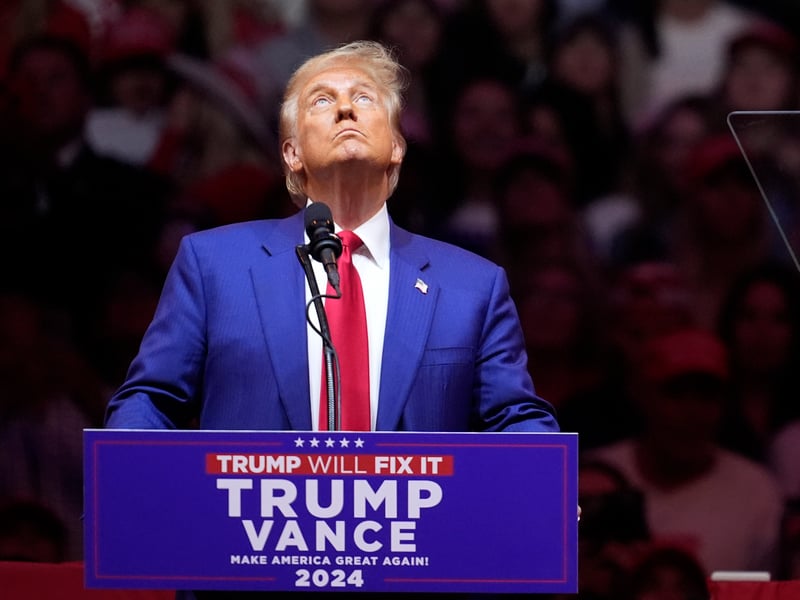
(CN) — It isn’t ancient history. Just 1,409 days ago, on Jan. 6, 2021, Donald Trump told supporters gathered in Washington to “fight like hell,” walk down to the U.S. Capitol and give House Republicans “the kind of pride and boldness that they need” to refuse to certify the 2020 election following Joe Biden’s decisive win in the presidential election.
Thousands of people marched on the Capitol, tangling with local police in a siege that resulted in six deaths and $2.8 million in property damage. The U.S. Department of Justice has charged more than 1,400 people with crimes related to the attack.
Though special counsel Jack Smith did not charge Trump with insurrection, three states and the U.S. House Select Committee on the January 6 Attack found his speech amounted to engaging in insurrection, raising questions about his constitutional qualifications for office.
“We had an assemblage on Jan. 6. They were resisting the execution of the federal laws that govern the transition of political power by force, violence or intimidation,” said Mark Graber, a professor at the University of Maryland Carey School of Law.
In January 2021, Graber was finishing a book chapter on the Constitution’s Section 3, originally drafting it as “the most forgotten provision of the 14th Amendment.”
Passed in the aftermath of the Civil War, the 14th Amendment bars people from holding office if they “engaged in insurrection or rebellion” while under the oath of office. The ban can only be overturned by a two-thirds vote in the U.S. House and Senate.
Several Colorado voters sued in 2023 to block the former president from the primary ballot. After the state Supreme Court found Trump engaged in insurrection, and Maine and Illinois made similar judgments, the question ended up at the U.S. Supreme Court. In an unsigned opinion, the nine justices agreed that states could not block a federal candidate from the ballot, but they left key questions unanswered.
“The way the Supreme Court resolved the decision did not address Trump’s underlying disqualification from office,” said Don Sherman, executive director of the nonprofit Citizens for Responsibility and Ethics in Washington. The organization led the 2023 ballot challenge.
Sherman recalled his decision to bring a preelection challenge in hopes of settling the issue of disqualification before an election brought further complications.
Following the Supreme Court’s opinion, Sherman likens the 14th Amendment to a “break in case of emergency” box, without anything to break the glass.
“Although Donald Trump remains a constitutionally disqualified individual, there is not a clear legal path on how to enforce that disqualification,” Sherman said. “He won a free and fair election. He will be president on Jan. 20.”
Attorney Scott Gessler, who represented Trump in the Denver bench trial, told Courthouse News in an email that the state ruling has no bearing on the upcoming inauguration.
“The U.S. Supreme Court ruled that Colorado had no authority to apply Section 3 of the 14th Amendment and no authority to decide what constitutes an insurrection under the 14th Amendment,” Gessler said.
While the Denver County District Court found that Trump engaged in insurrection, the judge hedged on the technicality of whether the president is an “officer” of the United States and whether the presidency is an “office” under the United States as outlined in Section 3.
Trump’s defense team relied heavily on the work of Josh Blackman, a professor at the South Texas College of Law Houston, in arguing the 14th Amendment carved out an exception for the president.
“In my view he is not disqualified, so there is no disability to remove,” Blackman told Courthouse News via email. “In my view Trump never took an oath as an officer of the United States, so he was not subject to Section 3. The U.S. Supreme Court vacated the Colorado Supreme Court’s decision and left in place the trial court decision.”
Blackman postulates the issue of 14th Amendment disqualification may still arise if citizens challenge an executive order and wish to argue Trump should not be in office.
While Congress is unlikely to successfully pass legislation to remove Trump or a resolution to remove the disability, some scholars think it behooves elected officials to try.
“If Democrats believe that Donald Trump, besides being a fascist in waiting, is at risk of being seated in violation of the Constitution, they should say something about it and they should do something about it,” said Evan Bernick, a law professor at Northern Illinois University.
Bernick is more concerned with Trump’s campaign pledge to remove the 14th Amendment’s Section 1 promise of birthright citizenship than he is about his disqualifications under Section 3.
Still, the 14th Amendment provides one of many constitutional limits on the power of the majority.
“The 14th Amendment is designed to prevent exactly that majoritarian results on the premise that somebody who is an insurrectionist cannot be trusted with a considerable amount of constitutional power, even if that’s what voters want,” Bernick said.
Seventy-six million Americans voted for Trump, earning him 312 electoral college votes and making him the first U.S. president to carry any level of finding of insurrection into the White House.
“I think people who read the history know the court got it wrong,” Graber said. “And there’s not much we can do.”
 Follow @bright_lamp
Subscribe to our free newsletters
Our weekly newsletter Closing Arguments offers the latest about ongoing trials, major litigation and rulings in courthouses around the U.S. and the world, while the monthly Under the Lights dishes the legal dirt from Hollywood, sports, Big Tech and the arts.