Search Articles


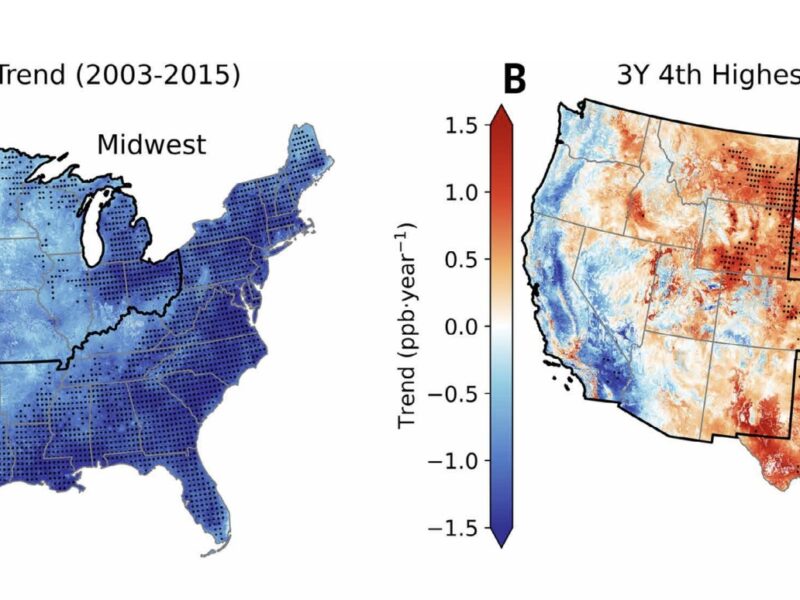
(CN) — For more than a decade, ozone in North America had been on a steady decline. That changed in 2015, researchers say in a study published Thursday in the journal Science, because of emissions from wildfires that can turn deadly.
Surface ozone is a harmful air pollutant that’s concentrated in the ground layer of Earth’s atmosphere. It’s formed when nitrogen oxides and volatile organic compounds hit sunlight, and contributes to both smog and global warming, in addition to health issues like asthma and lung cancer.
Regulations intended to mitigate ozone by reducing human-made emissions helped to rein in the pollutant, but researchers say that progress has been hindered by an increase in emissions from wildfires.
“Despite regulated reductions in anthropogenic emissions of O3 precursors, observation stations indicate that policy-relevant surface O3 levels have plateaued,” the authors write in the American Association for the Advancement of Science study.

Researchers from the University of Iowa and NASA Goddard Space Flight Center conducted the research using deep learning models to evaluate data from the Environmental Protection Agency, satellites and meteorological instruments. Specifically, they looked at North America between 2003 and 2024.
In 2015, they found, the surface ozone trend flipped from a yearly decrease of 0.65 parts per billion to an increase of 0.13 ppb. If not for wildfire emissions, the decline would have remained, albeit at a lower rate of 0.25 ppb decrease.
Researchers attributed surface ozone to an additional 318 deaths per year since 2013 — an increase of 46% mortality attributable to emissions from wildfires.
The study authors specifically examined the extreme fires and smoke in Canada from 2022 to 2024, finding that 43 million people were exposed to unhealthy levels of air pollution. In the U.S., that’s above 70 ppb.
According to the authors, the emissions from fires may have also hindered the U.S. from tightening its air quality standards for healthy ozone by 4 ppb.
“If the O3 standard were lowered to 65 ppb, 60% of the population (202 million people) would fall into nonattainment, and under a 60-ppb standard, the fraction would increase to 87% (294 million people). These findings demonstrate the challenge in adopting a more stringent O3 standard as growing wildfires contribute to high O3 episodes,” the authors write.
Benjamin de Foy, a professor in the department of earth and atmospheric sciences at St. Louis University, wrote a companion piece to Thursday’s study explaining the impact of the research. He points out that it’s difficult to quantify human mortality from wildfire-driven surface ozone because of the way ozone is formed — from mixtures of polluted masses of air — and because current monitors cover only 2% of the land area.
Researchers bridged that gap in the study by using an AI model inspired by the human brain, known as an artificial neural network model, with data from monitoring sites.
“This exemplifies one of the new aspects of doing science in the age of artificial intelligence: abductive reasoning, which makes inferences to the most likely explanation,” de Foy writes.
That’s a contrast from deduction, or drawing conclusions from a general rule, and induction, a general conclusion from multiple observations.
“Such an approach could accelerate counterintuitive findings which can be hard to identify with traditional data analysis and numerical simulations, as seen in a recent study that suggested that wildfires in the western United States may have reduced atmospheric particulate matter in the eastern part of the country by changing rainfall patterns,” de Foy says.
As for mitigating the health risks from the effects of wildfires, de Foy said restoring small, routine wildfires could help by boosting ecosystem health and making forests more resilient.
Managing air quality indoors would make a difference, too, he said, like using air purifiers and discouraging outdoor activities during air quality alerts.
 Follow @NinaPullano
 Follow @ninapullano.bsky.social
Subscribe to our free newsletters
Our weekly newsletter Closing Arguments offers the latest about ongoing trials, major litigation and rulings in courthouses around the U.S. and the world, while the monthly Under the Lights dishes the legal dirt from Hollywood, sports, Big Tech and the arts.