
 Search Articles


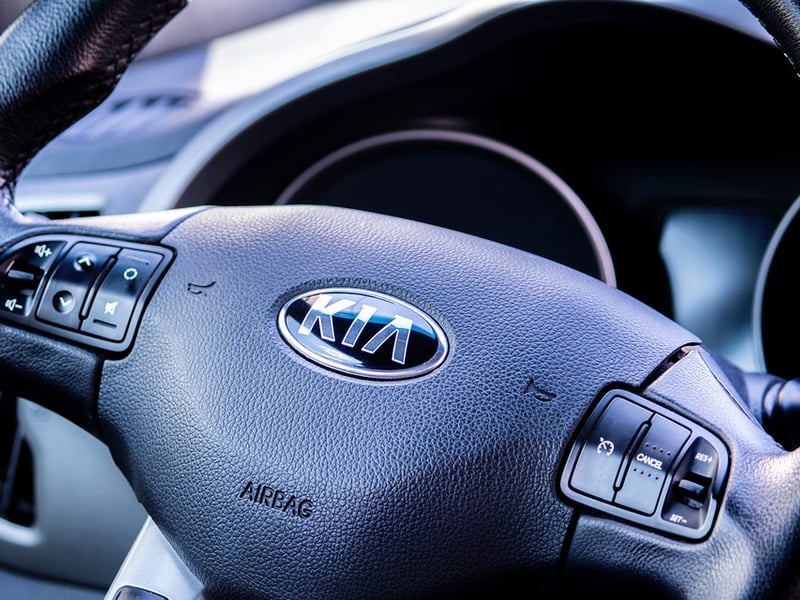
CINCINNATI (CN) — Kia America’s decision to skimp on antitheft devices allowed unlicensed drivers to steal its vehicles and cause at least one fatal accident, the widow of a victim argued Thursday at the Sixth Circuit.
Already the subject of various class actions, one of which was settled for $200 million last year, Kia’s decision to leave engine immobilizers out of nearly all vehicles produced from 2011-2022 drew widespread outrage among buyers when the defect was exploited by car thieves.
Cars lacking the antitheft device could be stolen even by amateur thieves in less than 90 seconds, a feat accomplished by 15-year-old Kaleb Baker on Nov. 23, 2023 in Hilliard, Ohio, a suburb on the northwest side of Columbus.
He and several other teenagers were involved in a high-speed pursuit after they stole a 2018 Kia Optima, and the collision at the end of the chase killed Matthew Moshi, 36.
Qualitee Moshi, Matthew’s widow, filed a wrongful death lawsuit against Kia America and claims its desire to make a cheaper car left consumers with vehicles that “provide no real protection against theft.”
The problem was exacerbated by a social media craze during the pandemic that saw thefts skyrocket.
After a federal judge dismissed her suit, Moshi appealed to the Sixth Circuit where her case was consolidated with that of Donald Strench, a driver who sustained permanent injuries in a crash with another underage driver who had stolen a Hyundai.
Kia and Hyundai are both part of the Hyundai Motor Group, a South Korean conglomerate headquartered in Seoul.
On Thursday, attorney Paul Giorgianni of Columbus, Ohio, argued on behalf of Moshi and Strench and was questioned repeatedly by the panel of judges about causation.
“This is a novel theory of causation, right?” U.S. Circuit Judge Eric Murphy, a Donald Trump appointee, asked. “You would admit there is a lot of precedent on the other side?”
Giorgianni disputed the point, and cited the 1989 Ohio Supreme Court case Federal Steel Wire Corp. v. Ruhlin Construction Co. , in which a commercial property owner was held liable for property damage from vandalism because of repeated instances of the crime.
“I’m struggling with proximate cause,” Murphy responded. “A thief is a superseding cause that precludes liability.”
But Giorgianni said the automakers’ conduct motivated the thieves. “Its failure to warn owners fueled these thefts by juveniles,” he told the panel. “Millions of vehicles were being put out there without the devices and we know it is reasonably foreseeable they will be stolen by juveniles.”
U.S. Circuit Judge Stephanie Davis, a Biden appointee, asked how it was foreseeable teens would steal the vehicles.
“The sheer number of these vehicles out there with flags on the antenna, basically saying, ‘steal me, no key required,’” Giorgianni said.
Attorney Jonathan Schneller of the Los Angeles-based firm O’Melveny and Myers LLP argued on behalf of the automakers and emphasized to the panel thefts of his clients’ cars were not an issue for years after their production.
“We marketed these cars successfully for a decade until a literally unprecedented social media event,” he said. “It was not a secret the cars didn’t have these devices.”
Murphy asked about Hyundai’s failure to issue recalls for the cars without the antitheft devices, but Schneller pointed out there was no such cause of action in the owners’ initial complaints.
“Ohio law does not impose any post-sale theory of liability,” he added.
Schneller told the court the issue of foreseeability in a product liability or failure to warn case is a “policy question” that Ohio has decided time and again ends with the first criminal act.
In this case, that would be the initial theft of the car, not the reckless driving that led to Moshi’s death or Strench’s injuries, according to the attorney.
“Hyundai made a profit-motivated decision to not install these devices, and that alone should give this court pause,” Giorgianni said in his rebuttal.
U.S. Circuit Judge Rachel Bloomekatz, another Biden appointee, rounded out the panel, which did not set a timetable for its decision.
 Follow @kkoeninger44
Subscribe to our free newsletters
Our weekly newsletter Closing Arguments offers the latest about ongoing trials, major litigation and rulings in courthouses around the U.S. and the world, while the monthly Under the Lights dishes the legal dirt from Hollywood, sports, Big Tech and the arts.