
 Search Articles


WASHINGTON (CN) — Since returning to the White House, President Donald Trump has chipped away at key constitutional liberties amid his mass deportation campaign and recent crackdown on crime in the nation’s capital, and now appears to be targeting core provisions of the First Amendment, sparking concerns among free speech advocates.
In the wake of the assassination of controversial right-wing commentator Charlie Kirk last Wednesday in Utah, several members of the Trump administration have vowed to prosecute perceived hate speech and violent rhetoric, while asserting that left-wing extremism is the primary cause for political violence.
Kirk’s killing, which investigators say came at the hands of22-year-old Tyler Robinson, has sparked a significant, but polarized, response from members of the Trump administration and Kirk’s critics throughout the country.
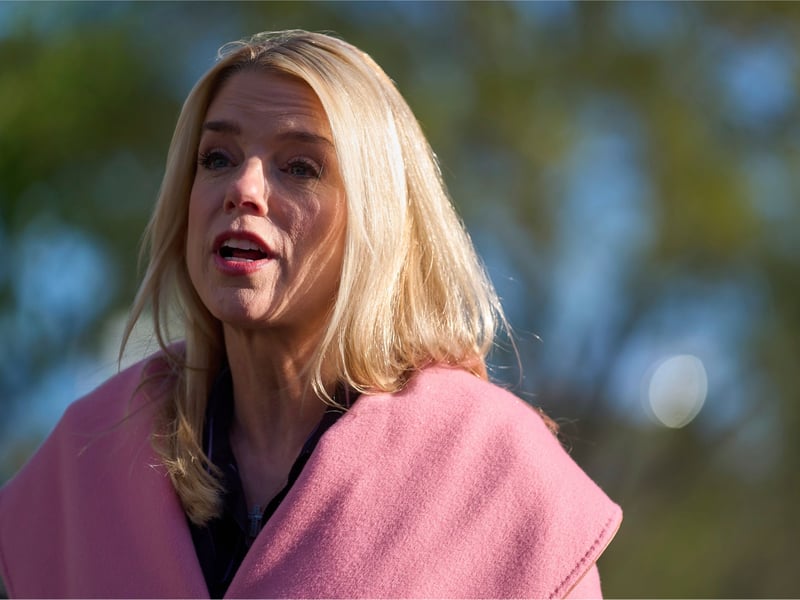
In a Monday podcast interview with Katie Miller — wife of White House Deputy Chief of Staff Stephen Miller — Attorney General Pam Bondi suggested that there was a legal distinction between hate speech and free speech, and that the former could be prosecuted.
But in interviews with Courthouse News, First Amendment scholars slammed that interpretation and said that hate speech is specifically protected by the First Amendment, which has been repeatedly upheld by the Supreme Court.
Bondi clarified her comments in a post on X Tuesday morning, suggesting that the Justice Department would consider criminal prosecutions for “hate speech that crosses the line into threats of violence,” which are not protected by the First Amendment.
“You cannot call for someone’s murder. You cannot swat a member of Congress. You cannot dox a conservative family and think it will be brushed off as ‘free speech,’” Bondi wrote. “These acts are punishable crimes, and every single threat will be met with the full force of the law.”
Vice president of the Freedom Forum Kevin Goldberg told Courthouse News Tuesday that, if Bondi were to try prosecuting any perceived hate speech, it would quickly be thrown out of court.
“In order to punish hate speech, the government has to engage in viewpoint discrimination, it has to decide what is hateful, what is speech that we support as a society and is popular, and what is speech that is unpopular and invaluable,” Goldberg said. “Applying the law in a viewpoint discriminatory manner is one of the easiest ways to violate the First Amendment.”
Goldberg added that “violent rhetoric,” which Bondi and several Republicans in Congress have cited as the cause behind Kirk’s assassination, is similarly protected by the First Amendment.
What is not protected, Goldberg explained, is incitement to imminent lawless action, or speech that pushes others to immediately break the law.
He pointed to the 2023 Supreme Court case Counterman v. Colorado, where the high court ruled 7-2 that a statement is a “true threat,” and thus unprotected by the First Amendment, when the government can show that the defendant had some understanding of the statements’ threatening nature.
“Generally, saying hateful things about Charlie Kirk or about someone who has defended Charlie Kirk cannot be considered true threats,” Goldberg said.
Thomas Berry, director of Constitutional Studies at the Cato Institute, said in an interview with Courthouse News that the Supreme Court’s holding specifically limits any prosecutions based solely on the recipient’s perception that a statement is threatening.
“The bottom line is that it is very, very difficult for the government to successfully bring prosecutions for threats and incitement, because, I think correctly, the Supreme Court is very concerned that if you open the door too wide, you’ll basically start allowing prosecutions for hyperbole and rhetoric,” Berry said.
No criticism goes unpunished
In the wake of Kirk’s assassination, his supporters have begun a campaign to report individuals for posting statements online critical of the commentator’s work in efforts to have them terminated or otherwise punished.
Vice President JD Vance joined the campaign on Monday while hosting the “Charlie Kirk Show” with Miller, encouraging supporters to “call them out, and hell, call their employer.”
Berry noted that private businesses have wide discretion to terminate employees for their speech, but any such firings in the government could raise First Amendment concerns.
On Monday, South Carolina Republican Representative Nancy Mace issued a letter to Education Secretary Linda McMahon urging the department to “cut off every dime to any school or university” that fails to punish employees posting negatively about Kirk.
Berry pointed to the 1968 Supreme Court case Pickering v. Board of Education, where the high court ruled 8-1 that school officials could only be terminated for their speech when the speech contains knowingly false statements or were recklessly made.
Down with the peace vigil
Most of the Trump administration’s response to Kirk’s assassination has been forward-looking, but it has taken several actions in recent weeks that take direct aim at the First Amendment.
On Sept. 7, Trump moved to dismantle a decades-old peace vigil encampment just outside the White House after apparently first learning about it from Real America’s Voice correspondent Brian Glenn in the Oval Office on Sept. 5., who called it “anti-American” and an “eyesore.”
The vigil stood against nuclear weapons and had been held around-the-clock in Lafayette Square since 1981 — until Trump ordered it removed, citing his executive order for the “beautification” of Washington and declared criminal emergency as justification.
Berry said that whether the ordered shutdown violates the First Amendment depends on what sort of forum courts view Lafayette Square as — there are four types, with traditional public forums being the most open, and nonpublic forums the most restricted — but could also avoid any violation so long as it applied universally.
“If you say we’re not going to allow a peace vigil here, but will allow a Charlie Kirk memorial here or allow a pro-Trump rally here, then you’re distinguishing based on viewpoints,” Berry said. “If you’re allowing a conservative protest but not a liberal protest, that’s pretty much always unconstitutional no matter what kind of public forum it is.”
Both Goldberg and Berry said that, while most of the Trump administration’s rhetoric was unlikely to hold any weight in court, their use of the “bully pulpit” to denounce certain types of speech they deem unfavorable was cause for concern.
“We are best served by strong First Amendment rights that apply equally to everyone, that are enforced equally against everyone and that promote free speech from everyone,” Goldberg said.
 Follow @Ryan_Knappy
Subscribe to our free newsletters
Our weekly newsletter Closing Arguments offers the latest about ongoing trials, major litigation and rulings in courthouses around the U.S. and the world, while the monthly Under the Lights dishes the legal dirt from Hollywood, sports, Big Tech and the arts.