
 Search Articles


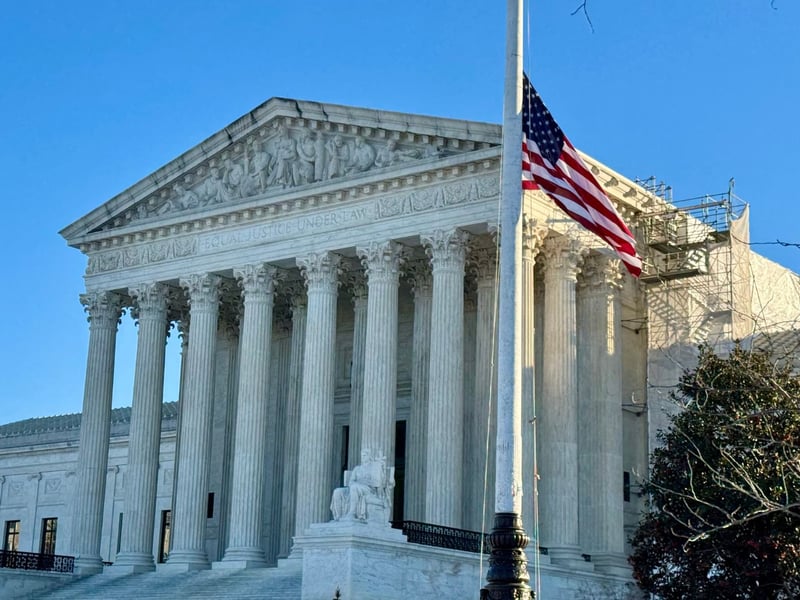
WASHINGTON (CN) — Next week, the government will push the Supreme Court to shut down what it sees as a conservative pipeline for federal policy challenges.
Some of the most controversial cases on the justices’ dockets the last few terms have originated from the Fifth Circuit Court of Appeals, including the fights over abortion pills, guns for domestic abusers, bump stock ban, funding for a consumer watchdog agency, federal immigration policies, federal agency law enforcement and more.
When e-cigarette manufacturer R.J. Reynolds Vapor Co. asked the Fifth Circuit to review a challenge to flavored vape regulations, the appeals court created a new path for the company and other litigants to challenge federal policies.
Instead of filing a challenge to flavored vape regulations in North Carolina or D.C., Reynolds collaborated with local retailers to put the case before the Fifth Circuit. Seven circuits — including the Fourth and D.C. Circuits — have upheld the Food and Drug Administration’s prohibitions on flavored e-cigarettes.
The government says Reynolds’ venue switcheroo is part of a larger trend.
“Reynolds, a manufacturer based in the Fourth Circuit, has invoked that theory to file three petitions for review, including the petition at issue here, in the Fifth Circuit,” U.S. Solicitor General Elizabeth Prelogar wrote. “At least eight other out-of-circuit manufacturers — based in China, California, Florida, Michigan, North Carolina, Ohio, and Washington — have since relied on the same tactic to seek judicial review in the Fifth Circuit.”
The federal government says that the appeals court defied “elementary” principles of statutory interpretation by allowing retailers to sue and requiring the venue to be proper as to only one party. The government argued that forum shopping, or strategically filing a lawsuit in a specific venue, is unlawful and harms the judiciary as a whole.
“When parties throughout the country deploy complex procedural stratagems to channel their cases to a single circuit, even when they have no meaningful ties to that circuit, they erode the perception that judicial decisions rest on universally applicable rules of law,” U.S. Solicitor General Elizabeth Prelogar wrote. “This court should avoid that harm by correcting the court of appeals’ erroneous interpretation of the [Family Smoking Prevention and Tobacco Control Act’s] venue provision.”
Under the Family Smoking Prevention and Tobacco Control Act, manufacturers must get marketing authorization from the Food and Drug Administration before introducing a new tobacco product into interstate commerce. The agency denied Reynolds’ authorization for berry- and menthol-flavored e-cigarette products out of concerns for public health.
National and state public health organizations said that 90% of adult smokers begin smoking in their teens. According to the FDA, tobacco companies rely on flavored products to attract young users.
A 2024 study found that nearly 90% of middle and high school e-cigarette smokers prefer flavored products.
When challenging the decision at the Fifth Circuit, Reynolds argued that the FDA’s denial was arbitrary and capricious. The agency has stymied industry efforts to market flavored e-cigarettes because of their appeal to children, and the Supreme Court is hearing a separate appeal concerning some of those denials.
On Tuesday, however, the justices will only be concerned with whether Reynolds’ lawsuit should proceed in the Fifth Circuit.
The federal government argued that the Tobacco Control Act requires challenges to FDA orders to be filed in the D.C. Circuit or in a circuit where that person resides or does business. By joining the local retailers’ lawsuit, the government says that Reynolds violated that limitation.
“Because Reynolds had no right to file its own petition in the Fifth Circuit, it also had no right to join someone else’s petition there,” Prelogar wrote.
Congress positioned the D.C. Circuit as the only jurisdiction where a person may seek judicial review regardless of residence, creating a unique “national court” that is responsible for reviewing legal challenges to the conduct of the national government.
The Biden administration claims the Fifth Circuit’s ruling transformed regional courts of appeals into national courts as well.
Reynolds argues the Supreme Court doesn’t have jurisdiction to review the Fifth Circuit’s ruling. By reviewing an interlocutory order, Reynolds says the justices are stepping on the appeals court’s toes.
The company says the FDA’s marketing denials affect retailers so they too have jurisdiction to bring a case against the government. The Justice Department disputed this, claiming the retailers are only indirectly affected whereas the manufacturers are directly prohibited from marketing a product.
A ruling on whether Reynolds’ lawsuit can move forward in the Fifth Circuit comes after several Supreme Court decisions limiting the authority of the administrative state. Last June, the conservative supermajority made it harder for the government to defend its rules against lawsuits and opened up the timing of when those challenges can be filed.
 Follow @KelseyReichmann
 Follow @kelseyreichmann.bsky.social
Subscribe to our free newsletters
Our weekly newsletter Closing Arguments offers the latest about ongoing trials, major litigation and rulings in courthouses around the U.S. and the world, while the monthly Under the Lights dishes the legal dirt from Hollywood, sports, Big Tech and the arts.