
 Search Articles


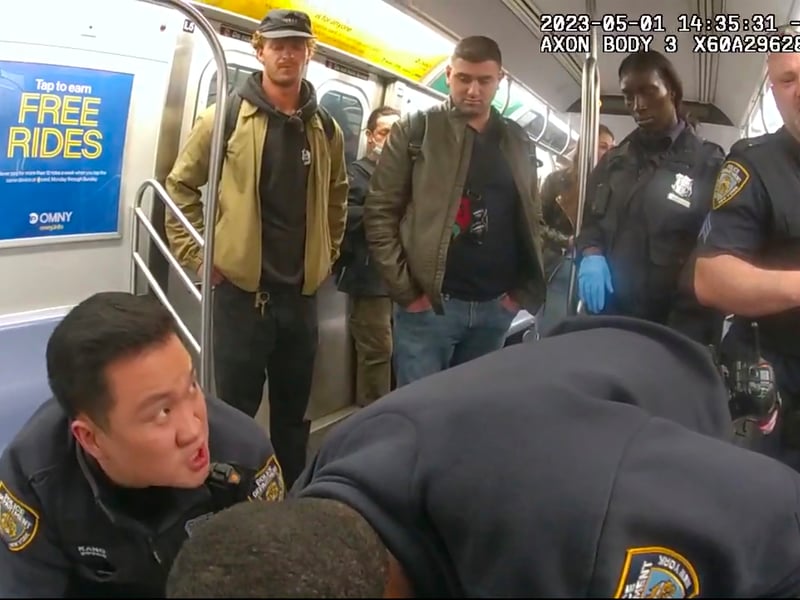
MANHATTAN (CN) — Jordan Neely’s father is taking Daniel Penny to civil court for Penny’s fatal chokehold of Neely on the floor of a New York City subway last year.
Penny, a 26-year-old Marine Corps veteran from Long Island, is currently on trial for manslaughter and criminally negligent homicide in Manhattan’s criminal court for the same incident. A verdict could come as early as Thursday; jurors have been deliberating since Tuesday afternoon.
In the meantime, Neely’s father Andrew Zachary, who has been in court every day of the three-week criminal trial, sued Penny for assault, battery and negligent contact.
In a five-page lawsuit filed late Wednesday in New York County Supreme Court, Zachary accused Penny of killing his son with “negligence, carelessness and recklessness.”
New York Supreme Court is the state’s highest trial-level court for civil cases. Zachary, who is represented by Donte Mills of the New York-based firm Mills & Edwards, says in the complaint that he’s seeking damages that exceed the jurisdictional of lower state courts.
Penny’s attorney Steven Raiser told Courthouse News on Thursday that they had not yet been served.
“The timing is unfortunate as Danny is awaiting a verdict from the jury where the potential consequences are far greater than any civil suit could threaten,” Raiser said. “We will not be distracted by this attempt to attack Danny while he is under such tremendous stress.”
Neely was a 30-year-old Black man who was experiencing homelessness and drug addiction when he died on May 1, 2023, after being choked by Penny for about six minutes. The city medical examiner ruled the chokehold to be the cause of Neely’s death.
His death caused national outcry after videos surfaced on social media of the incident. Some progressive activists likened Penny’s actions to those of a racist vigilante, while Penny has been celebrated in certain conservative circles for being a good Samaritan.
Penny insists he was acting to protect other passengers from Neely’s erratic, synthetic marijuana-induced behavior. Witnesses at Penny’s criminal trial described being terrified of Neely when he boarded the subway at the Second Avenue subway station in Manhattan, threw his jacket on the ground and started shouting threats.
One witness told jurors on Nov. 7 that she recalled Neely yelling, “‘I don’t care if I die. I don’t care if you die. Kill me. Lock me up. I don’t care if I go to jail for life.’”
Those threats are what Penny says prompted him to step in and restrain Neely with a chokehold from behind.
“I wasn’t trying to injure him,” Penny told detectives at the NYPD’s 5th Precinct. “I’m just trying to keep him from hurting everyone else. That’s what we learned in the Marine Corps. That’s what you guys learn today as police officers.”
But prosecutors, while acknowledging Penny’s intentions may have been pure, claim the former Marine went “way too far” to restrain Neely, who never came in physical contact with any of the straphangers on the subway car before Penny intervened, according to witness testimony.
“The defendant did not intend to kill,” assistant district attorney Dafna Yoran said during her opening argument on Nov. 1. “But under the law, deadly physical force such as a chokehold is permitted only when it is absolutely necessary and only for as long as it is absolutely necessary. And here, the defendant went way too far.”
Penny’s lawyers countered that their client was justified in using deadly physical force because of Neely’s violent words and actions. Through the testimony of their own independent forensic pathologist, they even suggested that Penny’s chokehold was not the cause of Neely’s death.
Penny faces up to 15 years in prison if convicted on the case’s top count of manslaughter in the second degree. The charge carries no minimum prison time.
 Follow @Uebey
 Follow @uebey.bsky.social
Subscribe to our free newsletters
Our weekly newsletter Closing Arguments offers the latest about ongoing trials, major litigation and rulings in courthouses around the U.S. and the world, while the monthly Under the Lights dishes the legal dirt from Hollywood, sports, Big Tech and the arts.