
 Search Articles


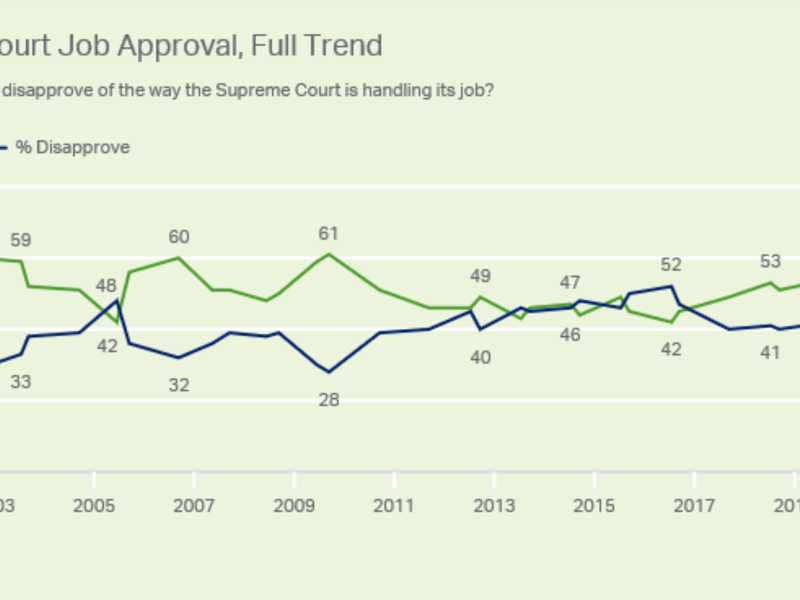
(CN) — Less than half of all Americans approve of the job the Supreme Court is doing, a Gallup poll released Wednesday found.
The 49% approval rating is down from 58% last year, according to a survey conducted from July 6 to July 21, following the wrap of the new 6-3 conservative majority’s first term. Former President Donald Trump installed three of the court’s nine justices during his single term in office, culminating with the election-eve confirmation of Justice Amy Coney Barrett to replace the late Ruth Bader Ginsburg.
Paul Collins, a professor of legal studies and political science at University of Massachusetts, Amherst, tied the drop in approval from last year to a sharp decrease in support among Republicans.
Even with its heavily conservative majority, the court found unanimity in a great number of cases last term, delivering a mixed bag for those expecting more right-wing overhauls.
“This was the first term with the three Trump appointees on the Court and the expectations among Republicans were high that the Court would take a decidedly conservative turn,” Collins explained Wednesday. “Though the Court did make some significant conservative rulings, the term was largely defined by moderation, which was disappointing to many Republicans.”
Among that mixed bag, the justices rejected a challenge to a provision of the federal health care law that requires most Americans to obtain minimum essential health insurance coverage. It later broke on party lines to uphold Arizona election laws said to be racially discriminatory and weaken the voting power of minorities. And it ruled that a Catholic social service agency was within its rights to refuse to consider applications from same-sex couples looking to foster children. In another closely watched case, the court championed the First Amendment rights of students in a ruling for a cheerleader whose profane Snapchat earned a suspension from the squad.
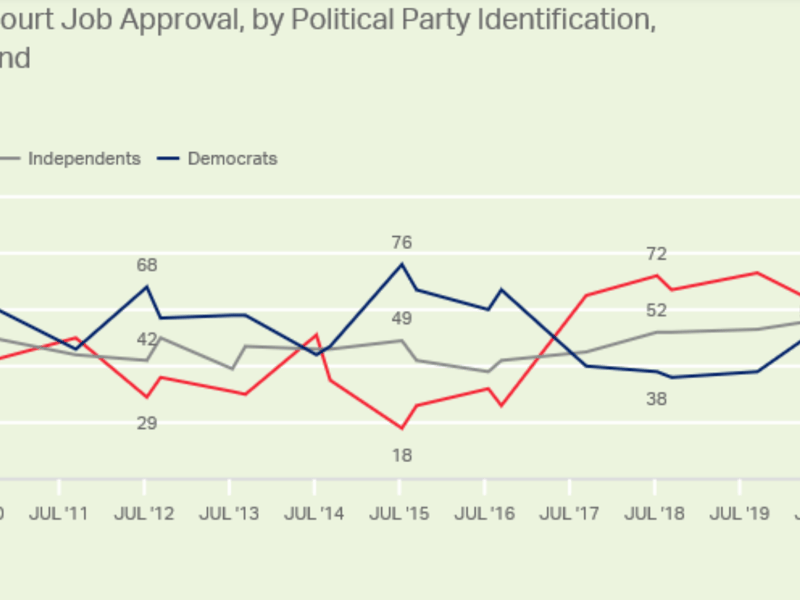
Broken down by party, the high court’s approval ratings among Democrats and Republicans both sit at 51%, and with independents at 46%. But while all parties showed lower approval ratings than they did a year ago, Republicans saw a large dip. Their approval declined by 9 percentage points while Democrats declined only by 5 percentage points.
Collins read this shift in numbers to say that support among Democrats remained relatively stable, “signaling that Democrats are relatively happy with the Court’s moderate decision making this term.”
Independents saw the biggest decline in approval numbers over the last year, dropping by 11 percentage points.
Collins added Wednesday that public support for the court matters because the Court depends on the support of the American public for its legitimacy.
“This is the case because the Court cannot enforce its decisions,” he said. “Instead, it relies on the elected branches of government to implement its decisions, and the public to go along with those decisions. If public support for the Court were to drastically decrease, this would likely harm the Court’s legitimacy, making it more likely that the public would reject its decisions and the executive and legislative branches would fail to enforce them.”
Gallup senior editor Jeffrey Jones noted in an analysis of the study Wednesday that the last time the Gallup’s approval numbers fell below 50% was five years ago in 2017.
“Before 2017, Democrats tended to have higher ratings than Republicans, including a 76% to 18% gap in 2015,” Jones wrote Wednesday of the years that marked the beginning of the Trump administration. “From 2017 to 2019, Republicans had higher ratings. In the last three readings, from 2020 and 2021, Republicans, Democrats and independents have had similar ratings.”
The highest percentage of approval was 62% in 2000, the year Gallup first started the poll. Since the poll has been conducted, the approval rating has never dipped below 42%, a low mark hit in both 2005 and 2017. The average for public approval is 52%.
Roughly 44% of those surveyed expressed disapproval of the high court’s job, while 7% had no opinion.
Republicans’ approval rating of the court reached a notable low in 2015 after the court struck down challenges to the Affordable Care Act. Following the Senate’s confirmation of two Trump-nominated justices, however, the sentiment increased in recent years.
Last summer, after a fall term with a mix of liberal- and conservative-leaning opinions, the court’s approval was around 58%.
“Americans give the Supreme Court its lowest job approval rating in four years,” Gallup researchers wrote. “But unlike in 2017, when wide party gaps in ratings of the court drove its approval below 50%, today Republicans and Democrats view it similarly. Bare majorities of both parties approve of the high court, perhaps because it has handed down rulings that have alternately pleased and frustrated both sides of the ideological spectrum.”
Jones noted that the cases that the justices have taken up for the upcoming fall term could further split the approval markers across party lines.
“Today’s symmetry in Republicans’ and Democrats’ ratings of the court may be put to the test in the court’s next term,” the poll states. “It has already agreed to hear several controversial cases, including a challenge to a Mississippi law that prohibits most abortions 15 weeks after conception.”
One case the court is set to hear is Mississippi’s bid to ban abortions after 15 weeks, a move that would overturn the landmark 1973 case Roe v. Wade .
The court is also set to hear another abortion rights case out of Kentucky, which is trying to restrict a type of second-trimester abortion called dilation and evacuation, or D&E for short. Conservative lawmakers refer to such procedures as “dismemberment” abortions, and Kentucky here tried to ban it by requiring “fetal demise” before the procedure occurs past 15 weeks.
In what will likely be a landmark case on public funding of religious schools, the court will also hear challenge to a Maine program that provides tuition reimbursement for secular private schools but not for religious schools, previously upheld by the First Circuit.
It has yet to decide if it will take up an affirmative action case that accuses Harvard University of discriminating against Asian American applicants in admissions. Though the allegations were championed by Trump’s Justice Department, the Supreme Court recently asked the Biden administration to weigh in.
A major Second Amendment case will go before the justices as well. In it, a former superintendent of the New York State Police says New York unconstitutionally required that applicants show an “actual and articulable” need to carry a concealed weapon.
Subscribe to our free newsletters
Our weekly newsletter Closing Arguments offers the latest about ongoing trials, major litigation and rulings in courthouses around the U.S. and the world, while the monthly Under the Lights dishes the legal dirt from Hollywood, sports, Big Tech and the arts.