
 Search Articles


(CN) — Uranus and Neptune might seem like the quiet, unassuming neighbors of our solar system, but their chaotic magnetic fields and strange blue hues have kept scientists guessing for decades.
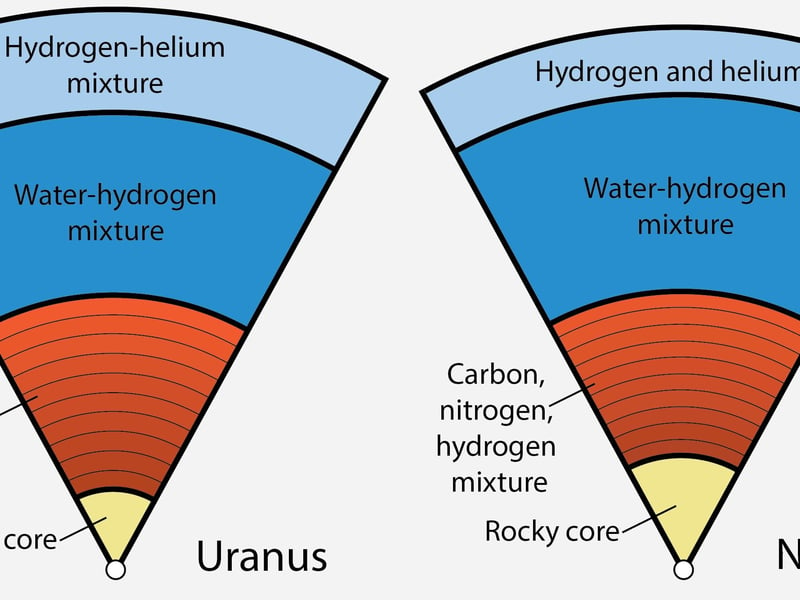
While some have speculated about phenomena like “diamond rain” or exotic “super-ionic water,” a new theory from a University of California-Berkeley researcher suggests that the planets have layers that don’t mix, much like oil and water.
Burkhard Militzer, a planetary scientist at UC Berkeley, published his findings Monday in the Proceedings of the National Academy of Sciences.
Using advanced computer simulations, he proposes that Uranus and Neptune have two distinct internal layers: a water-rich upper layer beneath their atmospheres and a heavier, carbon- and nitrogen-rich layer below.
This separation, driven by extreme pressures and temperatures, could explain the planets’ unusual magnetic fields and challenge previous theories.
“We now have, I would say, a good theory why Uranus and Neptune have really different fields,” Militzer said in a press release. “It’s like oil and water, except the oil goes below because hydrogen is lost.”
According to Militzer, Earth, which has a neat, bar-magnet-like magnetic field generated by its molten iron core, Uranus and Neptune’s magnetic fields are a mess, discovered to be disorganized during NASA’s Voyager 2 flybys in the late 1980s. That chaotic structure pointed to something unusual inside the planets.
His computer models revealed that under the crushing pressures — more than 3 million times Earth’s atmospheric pressure — and scorching temperatures exceeding 8,000°F (4,426.7°C) in the planets’ interiors, water, methane, and ammonia separate into distinct layers.
Hydrogen, squeezed out of the methane and ammonia, intensifies the division.
“The heavy part stays in the bottom, and the lighter part stays on top, and it cannot do any convecting,” Militzer said.
According to Militzer, this lack of convection, where materials move and mix in a fluid, is crucial.
On Earth, convection in the liquid outer core drives its global dipole magnetic field, the kind that aligns compasses to the poles. But Uranus and Neptune’s layered interiors prevent that large-scale mixing, resulting in their fractured magnetic fields.
If confirmed, this theory could help explain not just our ice giants but also similar planets outside our solar system, Militzer says.
Sub-Neptune planets, which are about the size of Uranus and Neptune, are among the most common exoplanets observed. Militzer’s model suggests that their interiors might also have these non-mixing layers, shaping their magnetic and gravitational characteristics.
To test the theory, he hopes for high-pressure laboratory experiments replicating the conditions inside these planets.
“If you ask my colleagues, ‘What do you think explains the fields of Uranus and Neptune?’ they may say, ‘Well, maybe it’s this diamond rain, but maybe it’s this water property which we call superionic,” Militzer said. “From my perspective, this is not plausible. But if we have this separation into two separate layers, that should explain it.”
Subscribe to our free newsletters
Our weekly newsletter Closing Arguments offers the latest about ongoing trials, major litigation and rulings in courthouses around the U.S. and the world, while the monthly Under the Lights dishes the legal dirt from Hollywood, sports, Big Tech and the arts.