
 Search Articles


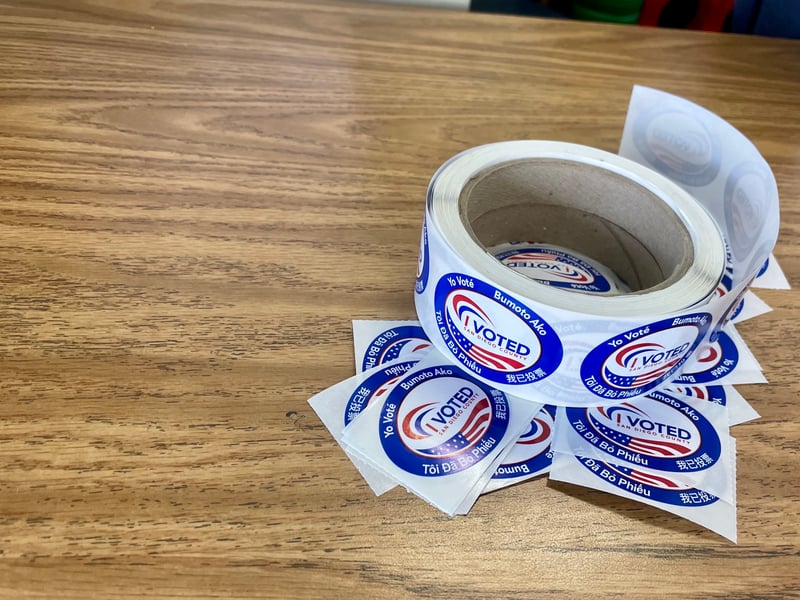
CHICAGO (CN) — It’s yet another election season with a crowded field of candidates as Illinois voters prepare to head to the polls on March 17. Here’s everything you need to know for the highly contested Illinois Senate seat and a few others:
U.S. Senate
Like many other races across the state, the Democratic primary for Senator Dick Durbin’s seat is crowded. Although Representative Raja Krishnamoorthi, Representative Robin Kelly and Lieutenant Governor Juliana Stratton are the clear front-runners, eight other people are running, including Steve Botsford Jr., Sean Brown, Awisi Bustos, Jonathan Dean, Bryan Maxwell, Kevin Ryan, Christopher Swann and Adam Delgado.
“At this point, it’s really a two-person race," Keith Boeckelman, a political science professor at Western Illinois University, said. “I wouldn’t count Kelly out completely, but she seems to be lagging.” He noted there’s been more back-and-forth between Krishnamoorthi and Stratton, which indicates that they view themselves as the two frontrunners.
Recent polls show veteran Congressman Krishnamoorthi leading the race, with Stratton closely behind. He’s campaigned on being vocally anti-Trump, but opponents have pointed out that he accepted more than $90,000 in contributions from Trump and other MAGA-affiliated donors. When asked about the donations, Krishnamoorthi’s campaign told the Chicago Sun-Times that Trump donors account for only .2% of the more than $24 million he has raised.
But Stratton has gone on the offensive regarding his campaign contributions.
“No amount of MAGA money can erase Raja Krishnamoorthi’s biggest weakness: his own record,” she said in one of her campaign ads. “He voted to fund ICE, he voted to thank ICE, and he’s spent a decade cozying up to the same ICE contractors and MAGA forces he claims to stand up against.”
Illinois Governor JB Pritzker has been an avid fan of Stratton since she announced her bid for the Senate seat. Notably, he donated $5 million to a super PAC supporting her campaign, which helped Stratton create a widespread ad campaign where she and her supporters say “fuck Trump.”
Boeckelman said the endorsement from Pritzker was assuredly helpful to her campaign, but his large campaign contributions were what made the real difference in her polling numbers.
“Stratton has tried to make Krishnamoorthi’s past votes related to ICE an issue in the race. That may be part of the reason she’s caught up with him," Boeckelman said.
Pritkzer’s involvement in the race has met the ire of some politicians, including the Congressional Black Caucus, which Kelly once chaired.
“Governor Pritzker’s effort to tip the scales in Illinois’ U.S. Senate race is beyond frustrating for the Congressional Black Caucus," Representative Yvette Clarke, the current chair of the Congressional Black Caucus, wrote in a letter. “A sitting governor shouldn’t be heavy-handing the race. Quite frankly, his behavior in this race won’t soon be forgotten by any of us.”
Experts noted that because the race is so crowded, a candidate may be able to win with a small percentage of the vote.
“Well, Robin Kelly could squeak in with maybe, you know, 30% support or 24% support support or something like that, so, I mean, it really speaks to why we need rank choice voting in this type of primary, because in all likelihood someone’s going to win with not even close to a majority support,” Scot Schraufnagel, a professor at Northern Illinois University, said. “They’re going to have much less than majority support, and yet they’ll win the nomination.”
Illinois 2nd Congressional District
There are also nearly a dozen people running in the Democratic primary for Kelly’s old seat in the House, which she gave up when she threw her hat into the ring for the Senate. Candidates include Jesse Jackson Jr., Donna Miller, Robert Peters, Willie Preston, Yumeka Brown, Adal Regis, Eric France, Patrick Keating, Sidney Moore and Toni Brown.
“Jesse Jackson Jr., until just the last couple of weeks, had only raised $200,000. He did have name recognition, but a lot of it was negative from his conviction for corruption,” Dick Simpson, a professor emeritus at the University of Illinois at Chicago and former alderman, said. “It’s hard to tell what might be the sympathy vote over the death of his father, Jesse Jackson, Sr., and that’s what’s hardest to gauge.”
Cook County Commissioner Donna Miller has led the pack of candidates in fundraising, though much of that has come under scrutiny since a good deal of her money has come from AIPAC. Representative Jan Schakowsky, a Democrat from the 9th Congressional District, initially endorsed Miller for the seat but revoked her endorsement when she realized Miller had taken AIPAC money.
State Senators Robert Peters and Willie Preston have also made good headway in the race. Peters, who represents South Shore and Woodlawn in the state Senate, has received endorsements from a litany of progressives, including Vermont Senator Bernie Sanders and Cook County Board President Tori Preckwinkle.
“He was the one that kind of spearheaded the Safe-T Act in the Illinois Legislature,” Boeckelman said. “I think in a multi-candidate race like this, I mean, there are 11 candidates in this race, but even with four leading candidates, I think if he can crystallize the progressive vote around himself, I think he would have a good chance.”
Boeckelman added that fellow state Senator Preston is trying to tie his campaign to the labor movement in an effort to get union endorsements, which could benefit him in the primary, though it might not be enough to eke out Peters.
Illinois GOP gubernatorial primary
Pritzker announced he’d run for a third term as governor, which would not be allowed in 37 other states, in June and said his campaign would focus on attacking the affordability crisis. Since then, several other Republicans have thrown their hat into the ring for a chance to challenge Pritzker in the general election. There are four candidates running for the GOP nomination for governor: Darren Bailey, a former state senator; Rick Heidner, a businessman; James Mendrick, DuPage County sheriff; and Ted Dabrowski, the former president of a media nonprofit.
Bailey unsuccessfully ran for governor in the last election and lost to Pritzker by 13 points, but experts noted he’s far ahead of the other candidates in the polls.
“Bailey is 20 or 30 points ahead of the other three candidates. The other three don’t have high visibility to begin with. They do have money, a couple of the cases,” Simpson said. “They’re just not going to be able to break through Bailey, in addition, and it’s the sympathy vote, that so many members of his family were killed in that plane crash.”
Bailey’s son, his daughter-in-law and his two grandchildren were killed in a helicopter accident in Montana. He has not made the tragedy a focal point of his campaign, but like Jackson, it may make voters more sympathetic and thereby more likely to vote for him.
Regardless of the particular race, experts say it’s more important now than ever to get out and vote, particularly as President Donald Trump has threatened to declare a national emergency to seize control of federal elections.
“It’s this is not about Democrat or Republican. This is about, honestly, fascism versus democracy,” Roberta Borrino with the League of Women Voters Illinois said. “So when confronted with that, we’re obviously on the side of democracy.”
 Follow @RosenCaitlyn
Subscribe to our free newsletters
Our weekly newsletter Closing Arguments offers the latest about ongoing trials, major litigation and rulings in courthouses around the U.S. and the world, while the monthly Under the Lights dishes the legal dirt from Hollywood, sports, Big Tech and the arts.