
 Search Articles


WASHINGTON (CN) — Senate Republicans this week said they were taking steps to restore a legal blockade against the dissemination of federally run media material within the U.S., framing the effort as a reaction to “government influence” in media.
In the days following the assassination of conservative commentator Charlie Kirk, lawmakers and conservative media figures have dialed in on the Smith-Mundt Act, a Cold War-era law that was amended in 2013, as they suggest that media narratives played a role in the shooting. Some have claimed the government has, for more than a decade, been permitted to spread propaganda among American citizens — or even that the law applies to independent media organizations.
But experts point out that while there’s room to improve the ways in which Americans interact with content from government media sources, the Smith-Mundt Act and its recent revision have been largely misunderstood as permitting the U.S. to target its own people with propaganda.
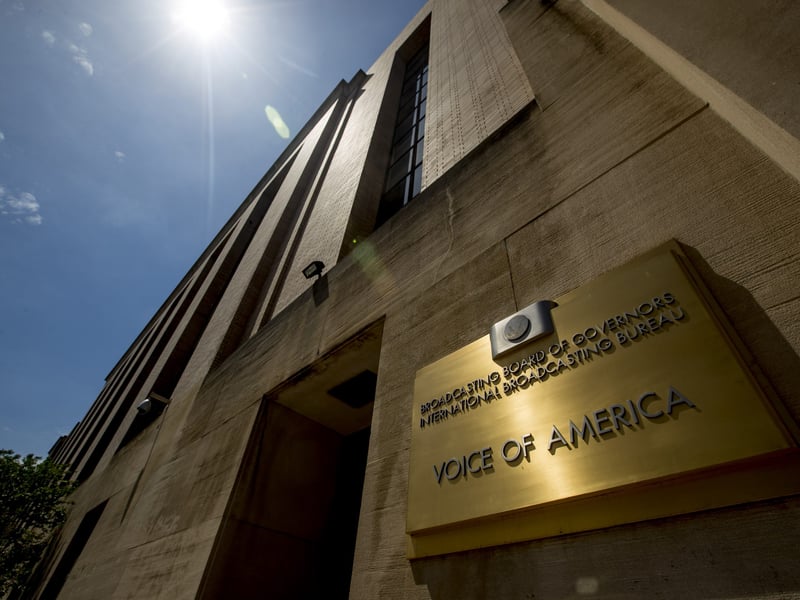
Signed by President Harry Truman in 1948, the Smith-Mundt Act was initially intended to give the U.S. tools to match the Soviet Union’s international media operation. It allowed the State Department to continue broadcasting to audiences outside the U.S. via programming such as Voice of America, first introduced during World War II.
“Congress felt it was a good idea to have a peacetime international state media broadcast network to counter Soviet messaging abroad,” Weston Sager, a lawyer and state media scholar, told Courthouse News in an interview. “Voice of America was the flagship media entity, created during World War II and bolstered by the passage of the Smith-Mundt Act in the late 1940s.”
Among the provisions of the Smith-Mundt bill was what Sager called a “de facto” ban on the dissemination of Voice of America content and other state media material to domestic audiences. The law was amended in 1990 to allow distribution of program material to Americans 12 years after its initial broadcast.
But the most significant change to Smith-Mundt came in 2013, when then-President Barack Obama signed the Smith-Mundt Modernization Act, which lifted the ban and allowed Americans greater access to content from organizations run by the U.S. Agency for Global Media.
Part of the reason for the change was that it had become harder to enforce restrictions on media dissemination in the internet age.
It was “much more difficult” to spread information during the Cold War era, Sager explained.
“You only had radio, letters, books,” he said. “You didn’t have the internet; you didn’t have cell phones — you didn’t have these instantaneous forms of information communication.”
Sager added that there was a perceived national security interest in lifting the de facto dissemination ban. Some officials, he said, thought allowing Americans access to government media material made for international audiences, especially non-English content, would help prevent “homegrown terrorism.”
The 2013 modernization, however, wasn’t a blanket removal of restrictions on domestic propaganda. It remains illegal for the government to use state media to target Americans with advertising or other messaging methods.
Still, following Kirk’s assassination on a Utah college campus this week, conservative figures and now Republican lawmakers have pointed to the Smith-Mundt Act as effectively allowing the government to “propagandize” its own people.
Utah Senator Mike Lee on Wednesday unveiled legislation he has called the “Charlie Kirk Act,” that if made law would “restore” the de facto dissemination ban. In a statement, he argued the measure would promote “freedom of thought” and allow Americans to “figure out the truth for themselves without government telling them what to believe.”
Kansas Senator Roger Marshall, who cosponsored Lee’s bill, tied the legislation directly to Kirk’s killing.
“The tragedy we witnessed last week was a sobering reminder of the perils of a population subjected to dangerous propaganda,” the Republican lawmaker wrote. “The federal government should never be able to directly target U.S. citizens with propaganda, and this bill takes meaningful steps to remove any semblance of government influence over American media.”
If made law, the bill would amend the Smith-Mundt Act to bar the USAGM from disseminating information from its “component networks” within U.S. borders or American territories. The measure includes carve-outs for a bimonthly anti-Communist pamphlet and a quarterly magazine for English teachers working abroad, both of which can be purchased by the Government Publishing Office.
The legislation also allows information from government media sources to be accessible to representatives of U.S. news media, scholars and members of Congress following its release. And state media content would still be archived 12 years after its dissemination.
The proposed measure comes after hundreds of thousands of people signed a petition urging Congress to clamp down on independent media organizations using the Smith-Mundt Act.
“This amended act will hold media outlets, radio stations, educators and content creators accountable for the false narratives and erroneous information they spread deliberately or irresponsibly,” the petition read. As of Thursday afternoon, the document had nearly 143,000 signatures.
But the perceived connection between the Smith-Mundt Act and independent media doesn’t exist in any significant way, said Sager.
“It didn’t have to do with what private media entities were publishing or saying about various individuals,” he explained. “It doesn’t have a lot to do with what some are saying was the reason for Charlie Kirk’s assassination. I don’t think that there was anything coming from the USAGM that would have led to people having ill will towards Charlie Kirk.”
Despite broad misunderstanding of the Smith-Mundt Act, however, there may still be some room to shield Americans from becoming the target of domestic propaganda.
The New York Times in 2018 reported that Radio Free Europe/Radio Liberty, an organization run by the USAGM, had used Facebook ads to target Americans with stories about Russia and NATO. A House Foreign Affairs Committee report from the same year revealed that the USAGM, then known as the Broadcasting Board of Governors, had disseminated such advertising on at least 860 occasions.
Sager, who authored a paper on the subject alongside Syracuse University researcher Jennifer Grygiel, said the USAGM’s actions potentially violated the Smith-Mundt Act’s prohibition on domestic propaganda targeting.
Following those revelations, he said, the agency supposedly implemented “a number of internal reforms” to prevent such a lapse from happening again. “But whether or not that had any effect, or whether or not the U.S. Agency for Global Media continued to target Americans with its materials is sort of a hard thing to know,” he added.
To that end, Sager suggested Lee’s proposed legislation could help increase federal guardrails, keeping the government from targeting its own citizens with propaganda.
“It does seem to be a step in the direction of limiting the USAGM’s ability to overtly influence public discourse in this country,” he contended. “I think he’s in the right ballpark, but maybe the details aren’t exactly correct.”
And Sager noted that, even if lawmakers brought back the Smith-Mundt Act’s de facto dissemination ban, it wouldn’t change the fact that the internet and other modern media sources make it difficult to enforce. He suggested that lawmakers should consider legislation requiring government media to be clearly identified.
“Instead of banning these materials, the focus should instead be to attribute them, so that way people know it’s coming from the U.S. government,” said Sager. “If this material is from the Voice of America — what is Voice of America? Many people don’t know. I think that this legislation or future legislation would benefit from having an added layer of protection for Americans.”
As of Thursday afternoon, Lee’s proposed bill had yet to be assigned to a committee.
President Donald Trump over the weekend shared a viral video posted by Ellie May, a TikTok user behind the petition to amend the Smith-Mundt Act. May accused the media of “spreading propaganda.”
The Trump administration has already taken steps to gut U.S. state-run media, targeting Voice of America in a March executive order aimed at paring the agency down to bare bones. Congressional Republicans have also slashed federal funding for editorially independent public broadcasting organizations NPR and PBS.
A federal judge in August blocked USAGM director Kari Lake from firing the head of Voice of America.
 Follow @BenjaminSWeiss
Subscribe to our free newsletters
Our weekly newsletter Closing Arguments offers the latest about ongoing trials, major litigation and rulings in courthouses around the U.S. and the world, while the monthly Under the Lights dishes the legal dirt from Hollywood, sports, Big Tech and the arts.