
 Search Articles


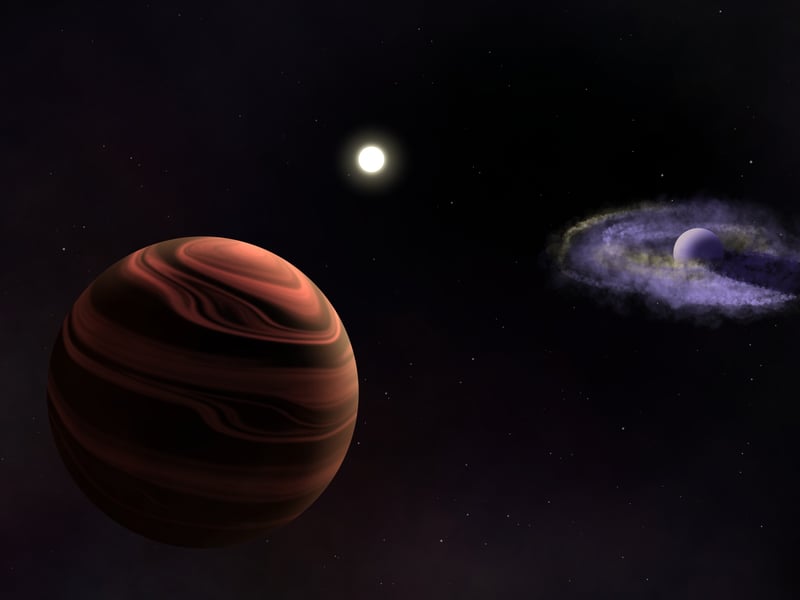
(CN) — Using the James Webb Space Telescope, astronomers have captured new observations of two young gas giants that may offer rare insight into how planets form and evolve.
Published Tuesday in the journal nature Nature, the study focuses on a star system called YSES-1, which includes a Sun-like star and two large planets. According to researchers, one of the planets appears to still be forming, while the other shows signs of silicate clouds in its atmosphere — a first for this type of planet.
The star system sits about 360 light-years away and has two young gas giants, YSES-1 b and YSES-1 c. Since both likely formed in the same disk around the star, researchers say it’s a rare chance to study how planets and their atmospheres take shape in the same environment.
“The YSES-1 system is unique and valuable for exploring young giant planet atmospheres and formation,” said Kielan Hoch, a Giacconi Fellow at the Space Telescope Science Institute and lead author of the study, in an email. “Observing single planet systems makes it difficult to compare against each other as the formation environment is different for each planet.”
Astronomers had seen the system before using ground-based telescopes, but JWST’s Mid-Infrared Instrument, or MIRI, provided a much clearer look. The telescope allowed researchers to directly detect dusty silicate clouds in the atmosphere of the outer planet, YSES-1 c.
The clouds are made of tiny particles less than one micrometer across. According to researchers, the clouds likely include iron and sit higher in the atmosphere than expected, possibly due to the planet’s young age and low gravity.
Some of that iron may even condense and fall back toward the surface.
“We are mostly sensitive to the composition of the upper atmosphere of the planet with JWST,” Hoch said. “However, the planet is still forming and this is the first time we are seeing these clouds in detail, so we are still learning about the atmospheric dynamics and evolution as the planet cools over time.”
Unexpectedly, JWST data also revealed evidence of a disk around the inner planet, YSES-1 b.
This kind of circumplanetary disk has only been observed a handful of times and is thought to be a sign that the planet is still in the process of forming, researchers say.
“We hoped to see clouds when we proposed for the observing time,” Hoch said. “But when we saw the feature it was wildly different than other silicate features seen in brown dwarfs. However, we did not expect to see evidence for a disk around the inner planet. That was certainly a surprise.”
The disk contains olivine dust, which models suggest should have settled long ago. Its presence raises questions about how the dust got there. Researchers say it may be second-generation material created by collisions or moon formation, though further study is needed.
“We have only discovered a few planetary mass companions and exoplanets with circumplanetary disks,” Hoch said, “and only two that are around planets older than 2–5 million years such as YSES-1 b.”
The team plans to gather similar data on other young planets to better understand how common these features are and how they change over time.
“I would add that this program and the analysis was led by early career researchers such as graduate students and postdoctoral researchers,” Hoch said. “I myself, was a graduate student when I submitted the proposal to observe the YSES-1 planets. This was before the launch of JWST!”
The James Webb Space Telescope first launched in December 2021 and has since provided astronomers with glimpses into space too distant or faint for the Hubble Space Telescope.
Subscribe to our free newsletters
Our weekly newsletter Closing Arguments offers the latest about ongoing trials, major litigation and rulings in courthouses around the U.S. and the world, while the monthly Under the Lights dishes the legal dirt from Hollywood, sports, Big Tech and the arts.