
 Search Articles


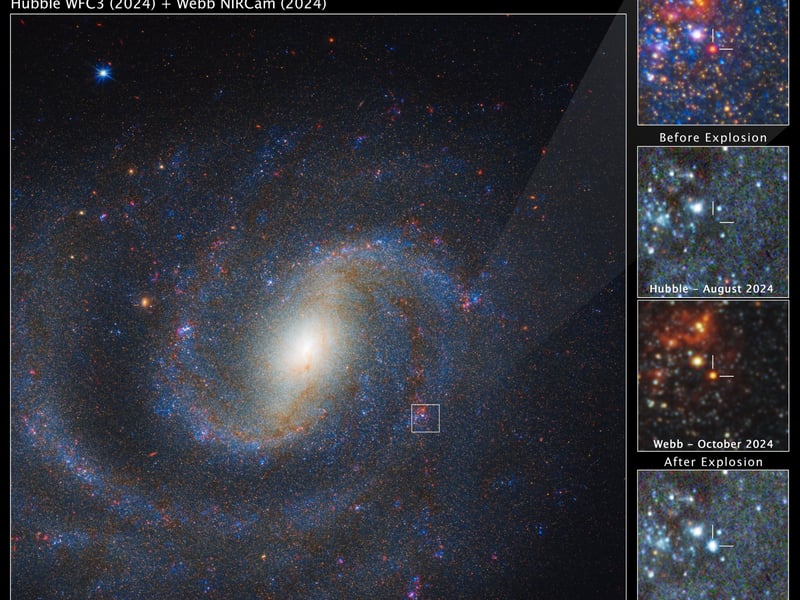
(CN) — Just before it blew apart, a red supergiant star was caught in stunning detail by NASA’s James Webb Space Telescope.
The observations, made by Northwestern University researchers and publishedWednesday in The Astrophysical Journal Letters, mark the first time the Webb telescope has pinpointed a supernova’s source star, or progenitor, in mid-infrared light.
By combining Webb’s infrared data with older Hubble Space Telescope images, scientists traced the explosion, known as SN2025pht, to a red supergiant in a nearby galaxy about 40 million light-years away.
The star was buried behind a thick veil of dust that made it appear 100 times dimmer in visible light than it really was.
“It’s the reddest, dustiest red supergiant that we’ve seen explode as a supernova,” said Aswin Suresh, a graduate researcher at Northwestern and coauthor of the study, in a press release.
For decades, astronomers have puzzled over why large red supergiants — stars that theory says should produce many of the universe’s supernovae — rarely seem to explode. The new data suggest they do, but most are simply hidden from view.
“Only now, with JWST, do we finally have the quality of data and infrared observations that allow us to say precisely the exact type of red supergiant that exploded and what its immediate environment looked like,” said study lead Charlie Kilpatrick, a research assistant professor at Northwestern’s Center for Interdisciplinary Exploration and Research in Astrophysics, in the press release.
Kilpatrick said astronomers had been waiting for Webb to catch a supernova in a galaxy it had already imaged. When one appeared last June, they finally got their shot.
The star, about 100,000 times brighter than the sun, was surrounded by an unusually dense shroud of dust that filtered its light into a deep red glow.
“SN2025pht is surprising because it appeared much redder than almost any other red supergiant we’ve seen explode as a supernova,” Kilpatrick said. “That tells us that previous explosions might have been much more luminous than we thought because we didn’t have the same quality of infrared data that JWST can now provide.”
Red supergiants are the swollen, aging giants of the stellar world — massive stars nearing the end of their lives.
When their cores collapse, they trigger powerful Type II supernovae, leaving behind a neutron star or black hole. Betelgeuse, the bright orange star in Orion’s shoulder, is the best-known example and is expected to explode someday.
According to researchers, the dust surrounding SN2025pht was chemically unusual. Instead of the oxygen-rich, silicate dust typical of red supergiants, Webb detected signs of carbon-rich material.
“This tells us that the wind was very rich in carbon and less rich in oxygen, which also was somewhat surprising for a red supergiant of this mass,” Kilpatrick said.
Researchers say the carbon-rich wind likely came from turbulent mixing inside the star, pulling carbon from its core before the explosion.
This supports the idea that many massive stars die wrapped in thick dust, hidden until they erupt.
“With the launch of JWST and upcoming Roman Space Telescope, this is an exciting time to study massive stars and supernova progenitors,” Kilpatrick said. “The quality of data and new findings we will make will exceed anything observed in the past 30 years.”
Subscribe to our free newsletters
Our weekly newsletter Closing Arguments offers the latest about ongoing trials, major litigation and rulings in courthouses around the U.S. and the world, while the monthly Under the Lights dishes the legal dirt from Hollywood, sports, Big Tech and the arts.