
 Search Articles


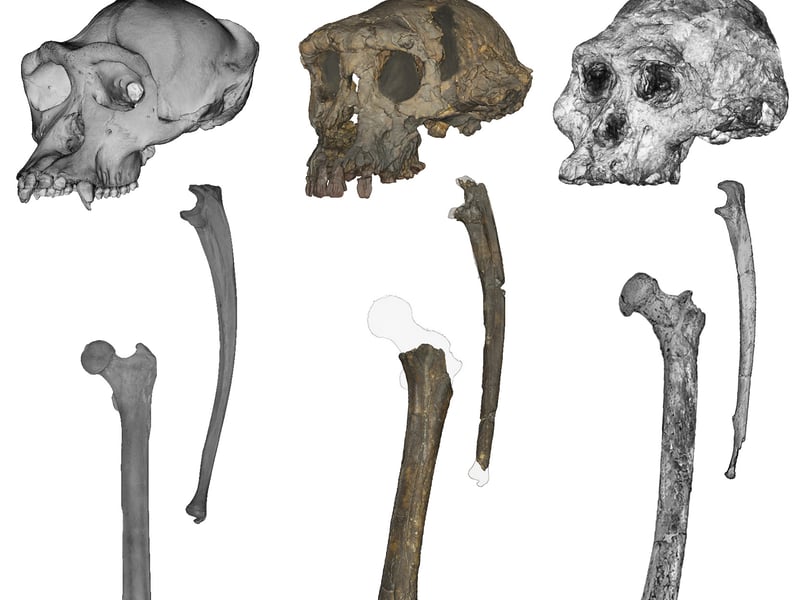
(CN) — The ability to move on our own two feet is what many scientists see as a distinct human trait — and a division in the tree of evolution from our ape ancestors. How far in the past that occurred is still an ongoing discussion but recent fossil analysis suggests it could be as distant as 7 million years.
Researchers in a study published on Friday in the journal Science Advances dug deep into a particular question — are the bones from a species called Sahelanthropus tchadensis the earliest hominin, the taxonomic subfamily that includes all human ancestors, including homo sapiens?
“Our new analyses support the original proposal that Sahelanthropus was adapted to bipedalism and therefore is the earliest known fossil hominin member of our lineage,” Scott Williams, lead author and associate professor in the department of anthropology at New York University, said in an email.
Discovered in Chad, a landlocked country in the middle of Saharan Africa, the Sahelanthropus tchadensis fossils include femur and skull bones. At the Toros-Menalla fossil site, bones from six to nine different Sahelanthropus specimens have been unearthed in the last 25 years.
Researchers from the University of Washington, Chaffey College, the University of Chicago and New York University believe Sahelanthropus may be the one of the first creatures to have many ape-like qualities, especially regarding the shape and size of its cranium, but due to its body structure, was able to walk on two feet.
Using 3D technology, among other methods, Williams and the team identified the femoral tubercle, the point of attachment for the large ligament between the femur and the pelvis responsible for walking upright in humans and found only in bipedal hominins. Williams said it was one of the most surprising findings.
“Together with other features, that really convinced me Sahelanthropus was bipedal,” he said. “Apes and other non-bipedal primates do not have such an attachment because they are not adapted to bipedalism.”
Additionally, the researchers found Sahelanthropus had a long femur compared to its ulna, and the femur bone angled inward, much like in modern humans, “so that our knees are closer together than our hips,” Williams said.
Furthermore, femoral torsion was evident: the femur bone twists inward in humans, while in apes, it twists outward.
Researchers also looked at fossils from an example of the human ancestor Australopithecus — made famous by the “Lucy” skeleton discovered in the 1970s and estimated be between 2 to 4 million years old — and analyzed them to find similarities to bone and ligament structures.
Sahelanthropus means “human from the Sahel,” and the species name tchadensis refers to the country of Chad. Williams said that the new findings will reinterpret ideas about human ancestor locomotion into the further past, but whether Sahelanthropus is considered an ape or human relative, it will keep its taxonomic genus and name.
The new analysis will likely spark further debate on the origins of bipedalism and early human ancestors, as a 2020 paper analyzing Sahelanthropus fossils from the same site questioned if the species was entirely bipedal, calling for more evidence.
For Williams, the new findings, including the size range of the bones and comparisons to ape and human ancestors, invites more exposition that link modern humans to our ancient past.
“This [evidence] tells us the last common ancestor of humans and chimpanzees (our closest living relatives) was quite ape-like and probably most similar to chimpanzees among living and known fossil primates,” he said. “That allows us to contextualize the ancestral condition from which bipedalism and hominins evolved and narrow down explanations for why bipedalism evolved.”
Subscribe to our free newsletters
Our weekly newsletter Closing Arguments offers the latest about ongoing trials, major litigation and rulings in courthouses around the U.S. and the world, while the monthly Under the Lights dishes the legal dirt from Hollywood, sports, Big Tech and the arts.