
 Search Articles


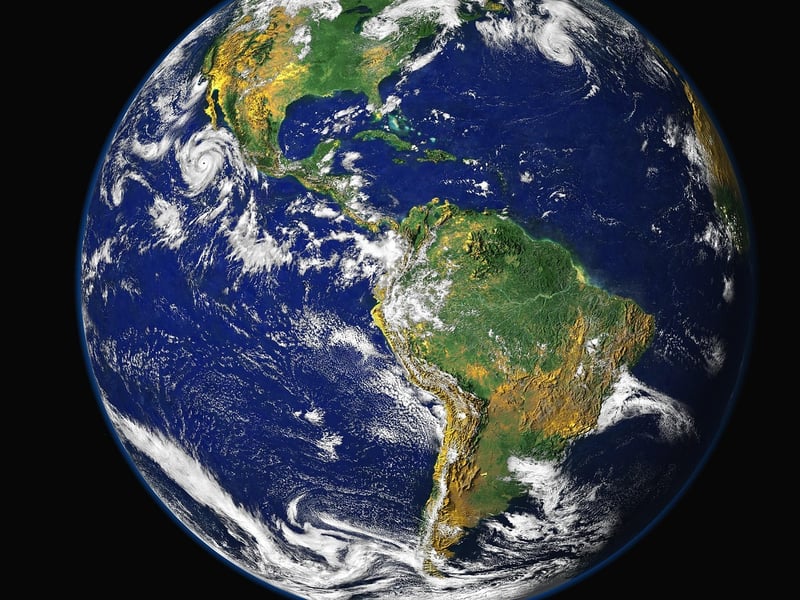
(CN) — Like making a cake, dry materials came before water in the formation of Earth.
In recent decades, paradigm shifts for planet formation theories had scientists debating on what exactly happened billions of years ago to create the planet, according to a study published Wednesday in Science Advances. The study’s researchers knew that large bodies coalesced to form the planets, moons and asteroids, but they decided the best way to uncover the details was to test the chemical signatures of the magmas from inside Earth. This is because the chemical signatures of the magmas contain a record of the timing and nature of the materials that formed the Earth and its layers.
For the time being, think of Earth as a multi-layered cake, as the study does. The top layer is the upper mantle, which extends from about 9.3 miles to 422.5 miles below Earth’s surface. Meanwhile, the lower mantle as the bottom layer spans to planet’s core, about 1,802 miles beneath our feet.
Because Earth’s creation was not instantaneous but instead was the result of materials accreting over time, each layer consists of different materials that give each a unique flavor, which the scientists tested to see how the planet formed.
Examining the layers involved an international team of researchers who conducted their work in the laboratories of both Francois Tissot, assistant professor of geochemistry and Heritage Medical Research Institute investigator, and Yigang Zhang of the University of Chinese Academy of Sciences. Their work culminated into the model created by Weiyi Liu, the first author of the study.
A California Institute of Technology graduate student, Liu based her model of Earth on samples from the lower mantle and upper mantle as well as the presence of volatiles that easily evaporate, such as water. The team found three times more volatiles in the upper mantle than in the lower mantle, so water and other similar materials are closer to Earth’s surface than to its core.
With these chemical ratios, Liu’s model shows Earth formed from hot, dry and rocky materials while water and other essential volatiles only appeared during the last 15% of Earth’s formation — and maybe even more recently, according to the study.
While this new information may put some of the scientific debate about Earth’s formation to rest, Liu and her team said it raises interesting questions about other planets. The researchers expect Mercury and Venus formed from similarly dry materials, and Tissot said understanding those worlds would help us understand ours.
“Space exploration to the outer planets is really important because a water world is probably the best place to look for extraterrestrial life,” Tissot said in a statement accompanying the study. “But the inner solar system shouldn’t be forgotten. There hasn’t been a mission that’s touched Venus’ surface for nearly 40 years, and there has never been a mission to the surface of Mercury. We need to be able to study those worlds to better understand how terrestrial planets such as Earth formed.”
 Follow @kndrleon
Subscribe to our free newsletters
Our weekly newsletter Closing Arguments offers the latest about ongoing trials, major litigation and rulings in courthouses around the U.S. and the world, while the monthly Under the Lights dishes the legal dirt from Hollywood, sports, Big Tech and the arts.