
 Search Articles


(CN) — The Washington Supreme Court on Thursday upheld a finding that the Stillaguamish Tribe of Indians’ sovereign immunity shields it from a quiet title lawsuit brought by a cattle ranch.
“Federal common law has long established that tribes are immune from suit and may be sued only where a tribe waives its immunity or when Congress has unequivocally abrogated immunity,” Justice Barbara Madsen wrote for the majority. “While the superior court has in rem jurisdiction over real property, it does not have subject matter jurisdiction over adverse possession claims involving non-reservation land owned by tribes.”
Justice Salvador Mungia, while concurring with the other eight judges, wrote separately to dissent from the racism he said was embedded in the federal case law that applied to the dispute.
“The cases the majority cites, and indeed must cite, are based on the racist premises that Native American tribes were never sovereign nations, that they had no fee title to the land on which they lived, and that the United States had the ultimate power as to those issues,” Mungia said. “The justification for those holdings was that Native Americans were inferior and were savages, who became wards of the United States.”
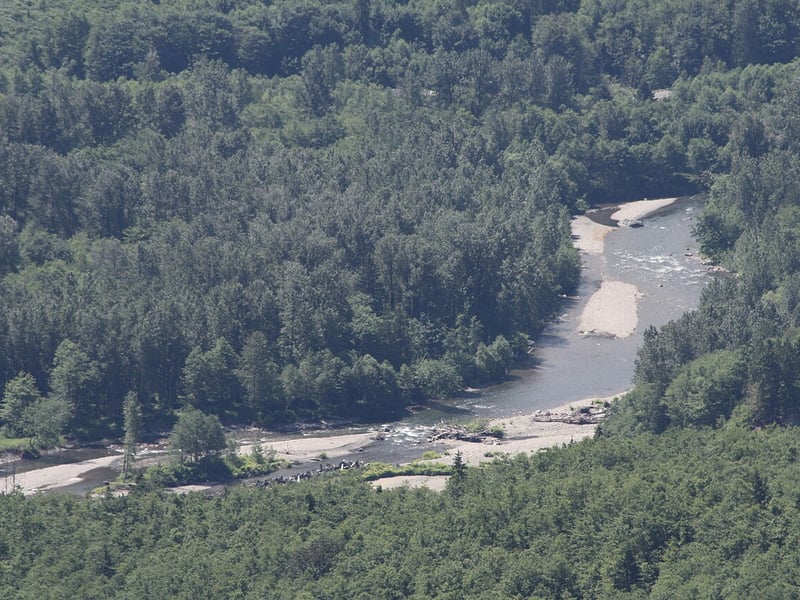
Flying T Ranch brought a quiet title lawsuit against the tribe over two parcels of land on the banks of the North Fork Stillaguamish River adjacent to the ranch that the tribe acquired as part of a larger purchase of land along the river to conserve the habitat of Puget Sound Chinook salmon.
The ranch claimed so-called adverse possession — sometimes called squatters’ rights — of the parcels it has used since the early 1960s to graze cattle. In addition, the ranch argued the tribe isn’t shielded by tribal sovereignty from its lawsuit because the “immovable property” exception that applies to foreign nations’ sovereignty in so far as it relates to real estate disputes in the U.S. should also apply to tribal sovereignty.
“We have a very basic adverse possession case where title ripened well prior to tribal acquisition, and the question is, in such case, is the landowner entitled to clean up the title and move on or does sovereign immunity somehow keep the cloud over the title,” Peter Ojala, the ranch’s attorney, told the court at a hearing in March.
When asked for comment on the ruling, Ojala said, “Given the importance of recognizing tribal sovereign immunity and the court’s desire to rectify the past, the result is not surprising.”
Still, he said the decision runs contrary to precedent and the state’s system to settle everyday land title issues.
“The decision today, at bottom, settles nothing, and adds no stability to land titles, and upsets everything — if it is true there is no subject matter jurisdiction in this case,” he wrote in an email. “If there is no subject matter jurisdiction, who owns the property is not settled, and the only thing to do is to dismiss a case without commentary. The pendulum has swung too far in the other direction in this case.”
Both a trial court and a state appellate court had rebuffed the ranch’s argument and concluded that Stillaguamish had sovereign immunity against the ranch’s claims, even if the parcels weren’t historically part of the tribe’s land, and that it was up to Congress, not the courts, to waive this immunity.
But whereas Congress has clearly made an immovable property exception for foreign nations to allow courts to weigh in on domestic land disputes involving these nations’ property in the U.S., it hasn’t done so for tribes.
“Congress has been clear that they abrogate tribal sovereign immunity and no one else,” Madsen observed at the hearing in March. “So, where would we get the authority to do that?”
The dispute over the Stillaguamish’s tribe immunity from Flying T’s claims is similar to a case that went up to the U.S. Supreme Court in 2018. In that case, the nation’s top court didn’t resolve the removable exception issue as it relates to tribal sovereign immunity, to the chagrin of Justices Clarence Thomas and Samuel Alito, because the plaintiffs had brought up this legal wrinkle only after the Supreme Court had agreed to hear the case.
In a concurring opinion in the 2018 decision Upper Skagit Indian Tribe v. Lundgren , Chief Justice John Roberts noted that there should be a way of resolving a mundane dispute over property ownership even when one of the parties of the dispute — involving non-trust, non-reservation land — is an Indian tribe.
“The correct answer cannot be that the tribe always wins no matter what,” Roberts said at the time.
Raven Arroway-Healing, the attorney for the Stillaguamish Tribe of Indians, reiterated at the March hearing that it’s in the nature of sovereign immunity that, under American common law, the courts don’t look at who’s right or wrong but only at whether they have jurisdiction over the case.
“That’s the reality of American common law sovereign immunity,” Arroway-Healing told the court. “It doesn’t look at the facts of the case.”
She added this can create outcomes that offend our sense of fairness and justice such as in the dismissal of a federal lawsuit against Saudi Crown Prince Mohammed bin Salman by the fiancée of the murdered journalist Jamal Khashoggi.
The tribe purchased the disputed parcel along with seven others, totaling about 143.4 acres along 1.2 miles of the North Fork Stillaguamish River. The parcels were acquired using funds from a conservation grant from the National Oceanic and Atmospheric Administration, through the Washington State Recreation and Conservation Office, that required the tribe to protect those lands in perpetuity with a deed of right for salmon recovery.
 Follow @edpettersson
Subscribe to our free newsletters
Our weekly newsletter Closing Arguments offers the latest about ongoing trials, major litigation and rulings in courthouses around the U.S. and the world, while the monthly Under the Lights dishes the legal dirt from Hollywood, sports, Big Tech and the arts.