
 Search Articles


(CN) — One star moved closer to another to become its sibling, announced space scientists Monday.
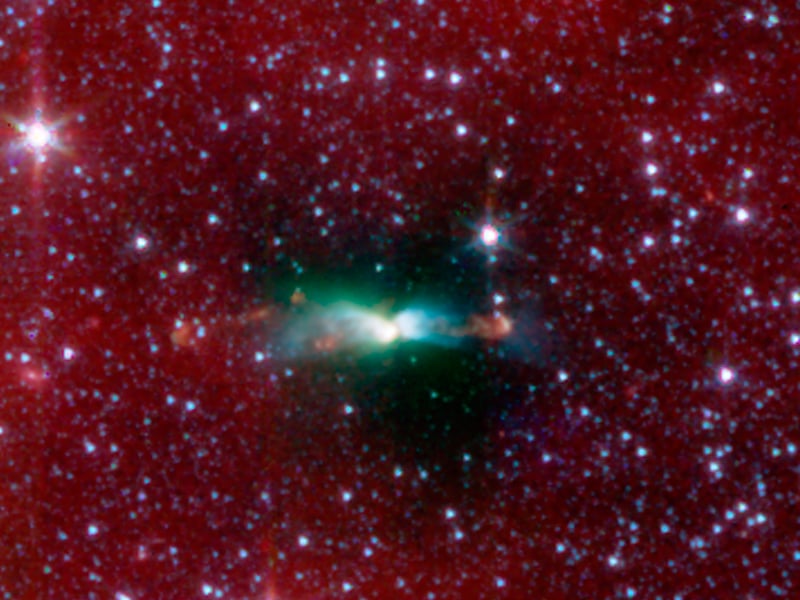
Led by postdoctoral associate Erin Cox, a team of Northwestern University astrophysicists observed a star-forming cloud called L483.
Published in The Astrophysical Journal , the study reports that the team used NASA’s Stratospheric Observatory for Infrared Astronomy (SOFIA) to take a closer look.
The team said they noticed something odd with the cloud’s magnetic field. Namely that it didn’t run parallel to the newborn stars’ outflows. Instead, the field twisted at a 45-degree angle.
“If this binary had formed out of disk material, then we would expect the geometry of the magnetic field to remain parallel to the outflow instead of showing this twisted morphology,” wrote Cox via email.
According to the study, they found a hidden star tucked behind the newborn star.
“It’s the star’s siblings, basically,” explained Cox. “We think these stars formed far apart, and one moved closer to the other to form a binary. When the star traveled closer to its sibling, it shifted the dynamics of the cloud to twist its magnetic field.”
Typically, Cox added, binary stars are common. More than half of the stars in our galaxy having at least one companion. Per the study, astrophysicists agree that if star-forming clouds are large enough, they can produce two stars simultaneously.
According to Cox, young protostars are difficult to observe, making their origins mysterious. However, L483’s binary stars suggests that it’s possible for two stars to form apart and find their way to each other to form a binary. This could help further research into how binaries form.
“Since star and planet formation take place at the same time, learning about the origins of binary stars will also give us insight to what kinds of planets grow around these stars,” wrote Cox.
As for why the star moved closer to its sibling, Cox said that they didn’t know for certain.
“This type of migration has been predicted by computer simulations, but the exact mechanism that causes the stars to migrate toward each other is still being investigated,” wrote Cox.
Cox noted that binary stars are no strangers to science fiction, mentioning the desert planet of Tatooine in Star Wars as one example of a twin-sun system. L483’s binary stars open the possibility that sibling stars could orbit habitable planets.
“In our census of exoplanets, we know planets exist around these double stars, but we don’t know much about how these planets differ from the ones that live around isolated stars,” said Cox. “With new instruments coming online to discover and probe new binary systems, we will be able to test these results with a statistical sample.”
There is still work to do, but Cox believes that L483’s stars may give researchers information about the beginnings of stars and habitable planets in the galaxy.
“I think the most exciting part of this work is that we may be able to use the magnetic field of the protostellar envelope as a signature of how a binary system has formed. While more work is needed to investigate a larger sample of protobinary stars, these results help unlock the mystery of what sets the initial conditions for these double stars and their eventual planets,” wrote Cox.
 Follow @kndrleon
Subscribe to our free newsletters
Our weekly newsletter Closing Arguments offers the latest about ongoing trials, major litigation and rulings in courthouses around the U.S. and the world, while the monthly Under the Lights dishes the legal dirt from Hollywood, sports, Big Tech and the arts.