
 Search Articles


MANHATTAN (CN) — Investors treaded water this week, hit with news of a federal investigation into the Federal Reserve chair, renewed tensions in Iran, and maybe a new raft of tariffs.
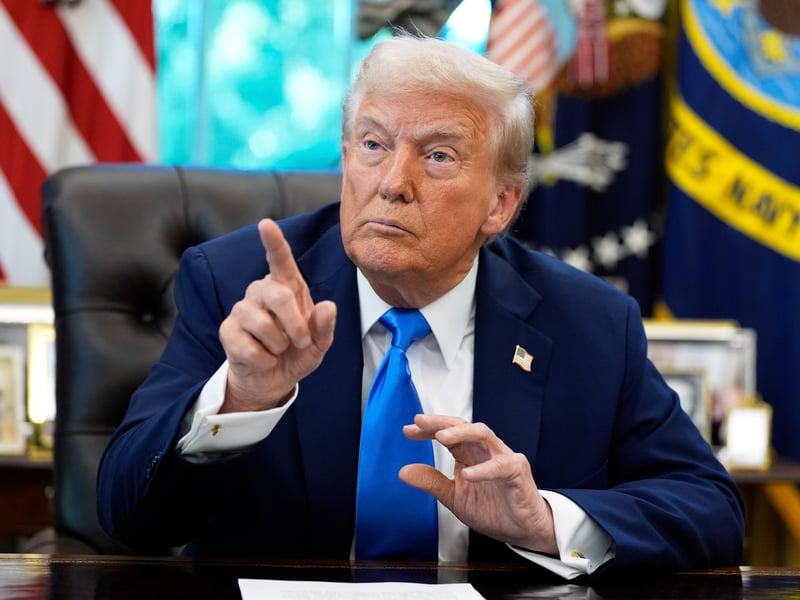
On Friday, Trump pitched potential new tariffs on European countries that oppose his push to acquire Greenland. “I may put a tariff on countries if they don’t along with Greenland, because we need Greenland for national security,” the president said.
Worries about oil prices due to the protests in Iran already had chipped away at equities, not to mention news Monday that the Justice Department opened a criminal probe into Fed Chair Jerome Powell, a frequent Trump punching bag. By the closing bell Friday the Dow Jones Industrial Average had lost 145 points, the Nasdaq 156 points, and the S&P 500 26 points.
“The combination of an uncertain Fed path, a volatile geopolitical map, and a maturing technology cycle suggests that the smooth sailing is behind us,” wrote Christopher Gildea at Tower Bridge Advisors. “We remain optimistic, but our eyes are wide open to the risks on the horizon.”
As for economic data released this week, it was mostly good. The latest retail sales report from the U.S. Census Bureau, which was delayed by weeks due to the government shutdown, reported a 0.6% increase in November, better than the 0.4% most economists had predicted.
Excluding automobiles, core retail sales picked up by 0.5%, though the 3.3% annualized retail sales are the slowest growth seen October 2024.
Inflation reports this week came in roughly as expected. On the producer front, prices increased by 0.1% and 0.2% in November. Over the last 12 months, the producer price index is up 2.9%. However, taking into account only core goods—which excludes food and energy costs, which can be volatile— the PPI is up 3.2% year over year.
“The inflation debate is not settled,” Peter Boockvar, chief investment officer at One Point BFG Wealth Partners, wrote in a short investor’s note. “The questions with the rising producer price pressures is what can be passed on and what has to be eaten, particularly [by] those who need to procure industrial metals.”
Fortunately, consumer prices didn’t budge much, according to the U.S. Bureau of Labor Statistics, which reported only a 0.3% increase in its consumer price index. Year-over-year, the CPI increased 2.7%, in line with expectations and the same annualized increase seen in November, while core inflation increased just 0.2%.
The main driver for inflation in the report was shelter costs, which rose 0.4% in December. However, some experts believe those costs will soon fall as well.
“The inflationary pressures from tariffs are being countered by the deflationary impact of tighter immigration in the housing market,” said Eric Teal, chief investment officer at Comerica Wealth Management. “Net immigration is approaching zero this year, and given the supply glut of apartments, vacancy rates are expected to increase and rents to decline.”
The latest optimism index from the National Federation of Independent Business shows small businesses are gradually getting more confident, as it increased half a point last month. The group’s uncertainty index also fell seven points to the lowest reading since mid-2024.
“While Main Street business owners remain concerned about taxes, they anticipate favorable economic conditions in 2026 due to waning cost pressures, easing labor challenges, and an increase in capital investments,” NFIB chief economist Bill Dunkelberg said in a statement.
 Follow @NickRummell
Subscribe to our free newsletters
Our weekly newsletter Closing Arguments offers the latest about ongoing trials, major litigation and rulings in courthouses around the U.S. and the world, while the monthly Under the Lights dishes the legal dirt from Hollywood, sports, Big Tech and the arts.