
 Search Articles


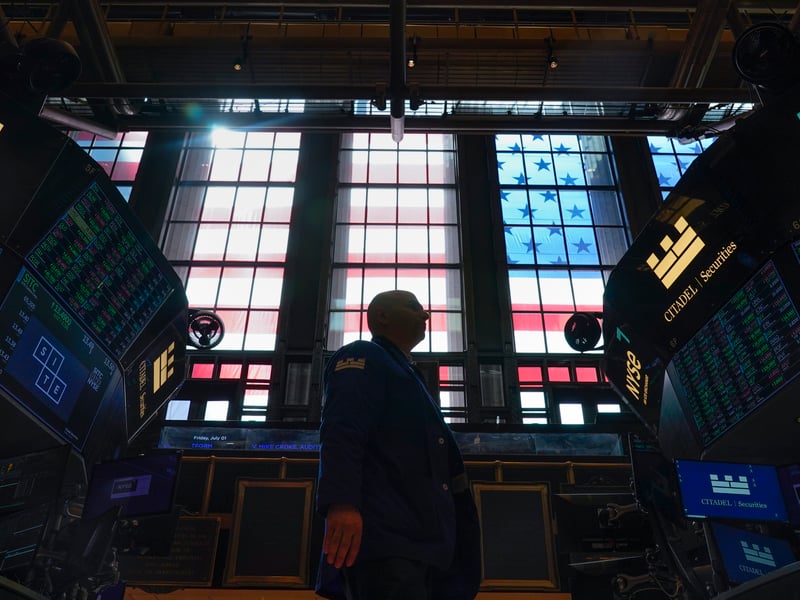
MANHATTAN (CN) — Wall Street suffered one of its worst outings in years, as the bloodbath in equities that began last week splashed over into Monday in a volatile trading session.
The Dow Jones Industrial Average began the day by immediately dropping 800 points, while the Nasdaq began 1,000 points lower than the closing bell on Friday. The Dow ended the day losing more than 1,000 points, while the Nasdaq fell 576 points and the S&P 500 dropped 160 points.
The volatility index, which is known as the “Wall Street fear gauge”, increased 57% by the closing bell and is higher than any time since the Covid-19 shutdowns began.
Markets abroad fared no better, with the pan-European Stoxx 600 losing 2.17% and key indices from France, Germany, and the United Kingdom all seeing 1.5% to 2% declines. In Asia, the Nikkei in Japan had its worst outing since the Black Monday crash of 1987, falling more than 12%, and Korean’s Kospi dropped 8.7%.
Investors were spooked last week by the lackluster employment report and the 1.7% drop in the ISM manufacturing index. However, while most experts predicted the bull market on Wall Street was unsustainable, many also say this current carnage is unwarranted
“We’re getting the pullback we anticipated but way faster than we expected,” said Gina Bolvin, president of Bolvin Wealth Management Group. “Investors need to take a deep breath. Corrections are normal, and while unemployment is rising, it’s still historically low.”
Still, the economy has had warnings signs of a slowdown for a while, from retail sales dropping except among high-income consumers and certain sectors, as well as manufacturing seeing a decline. The housing market, too, has been a thorn in investors’ sides despite Wall Street posting record closings.
“If the stock market is in for turbulence and a further sell-off that lasts more than just the few weeks we’ve seen, I’d expect some buckling and pausing with that higher-end spend,” wrote Peter Boockvar, chief investment officer at Bleakley Financial Group. “You can be sure, too, that employers will further pause the pace of hiring’s too if markets further correct.”
Some experts say the rout may be a good thing for Wall Street in the long run, since it gives the Federal Reserve justification to more aggressively pare back the federal funds interest rate. The Fed has raised interest rates 11 times since March 2022, and experts previously had forecast two rate cuts for this year.
“In our view, the likelihood of three rate cuts this year has increased from two, and we now expect a 25 [basis point] rate cut in September, November, and December,” said Gregory Daco, chief economist at EY-Parthenon. “But it’s crucial to remember the Fed’s hawkish and inflation-wary stance, if the economy does not deteriorate significantly.”
Stephen Brown, deputy chief North America economist at Capital Economics, also wrote in an investor’s note midday that while “the risk of a hard landing has increased” the most likely outcome for the economy is a soft landing where inflation is finally tamed and employment and growth remain fairly strong.
Economic data on Monday also should have a calming effect, albeit a minor one, for investors. The ISM services index for July, which was released on Monday, showed an increase to 51.4 from 48.8, which was the lowest it had been since 2009 not including the Covid-era shutdowns.
“The uptick in the ISM services will do little to reverse market jitters of a recession in the wake of Friday’s employment report, but it aligns with our view of an economy in transition rather than one on the brink of collapse,” Matthew Martin at Oxford Economics wrote in an investor’s note.
Martin noted investors had unrealistic expectations of a Fed rate cut in September — he predicts a 0.25% rate cut rather than the 0.5% cut some hope for — and that business activity is still in positive territory. “The six-month moving average [for the ISM services index] remains well above the level that would be consistent with a recession,” he wrote.
 Follow @NickRummell
Subscribe to our free newsletters
Our weekly newsletter Closing Arguments offers the latest about ongoing trials, major litigation and rulings in courthouses around the U.S. and the world, while the monthly Under the Lights dishes the legal dirt from Hollywood, sports, Big Tech and the arts.