
 Search Articles


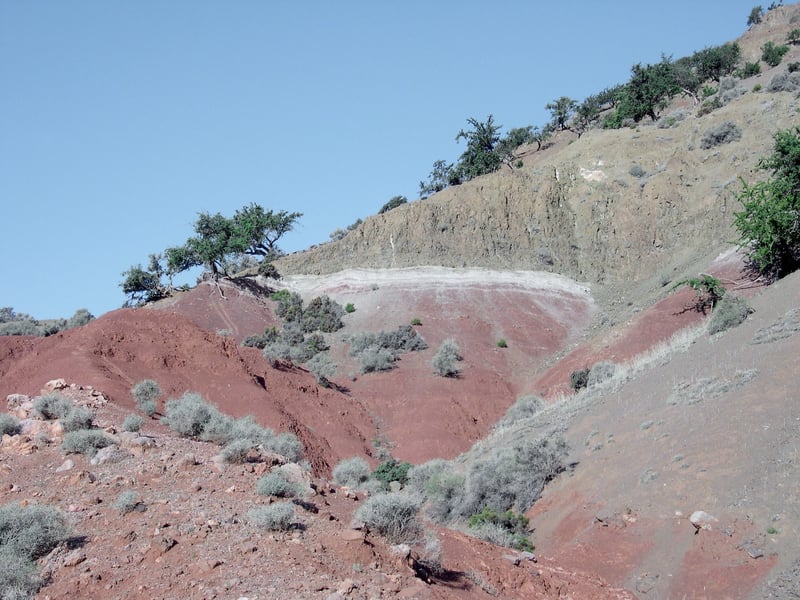
(CN) — The mass extinction between the Triassic and Jurassic periods may have been primarily triggered by cold temperatures from a series of massive volcanic eruptions that occurred over less than a century rather than millennia as once thought, scientists say.
Over 200 million years ago over three-quarters of all living species on the planet were wiped out in an event that marked the end of the Triassic period. Scientists have long held that the driving force behind the mass extinction was the surfacing of carbon dioxide, released after a series of massive volcanic eruptions, gradually warming the planet to unsustainable levels.
In a study published Monday in the journal Proceedings of the National Academy of Sciences, a team of scientists posit that it was, in fact, the cold conditions that did the most damage rather than the warm.
The prominent theory behind the End Triassic Extinction, one of the planet’s five great mass extinctions, has attributed warming to the enormous volcanic eruptions that spanned over 600,000 years.
However, researchers in the study looked at data to support the notion that the first eruptions lasted less than a century each, condensing the time frame and raising questions about the ensuing climate conditions.
Sunlight-reflecting sulfate particles released in the atmosphere from the rapid eruptions cooled the planet and froze much of the inhabitants, according to the researchers.
“Carbon dioxide and sulfates act not just in opposite ways, but opposite time frames,” lead author Dennis Kent of the Columbia Climate School’s Lamont-Doherty Earth Observatory, said in a statement.
Certainly, the rising temperatures compounded the impact later on, but the cold conditions were initially detrimental, Kent and his team say.
“It takes a long time for carbon dioxide to build up and heat things, but the effect of sulfates is pretty much instant,” Kent said. “It brings us into the realm of what humans can grasp. These events happened in the span of a lifetime.”
Kent previously authored a 2013 study that provided one of the most definitive links tying the massive eruption of the Central Atlantic Magmatic Province — a vast region that covered parts of what are now North and South America, Europe and Africa — to the Triassic-Jurassic extinction.
The paleomagnetism scientist and his team used radioactive isotopes to date the start of volcanism to roughly 201,564,000 years ago and identified a consistent polarity reversal in the sediments beneath the eruptions that showed they happened at the same time.
Now, building off that finding, Kent and his team correlated data from the Central Atlantic Magmatic Province deposits in three different areas to find that the alignments of magnetic particles in the rocks showed where Earth’s magnetic pole was during the eruptions. The deposits were taken from the mountains of Morocco, New Jersey’s Newark Basin and along Nova Scotia’s Bay of Fundy.
Because Earth’s magnetic pole is offset from the unchanging axis of rotation and changes position by just a few tenths of a degree yearly, researchers were able to group magnetic particles in lava together by time based on the direction they are pointed in.
Magnetic particles that were embedded within the same time frame of a few decades or so point in the same direction. Particles that were embedded much later point in a different direction.
Using that method, Kent and the team found five successive initial lava pulses spread over around 40,000 years and aligned in the same direction. This indicated that the lava pulses had emerged in under 100 years, before a shift in the magnetic pole could occur.
According to the scientists, this means the giant volcanic eruptions rapidly spewed so many sulfates that the sun was mostly blocked out, which led to severe cold temperatures. Volcanic sulfate aerosols only linger within the atmosphere for years, as opposed to carbon dioxide which can hang around for centuries, so the cold spells they cause typically don’t last too long.
However, the scale and speed of the massive eruptions caused devastating winters, according to the scientists.
“The magnitude of the environmental effects are related to how concentrated the events are,” study co-author Paul Olsen, a paleontologist at Lamont-Doherty, said in a statement. “Small events spread out over [tens of thousands of years] produce much less of an effect than the same total volume of volcanism concentrated in less than a century. The overarching implication being that the CAMP lavas represent extraordinarily concentrated events.”
Subscribe to our free newsletters
Our weekly newsletter Closing Arguments offers the latest about ongoing trials, major litigation and rulings in courthouses around the U.S. and the world, while the monthly Under the Lights dishes the legal dirt from Hollywood, sports, Big Tech and the arts.