
 Search Articles


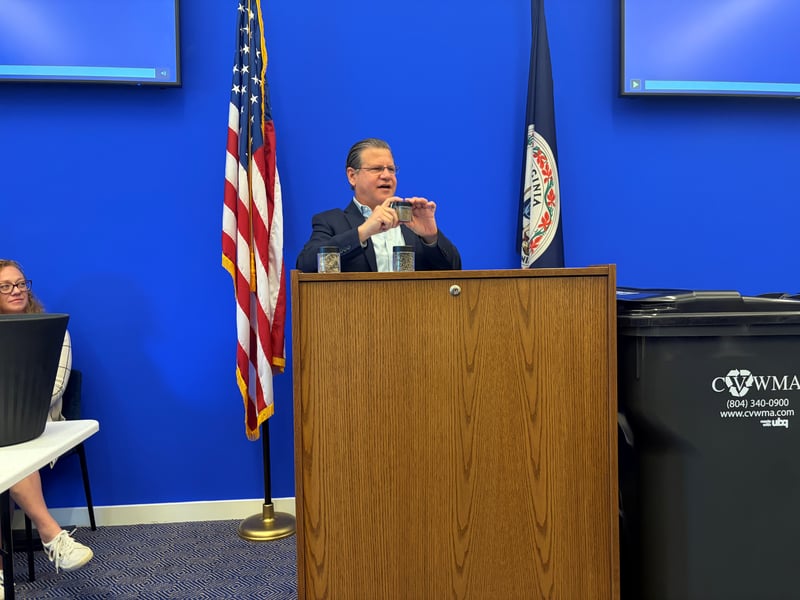
RICHMOND, Va. (CN) — Virginia localities announced a partnership with an Israeli waste diversion company Thursday in hope of tackling the world’s plastic problem.
The Central Virginia Waste Management Authority, which oversees trash collection for 13 neighborhoods, including the state capital of Richmond, will begin implementing trash bins made of organic waste that traditional recycling companies can’t use. The bins are made of around 5% of what the company UBQ calls evolved plastics — tiny thermoplastic pellets it makes from household waste, ranging from half-eaten pizzas to chicken bones to dirty diapers.
“The amount of waste that humanity generates every year is 2.5 billion tons,” UBQ co-founder Jack “Tato” Bigio said at a press conference. “We’re taking the garbage of the garbage, and that is the new material that we have invented.”
UBQ’s commercial plant in the Netherlands processes thousands of pounds of Europe’s trash. It converts the waste into materials used by companies like PepsiCo, McDonald’s and Mercedes-Benz for everyday items such as coat hangers and flower pots. Now the company is adding trash bins to its menu, manufactured by Michigan-based Cascade Engineering.
While most recycling plants and waste conversion companies use discarded plastics, UBQ uses organic waste. This waste accumulates and decomposes in landfills, attracting methane-producing bacteria that generate landfill gas composed of roughly 50% methane and 50% carbon dioxide.
“The beauty is that we’re creating a world where instead of plastics making waste, we’re making plastics out of waste,” Bigio said. “It transfers waste into a clean, usable and most importantly, cost-competitive material.”
According to the Environmental Protection Agency, municipal solid waste landfills are the third-largest source of human-related methane emissions in the U.S.
While UBQ currently operates out of Europe, Bigio said the company plans to expand production to the United States soon. According to a report from the National Oceanic and Atmospheric Administration, an estimated 8 million tons of plastic waste enter the world’s oceans each year. The U.S. is the largest producer of plastic waste, creating 42 million tons every year — more than all EU countries combined.
The Central Virginia Waste Management Authority said it bought 3,000 bins for around $100,000, describing it as more than just a rollout of new trash bins.
“It marks a new way of thinking about waste, turning what we once discarded into something useful, durable and climate-positive,” Richmond’s director of sustainability, Laura Thomas, said. “These carts are more than containers for waste. They’re symbols of what’s possible when partnership meets purpose together.”
Bigio said that every kilogram of UBQ’s evolved plastics uses about one and a half kilograms of trash. UBQ pulls metals and fibers, such as glass, from the waste it receives and sells them to metal producers.
Landfills produce methane gas, which is at least 28 times more effective than carbon dioxide at trapping heat in the atmosphere over 100 years, according to the EPA. They also take up large spaces of natural habitats and often leak leachate, a liquid containing high levels of ammonia that contaminates nearby water sources.
“The more UBQ we have around, the better for the planet,” Bigio said. “We’re proving that waste can be reimagined and it can be the foundation of new generations of materials and new possibilities, a future where waste is not the end of the story, but it’s only the beginning.”
Subscribe to our free newsletters
Our weekly newsletter Closing Arguments offers the latest about ongoing trials, major litigation and rulings in courthouses around the U.S. and the world, while the monthly Under the Lights dishes the legal dirt from Hollywood, sports, Big Tech and the arts.