
 Search Articles


RICHMOND, Va. (CN) — Less than a half mile from the former White House of the Confederacy, Black Democratic lawmakers gathered Thursday to push for legislation ending tax exemptions for Confederate history organizations.
The bill, introduced in the House of Delegates by Alex Askew, eliminates the state recordation tax exemption for the Virginia Division of the United Daughters of the Confederacy implemented in 1950 and the tax-exempt designation for real and personal property owned by the United Daughters of the Confederacy, the General Organization of the United Daughters of the Confederacy, the Confederate Memorial Literary Society, the Virginia Division Sons of Confederate Veterans, the Stonewall Jackson Memorial, Incorporated, and the J.E.B. Stuart Birthplace Preservation Trust, Inc.
State code exempts most nonprofit organizations, including hospitals and churches. Askew’s bill allows localities to continue these exemptions while removing any mandatory state exemptions.
“This legislation does not challenge Confederate organizations’ right to exist, and it’s not about free speech,” Askew said in a press conference. “It’s about fairness in financial and fiscal priorities of Virginia.”
This bill is in the Legislature for the third year after a high school student alerted then-delegate Don Scott, now Virginia’s first Black Speaker of the House, to the state code containing the exemption. The bill passed through the Democratic-controlled Legislature in 2024 before receiving a governor’s veto.
Like in the last session, Republican lawmakers do not support the legislation. The bill passed its second constitutional reading on Thursday on a voice vote. On Jan. 22, a finance committee reported the bill on a 12-10 vote.
Republican Governor Glenn Youngkin argued that the government should investigate broad reforms regarding exemptions from local property and recordation taxes.
“The property tax exemption by designation is ripe for reform, delineated by inconsistencies and discrepancies,” Youngkin said in his veto statement. “Among these groups, some organizations have titles offensive in contemporary discourse, such as outdated references to the intellectually or developmentally disabled; some organizations reference political affiliations and engage in political contributions like the Ocean View Democratic and Social Club, and others are historical societies whose lineage is connected to contentious periods such as the Civil War, illustrated by the United Daughters of the Confederacy.”
Youngkin said he disagreed with singling out specific organizations.
“A more effective approach to reform would involve broad-based measures, allowing local governments autonomy in determining tax exemptions and considering the locality’s tax base and deed transfers,” Youngkin said. “Choosing winners and losers is imprudent and undermines the tax system’s fairness.”
Askew said he didn’t expect the governor to change his mind this year but hopes reintroducing the bill will allow voters to know where lawmakers stand on the issue ahead of the 2025 election, in which every seat in the House of Delegates is up for grabs.
Askew said that former Congresswoman Abigail Spanberger, the Democratic front-runner in the 2025 gubernatorial election, confirmed she would support the legislation. Lieutenant Governor Winsome Sears, the Republican front-runner, did not respond to a request for comment.
According to Jahd Khalil of Virginia Public Media, a Richmond city assessor estimated that the United Daughters of the Confederacy would have had to pay over $50,000 in property taxes in 2024 for its Richmond-based headquarters.
The United Daughters of the Confederacy claims to have nearly 12,000 members. The organization, which worked tirelessly during the Jim Crow era to erect monuments honoring Confederates and lobbying to write history textbooks reflecting its version of why the war happened, states on its website that it denounces any individual or group that promotes racial divisiveness.
“The UDC strongly opposes Virginia House Bill 1699 and believes that Confederate organizations have been targeted with a bill aimed at organizations the party in power deems unworthy,” United Daughters of the Confederacy President General Julie Noegel Hardaway said in a statement.
Askew said Virginians shouldn’t bear the organizations’ tax burdens.
“A tax exemption is a privilege, not a right,” Askew said. “Organizations like United Daughters of Confederacy have promoted the lost cause, a romanticized and false narrative of the Confederacy. They built statutes to worship the Confederacy and the KKK and pushed the lie that war was about states’ rights rather than slavery.”
According to Askew, the bill is timely following President Donald Trump’s second inauguration. Congress overrode Trump’s veto of the National Defense Authorization Act, which had a provision requiring the renaming of military bases and military property honoring Confederate soldiers within three years.
“He prioritized preserving the history of the Confederacy over our safety, over the safety of America, and now he’s promising to undo those changes to once again glorify a painful and shameful chapter of our history,” Askew said.
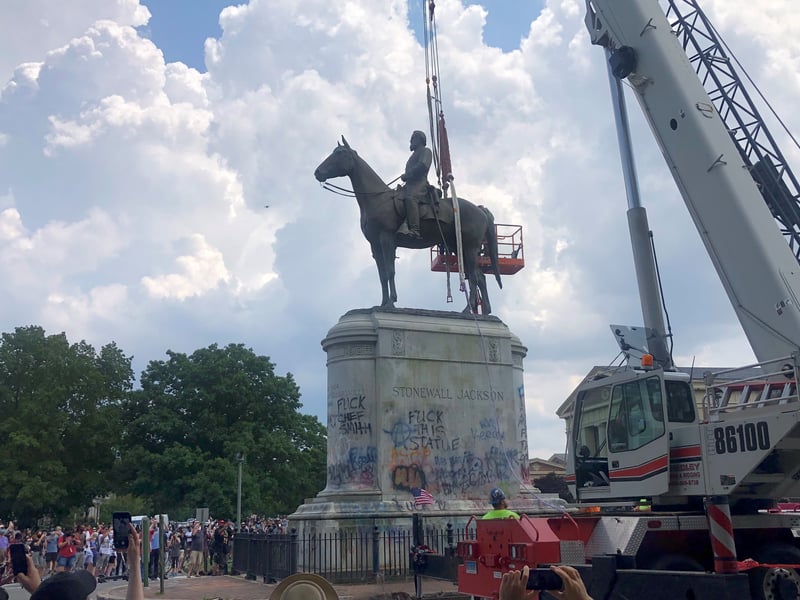
Three Confederate statues still stand within the confines of Virginia’s Capitol lawn despite Richmond removing the bulk of its monuments after a protest in 2020 sparked by the police killing of George Floyd.
Subscribe to our free newsletters
Our weekly newsletter Closing Arguments offers the latest about ongoing trials, major litigation and rulings in courthouses around the U.S. and the world, while the monthly Under the Lights dishes the legal dirt from Hollywood, sports, Big Tech and the arts.