
 Search Articles


RICHMOND, Va. (CN) — Since his release from prison in 2023, George Hawkins has integrated himself into his community in nearly every way. He runs a bread vendor business, pays taxes and coaches youth basketball.
“I impact my community,” Hawkins said on the steps of the Fourth Circuit courthouse. “I’m a productive member of my society.”
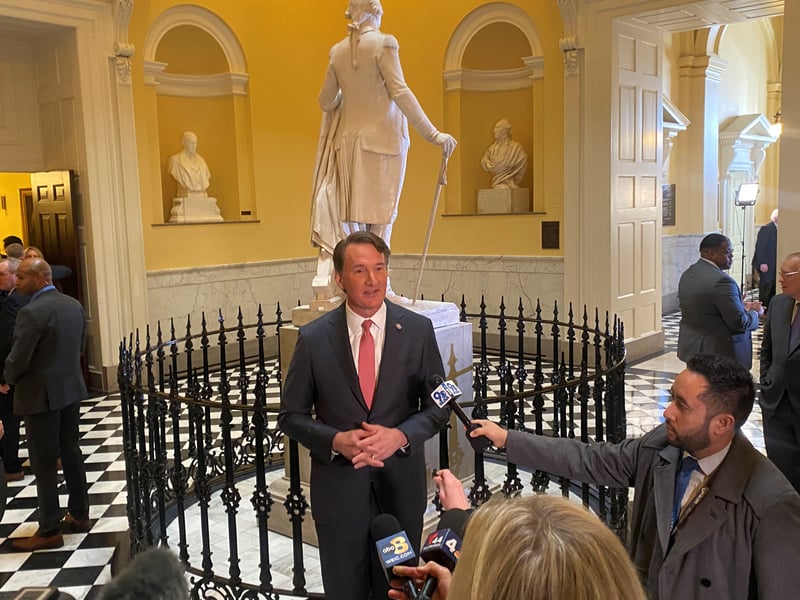
Yet despite two applications, Hawkins — convicted of attempted murder and aggravated malicious wounding in 2010 — remains ineligible to vote. On Friday, he argued to a three-judge panel that Virginia Governor Glenn Youngkin’s system, or lack thereof, for restoring felons’ voting rights is arbitrary.
“Voting is expressive conduct under the First Amendment,” attorney John Sherman of the Fair Election Center, representing Hawkins, said in an interview. “The governor cannot arbitrarily decide who can vote and who cannot amongst the disenfranchised population in Virginia.”
Virginia is the only state that gives the governor unbridled discretion to restore felons’ right to vote. What makes an applicant worthy of clemency remains unclear, as the governor has not provided any objective criteria or rules for the previously incarcerated to follow. The process also lacks a time limit for the governor to issue decisions.
Virginia’s three previous governors, two Democrats and a Republican, rejected the power the state constitution affords to the governor and instead opted for a uniformly administered nondiscretionary restoration system. Youngkin, a Republican, terminated that policy when he took office in 2022.
Hawkins claims the process runs afoul of the U.S. Supreme Court’s 1938 decision in Lovell v. City of Griffin , in which the majority held that the First Amendment prohibits the arbitrary licensing or permitting of political expression or expressive conduct.
U.S. District Judge John Gibney granted the state’s motion for summary judgment after holding that Youngkin’s rights restoration system isn’t an administrative licensing scheme subject to the First Amendment’s unfettered discretion doctrine.
“No one would suggest that Governor Youngkin’s ‘fully implemented’ system is transparent, or that it gives the appearance of fairness. Much like a monarch, the governor receives petitions for relief, may or may not rule upon them, and, when he does rule, need not explain his reasons,” the Barack Obama appointee wrote. “But transparency and the appearance of fairness are not the issue in this case."
Gibney distinguished Supreme Court precedent and the present case, asserting that licensing schemes regulate an existing right to protected free speech, while the restoration process exists to aid in deciding whether a candidate deserves restoration of a right he lost.
U.S. Circuit Court Judge Pamela Harris asked how his case fits into prior Supreme Court rulings establishing that executives may enjoy unfettered discretion in clemency matters despite the 14th Amendment’s due process requirements.
“It just seems like the court has already held that it’s going to make an exemption to rules that ordinarily require clear standards to avoid arbitrariness in execution,” the Obama appointee said. “Why doesn’t that doctrine apply here?”
Sherman responded that Hawkins seeks criteria for an arbitrary system, while the Supreme Court cases concerned second-guessing judicial decisions.
“The First Amendment is stronger medicine,” Sherman said. “The First Amendment doctrine that we are invoking is 86 years old. It has applied to a wide variety of expressive conduct, and in this case, it should apply to the context of the expressive conduct that is voting.”
Harris asked the state why voting wouldn’t count as political expression.
“Can you explain to me why it would make sense to say that giving money to a candidate is First Amendment protected expressive activity, but giving your vote is not?” Harris asked.
State attorney Erika Maley answered that voting isn’t a First Amendment right because the Constitution addresses it more directly in other provisions.
U.S. Circuit Court Judge James Andrew Wynn, also an Obama appointee, asked Maley if there are any procedural limits on the process.
“You don’t think the government can just say ‘we’ll flip a coin’ and do it?” Wynn asked.
Maley said there are, in some cases, unlawful discriminatory practices the governor could deploy, like only reenfranchising Republican voters.
The Sentencing Project estimated that over 200,000 Virginians lacked the right to vote post-sentence, making up slightly over 5% of the voting-age population. According to a 2023 lawsuit, Black Virginians account for nearly half of disenfranchised voters despite comprising less than 20% of the commonwealth’s voting-age population.
The commonwealth declined to comment. U.S. Circuit Court Judge DeAndrea Benjamin, a Joe Biden appointee, rounded out the panel.
Subscribe to our free newsletters
Our weekly newsletter Closing Arguments offers the latest about ongoing trials, major litigation and rulings in courthouses around the U.S. and the world, while the monthly Under the Lights dishes the legal dirt from Hollywood, sports, Big Tech and the arts.