
 Search Articles


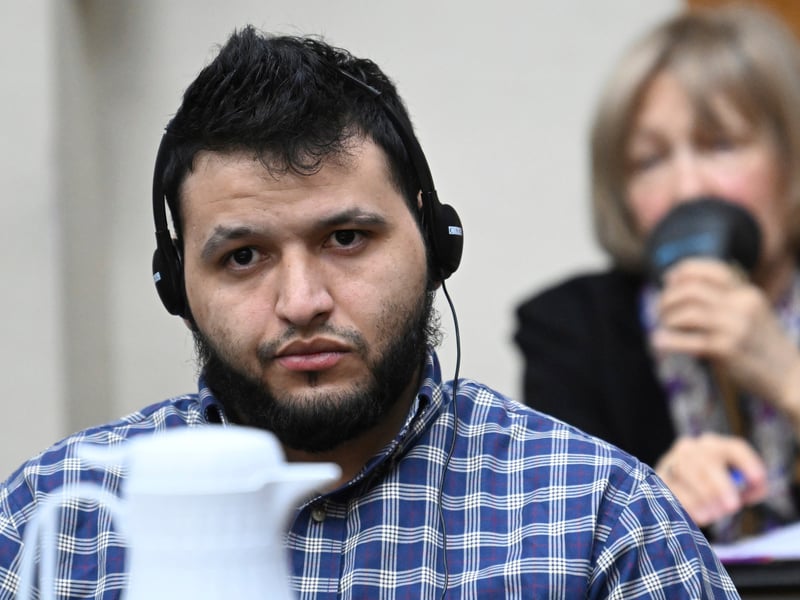
ATHENS, Ga. (CN) — Jose Ibarra was sentenced to life in prison without the possibility of parole after he was found guilty Wednesday of murdering Laken Riley, a 22-year-old nursing student, while she was jogging on the University of Georgia campus in February.
Ibarra was found guilty on all charges of felony murder, malice murder, kidnapping with bodily injury, aggravated assault with intent to rape, aggravated battery, hindering a 911 call, tampering with evidence and a Peeping Tom charge from before Riley was killed.
Athens-Clarke County Superior Court Judge H. Patrick Haggard delivered the verdict just 15 minutes after closing arguments were completed.
Ibarra had pleaded not guilty and waived his right to a trial by jury, leaving his fate in the judge’s hands.
The 26-year-old Venezuelan sat expressionless, as has throughout the four-day trial, while an interpreter repeated the judge’s verdict to him.
Meanwhile, several of Riley’s family members and friends cried and held each other in the back of the courtroom, as the emotional case ended. Several of them then delivered tearful victim impact statements before the judge’s sentencing decision.
“Jose Ibarra took no pity on my scared, panicked and struggling child. There is no end to the pain, suffering and loss we have experienced and continue to endure,” Riley’s mother, Allyson Phillips, told the judge.
“This sick, twisted and evil coward showed no regard to Laken’s life, and we ask that the same be done to him,” she added through tears.
Riley’s father, John Phillips, pleaded with the judge to sentence Ibarra to life in prison without the possibility of parole, “so that he can never have the opportunity to do this to anyone else ever again.”
Riley’s younger sister should never have to worry about Ibarra being up for parole one day, Athens-Clarke County Assistant District Attorney Sheila Ross told the judge.
Prosecutors did not seek the death penalty, which is legal in Georgia, but not possible in a bench trial unless the case involves treason or aircraft hijacking.
“The evidence in this case has been overwhelming,” Ross said in her closing statement. “He killed her because she would not let him rape her.”
Before resting their case Wednesday morning, Ibarra’s defense attorneys attempted to point to his brother, Diego Ibarra, as a potential suspect.
They called Special Agent Lucas Beyer of the Georgia Bureau of Investigation back to the stand, but he testified that there was no evidence placing Diego Ibarra anywhere other than at home on the morning of Riley’s murder.
They argued the person, who appears to be Jose Ibarra, in surveillance footage could have been his brother, pointing to witness testimony that the men often shared clothing and the same cellphone.
“I found no evidence to contradict his statement that he was at home at the time,” Beyer told the court.
Ibarra declined to testify and closing arguments wrapped up Wednesday morning.
“Laken Riley herself has given you all the evidence you need to find this man guilty of every count in this indictment,” Ross told the judge.
“She did fight, and that fight gives you all the physical evidence you need to convict him.”
Prosecutors rested their case Tuesday after calling dozens of witnesses.
Among the evidence presented was a surveillance video showing Riley running near the university’s intramural fields the morning of her death, and police body camera footage as her body was found in a wooded area about 65 feet off the trail.
Georgia Bureau of Investigation agents testified that she died by blunt force trauma and asphyxia from either manual strangulation or neck compression. Rocks covered in Riley’s blood and hair were recovered near her body.
Ibarra’s attorneys argued there was not enough evidence to show he attempted to sexually assault her, pointing to testimony that Riley had no such injuries or traces of seminal fluid.
But prosecutors noted the evidence of a nearly 20-minute struggle between Ibarra and Riley, who was found with her shirt and sports bra almost completely removed and her pants partially pulled down.
Ibarra’s DNA was also found under Riley’s fingernails. When police arrested him the day after the murder, he had several scratches on his body.
Another video showed Ibarra that morning in a black hat and hooded jacket attempting to enter a female student’s apartment and looking into her windows. Prosecutors argued Ibarra had gone out “hunting for females” that morning.
He was seen on another video disposing of the jacket in a nearby dumpster, which was found by police containing Riley’s blood and hair, as well as black gloves with a missing thumb hole. Riley’s phone was found with Ibarra’s thumbprint where prosecutors said he hung up her 911 call.
Selfies of Ibarra wearing the same clothing were also found taken on his phone from the same day.
The murder roiled the otherwise lively college town of Athens as the first suspected homicide on the grounds of Georgia’s flagship university in over two decades.
The case also drew national attention during Donald Trump’s presidential campaign and his calls for stricter U.S. border security. Ibarra, a Venezuelan national, entered the United States illegally in 2022, U.S. Immigration and Customs Enforcement said. He and two of his brothers, who also came into the country without authorization, were taken into custody in Athens the day after Riley’s death.
“Open border policies failed Laken Riley, and today’s verdict is a reminder that the safety of our communities must remain our number one priority,” Governor Brian Kemp wrote in a statement Wednesday.
 Follow @Megwiththenews
Subscribe to our free newsletters
Our weekly newsletter Closing Arguments offers the latest about ongoing trials, major litigation and rulings in courthouses around the U.S. and the world, while the monthly Under the Lights dishes the legal dirt from Hollywood, sports, Big Tech and the arts.