
 Search Articles


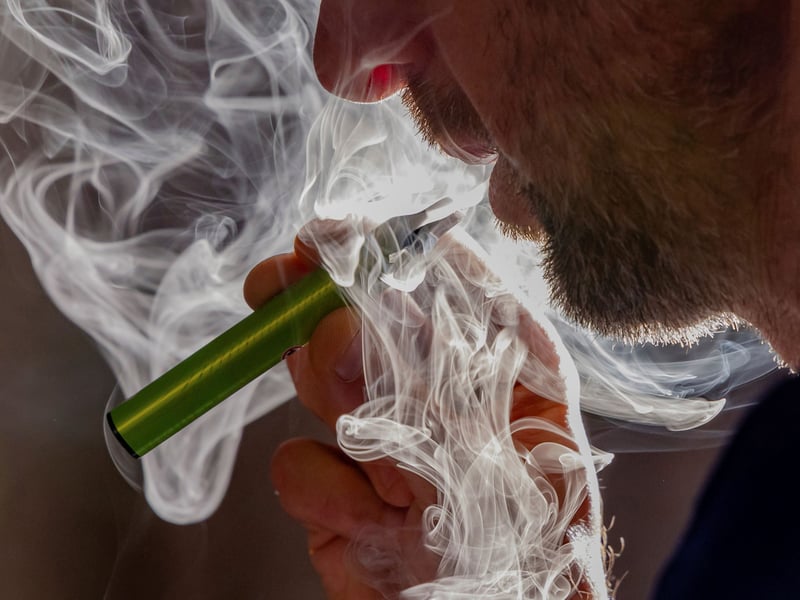
WASHINGTON (CN) — Vape manufacturers won a Supreme Court standoff against the Food and Drug Administration on Friday, giving companies the advantage of challenging policy decisions in their preferred venue and “team up” with retailers adversely affected by agency decisions.
In a 7-2 opinion, the high court ruled that a provision in the Family Smoking and Prevention Act — that “any person adversely affected” by an FDA’s denial order can sue in the D.C. Circuit or a local circuit court — should also apply to retailers who would otherwise sell the vapes.
Justice Amy Coney Barrett, a Donald Trump appointee, wrote in the court’s opinion that retailer Avail Vapor Texas in Houston and the Mississippi Petroleum Marketers and Convenience Store Association were within the “zone of interest” and thus could join the North Carolina-based manufacturer R.J. Reynolds Vapor Co.’s challenge.
By allowing the Texas and Mississippi companies to participate in the manufacturer’s case, the suit could proceed in the Fifth Circuit Court of Appeals rather than in the Fourth Circuit or the D.C. Circuit.
RJR Vapor sought to challenge a marketing authorization denial for its new vape flavors in the Fifth Circuit. The North Carolina-based company would normally file before the Fourth Circuit or the D.C. Circuit, but Reynolds tied itself to a local retailer to put its lawsuit in front of a friendlier audience.
Barrett explained that the retailers faced significant harms as a result of the FDA’s denial and therefore count as “any person adversely affected,” allowing the three petitioners to effectively “team up” in the Fifth Circuit.
“The retailers fit the bill,” Barrett wrote. “If the FDA denies an application, the retailers, like the manufacturer, lose the opportunity to profit from the sale of the new tobacco product — or, if they sell the product anyway, risk imprisonment or other sanctions. Given this significant, direct impact on retailers, their interests are not ‘so marginally related to or inconsistent with the purposes implicit in the statute that it cannot reasonably be assumed that Congress intended to permit the suit.’”
Under former President Joe Biden, the federal government pushed the justices to reject the Fifth Circuit’s ruling, arguing that it endorsed forum shopping — a term describing strategic efforts to put a lawsuit in front of a favorable court.
Reynolds requested authorization for berry- and menthol-flavored e-cigarette products that the FDA claimed could hook young users on tobacco. National and state public health organizations said that 90% of adult smokers begin smoking in their teens, and a 2024 study found that nearly 90% of middle and high school e-cigarette smokers preferred flavored products.
The company sought to continue marketing its popular Vuse Alto products, but the FDA determined the company failed to show such marketing was “appropriate for the protection of the public health” under the TCA.
‘The FDA’s order sounded the death knell for a significant portion of the e-cigarette market, and RJR Vapor sought to challenge it,” the high court wrote in the syllabus preceding the opinion.
The Fourth and D.C. Circuits have upheld government restrictions on these products, but the Fifth Circuit deviated from seven other circuits to side with Reynolds in March 2024.
Since then, the government said over a dozen e-cigarette companies filed appeals in the Fifth Circuit. At oral argument, the government noted about 75% of e-cigarette cases were filed in the appeals court last year, all out-of-circuit applicants jumping on a trend started by Reynolds.
Justice Ketanji Brown Jackson, joined by Justice Sonia Sotomayor, dissented from the decision and said the majority ignored the purpose of the statue.
Jackson warned that the decision reduced the “zone of interest” test to a “near-meaningless proposition” that companies even “arguably affected” could sue over an FDA denial.
“Every available indicator reveals that Congress intended to permit manufacturers — not retailers — to challenge the denial of a manufacturers’ marketing application (and to do so only in the designated courts),” the Joe Biden appointee wrote. “In concluding otherwise, the majority not only opens up an avenue for judicial review that Congress did not intend, it also allows manufacturers like RJR Vapor to evade the statute’s venue requirements.”
Jones Day attorney Ryan Watson, who represented RJR Vapor and the retailers, lauded the high court’s decision in an emailed statement on Friday.
“In today’s decision, the Supreme Court recognized that federal agency action can have downstream effects that can be devastating for parties that are not the most direct target of the agency’s action,” Watson said. “The court’s decision ensures that the courthouse doors are not closed for those adversely affected parties.”
 Follow @KelseyReichmann
 Follow @kelseyreichmann.bsky.social
Subscribe to our free newsletters
Our weekly newsletter Closing Arguments offers the latest about ongoing trials, major litigation and rulings in courthouses around the U.S. and the world, while the monthly Under the Lights dishes the legal dirt from Hollywood, sports, Big Tech and the arts.