
 Search Articles


(CN) — Already one of the most adored paintings in European art by casual observers and professional critics alike, Vincent Van Gogh’s “The Starry Night” has drawn the keen eye of yet another group: physicists studying fluid dynamics.

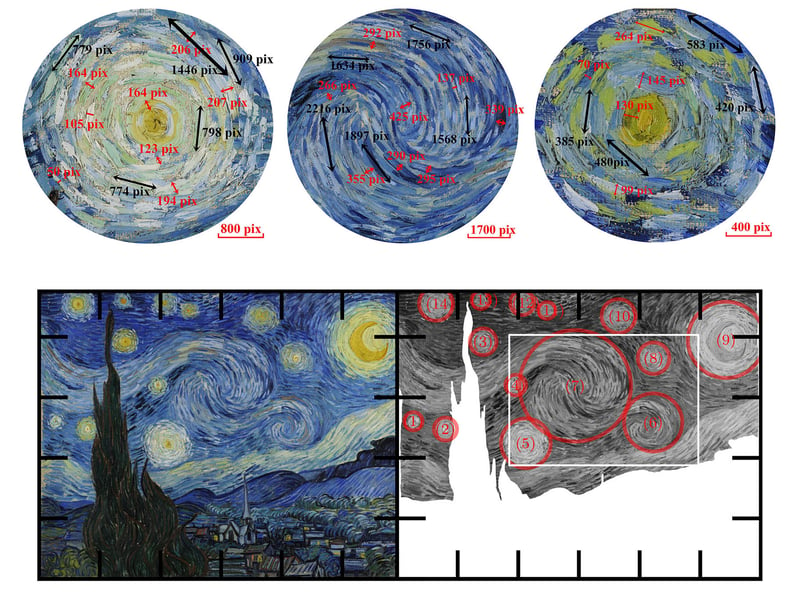
A new study in the journal Physics of Fluids examined the renowned painting’s patterns and brushstrokes to see just how accurate those famous swirls in its night sky are.
“With a high-resolution digital picture, we were able to measure precisely the typical size of the brushstrokes and compare these to the scales expected from turbulence theories," said study author Yongxiang Huang from the State Key Laboratory of Marine Environmental Science & College of Ocean and Earth Sciences at Xiamen University in a statement accompanying the study.
The team from universities in China and France examined the 14 main swirls in a high-resolution scan of the painting found online, both in color and grayscale, and compared it to multiple mathematical models of turbulence. They found that the size and distribution of Van Gogh’s brushstrokes followed the expected patterns of turbulence whirls and eddies under a model of large-scale turbulence widely used since 1941.
Meanwhile, the diffusion of light within the brushstrokes and the relative brightness of the paint at different points, which served as the stand-in for observed kinetic energy in turbulent air, followed a 1959 scale for how energy dissipates in the smaller scale. Much of that smaller-scale accuracy stemmed not just from Van Gogh’s style of painting, but from the particular composition of the paint he used, a mix of stone powder and linseed oil.
“In other words, Vincent van Gogh, as one of the most notable post-impressionist painters, had a very careful observation of turbulent flows: he was able to reproduce not only the size of whirls/eddies, but also their relative distance and intensity in his painting," the study authors wrote in conclusion.
Van Gogh is not the first painter to accurately capture turbulence in his work. Centuries before, Leonardo da Vinci captured turbulent flow with similar accuracy, backed up by a similar 2021 Italian study also published in Physics of Fluids. And similar swirling patterns show up in “The Great Wave off Kanagawa,” an iconic Japanese painting from 1831 that multiple studies from the Royal Society have pointed to as an accurate depiction of turbulence in water.

Indeed, this study also dedicated an appendix to a similar examination of two other images, “Chain Pier, Brighton” by John Constable (1825) and the famous Voyager 1 photograph of Jupiter’s Great Red Spot. The clouds in the former, painted in the much more true-to-life Romantic style, came from Constable’s own observations of the London clouds. And the Great Red Spot, even though it is not on Earth, exhibits much of the same expected turbulence patterns found on Earth and captured in these paintings.
But the team chose “The Starry Night” as the painting to focus the study on because Van Gogh managed to capture both the large- and small-scale turbulence in one image, something that rarely occurs even in real-world observations.
Subscribe to our free newsletters
Our weekly newsletter Closing Arguments offers the latest about ongoing trials, major litigation and rulings in courthouses around the U.S. and the world, while the monthly Under the Lights dishes the legal dirt from Hollywood, sports, Big Tech and the arts.