
 Search Articles


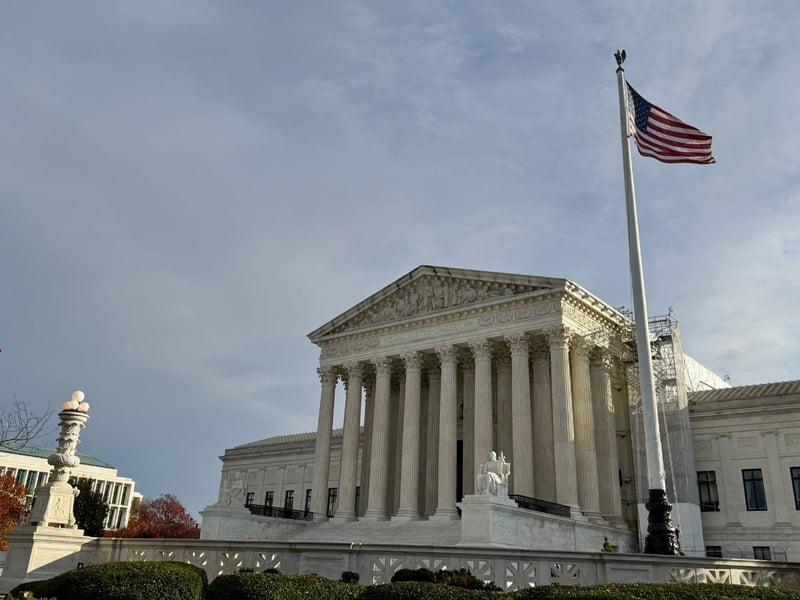
WASHINGTON (CN) — In a diversion during Donald Trump’s nearly three-hour conversation with podcaster Joe Rogan Oct. 25, the incoming president complained that environmental regulation is gumming up American development. Next week, the Supreme Court will consider cutting the fat.
“They could stop you cold with the environmental impact study stuff,” Trump said.
He was referring to the requirement that government agencies consider the impact of industry projects under the National Environmental Policy Act. Developers like Trump condemn the law for slowing plans while driving up costs.
On Tuesday, a political subdivision will advocate before the high court for a limited reading of the law, rebuking efforts to consider the downstream environmental impacts of an 88-mile oil and gas rail line in Eagle County, Utah.
“What began as a modest procedural check to ensure that agencies did not proceed heedless of proximate environmental impacts soon took on a life of its own, with ‘environmental and industry groups’ seizing on NEPA compliance in litigation seemingly aimed at ‘tak[ing] financial resources away from developers and creat[ing] such delay as to completely impede the progress of a project,’” the Seven County Infrastructure Coalition wrote.
But where builders see overregulation, environmental and health advocates see essential roadblocks protecting the public’s interest.
Dr. Brian Moench, board chair of the Utah Physicians for a Healthy Environment, compared capping NEPA review as the coalition suggests to the Food and Drug Administration only considering the public health consequences of manufacturing a drug after releasing the drug on the market.
“Any court would conclude that such a ruling would be a mockery of the purpose of the FDA,” Moench said in a press call. “If the EPA only considered the environmental consequences of constructing a coal-fired power plant and not the public health consequences of the lifetime emissions from operating the plant, any court could grasp the illogic and mockery of the Clean Air Act and question the very purpose of the EPA.”
The case stands to impact a broad swath of environmental law that advocacy groups say could increase pollution, harm public health and lead to the loss of biodiversity nationwide.
For Jonathan Godes, a city council member in Glenwood Springs, Colorado, however, there’s a chance the impact could be felt more immediately.
The Uinta Basin Railway would transverse the state’s northeastern mountainous terrain, connecting the basin’s waxy crude oil source to an existing interstate freight rail network. Connecting to the Union Pacific Railroad main line, oil from the basin would travel through the Colorado Rockies toward Denver and on to Gulf refineries.
Running as many as 10 trains, the rail could transport up to 350,000 barrels of oil out of the basin each day, the Seven County Infrastructure Coalition estimated.
Godes said there’s a risk that the proposed Utah railway derails in restricted areas along the Colorado River that are very sensitive and prone to natural disasters.
Wildfires are particularly concerning for Glenwood Springs, which recently experienced the Grizzly Creek Fire. Godes said NEPA’s environmental impact studies give local communities an opportunity to share local concerns with the federal government.
“Whether we win or not at the local level, at least it gives us a seat at the table and a sometimes collaborative approach to working through some of these issues,” Godes said. “If this process is redefined and the federal government is able to essentially put their boot on the necks of local government and not contemplate how this impacts us and we don’t have a voice, I think that is incredibly troubling for local control and the people on the ground.”
In 2019, the Seven County Infrastructure Coalition received conditional approval from the Surface Transportation Board to help secure financing for the rail line but prohibited any construction until the review was completed. After releasing a draft report for industry comments, the board approved the product in its final report in August 2021.
Throughout 3,600 pages of analysis, the board said the rail line’s construction could disturb local waters and wetlands, and new lines would lead to noise for local inhabitants. The board also noted mitigation measures to avoid air quality and greenhouse gas emissions from the line’s construction that could affect local wildlife.
In the completed review, the board estimated that the Uinta Basin Railway would increase oil production in the basin five-fold. The board considered several downline impacts, like the risks of increasing traffic volume on existing lines.
Advocacy groups pushed the board to consider the environmental impact of potential oil and gas development projects in the basin. The board found these concerns too attenuated.
The review’s downline impacts would directly impact Eagle County, Colorado. The proposed rail line would lead to increased traffic and more than twice the current risk of rail incidents. Eagle County and environmental advocacy groups asked the D.C. Circuit to step in.
The appeals court sided with Eagle County, rejecting the Surface Transportation Board’s permit for failing to do a comprehensive review of the railway’s potential harm to the environment.
The Seven County Infrastructure Coalition said the D.C. Circuit incorrectly extended NEPA’s requirements. The appeals court said that because the board traced increased crude oil production to Gulf Coast refineries, the board was obligated to study the environmental consequences of additional outputs in the region.
Under Department of Transportation v. Public Citizen , the coalition argues that environmental impact studies only concern areas within that agency’s authority.
“There is simply no role under NEPA’s text and this court’s precedents for stymying development projects based on environmental effects that are so wildly remote in geography and time,” the coalition wrote. “This court should reaffirm that NEPA embodies a demanding form of proximate cause, not mere but-for causation, and reverse.”
The environmental advocates claim the D.C. Circuit applied the test set out by Congress in the Building United States Infrastructure through Limited Delays and Efficient Reviews, or BUILDER, Act.
Sam Sankar, senior vice president of programs at Earthjustice, said industry groups wanted the court to limit NEPA because they couldn’t achieve their objectives through the political process.
“It’s a perfect example of where the court is doing the dirty work for all of these industries that are interested in changing our environmental laws, reducing community input, eliminating transparency to government decision-making, and making sure the government puts blinders on before it actually makes big decisions,” Sankar said.
Moench warned that greenlighting the Uinta Basin Railway would have devastating health impacts on the community. In 2013, researchers from the University of Colorado found high levels of volatile organic compounds — carcinogens and other toxins that are especially dangerous to female development, infants and children. Samples in the basin were as much as you would expect from 100 million cars, Moench said.
“The purpose of the railway is to increase oil production in the area by 500% over those 2013 levels,” Moench said. “The amount of air pollution documented in 2013 was staggering, add the railway and you would create an unthinkable public health nightmare spreading throughout the entire region.”
Moench said Utah lawmakers were manipulated into giving oil companies public subsidies, which a handful of CEOs were using to exhaust the oil reserve.
“The cost, literally and figuratively, would be borne by everyone else and future generations,” Moench said. “Were the court to allow this perverse project, it would be the very definition of an utterly failed federal government.”
 Follow @KelseyReichmann
 Follow @kelseyreichmann.bsky.social
Subscribe to our free newsletters
Our weekly newsletter Closing Arguments offers the latest about ongoing trials, major litigation and rulings in courthouses around the U.S. and the world, while the monthly Under the Lights dishes the legal dirt from Hollywood, sports, Big Tech and the arts.