
 Search Articles


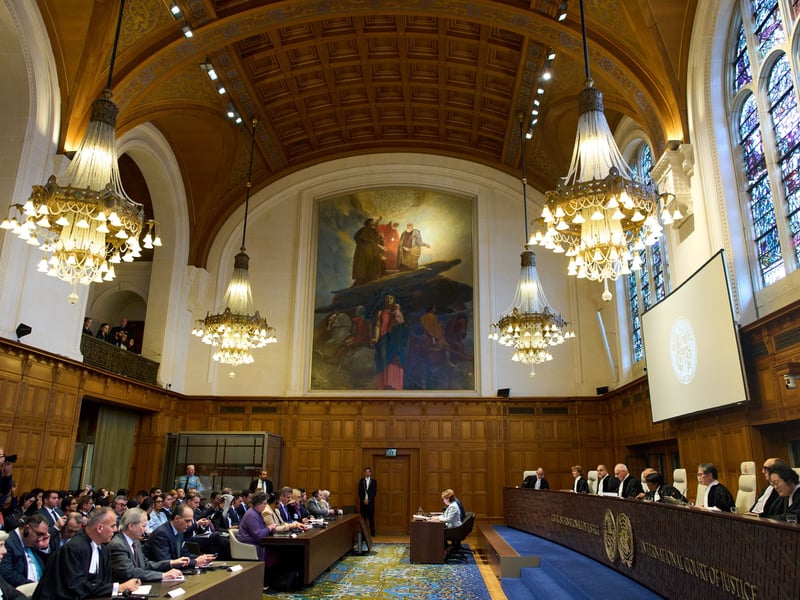
THE HAGUE, Netherlands (CN) — Washington stepped directly into the explosive Gaza genocide case unfolding at the United Nations’ top court, telling judges accusations against Israel are wrong and warning them not to weaken the legal definition of genocide.
In a declaration submitted Thursday but announced Friday to the International Court of Justice, the U.S. said it was intervening to present its interpretation of the Genocide Convention, the post-World War II treaty at the center of the dispute.
The case began when South Africa asked the court in late 2023 to rule that Israel’s actions in Gaza violate the 1948 Genocide Convention, adopted after the Holocaust to outlaw attempts to destroy national, ethnic, racial or religious groups. The accusations stem from Israel’s war in Gaza following Hamas’ Oct. 7 attacks, which Israel says it is responding to in self-defense.
In its submission, Washington did not mince words.
“To avoid any doubt, the United States affirms, in the strongest terms possible, that the claims of ‘genocide’ against Israel are false,” the U.S. said in its declaration.
Countries that have signed the Genocide Convention can intervene when its meaning is at issue. Washington used that opening to argue that genocide requires proof of a specific intent to destroy a protected group, and that civilian deaths in wartime do not qualify unless they are part of a deliberate plan to destroy such a group.
The move reflects Washington’s broader stance during the Gaza war, defending Israel’s right to respond to the Hamas attacks while urging steps to reduce civilian suffering.
The U.S. was not alone in stepping into the case this week. Judges confirmed that Namibia, Hungary and Fiji also filed declarations of intervention on March 12. Namibia emphasized states’ duty to prevent and punish genocide and argued they can be responsible for acts carried out by their officials. Hungary urged a strict interpretation and warned against lowering the evidentiary bar for proving genocidal intent, while Fiji likewise stressed the need for clear proof of a specific intent to destroy a protected group.
A day earlier, the Netherlands and Iceland submitted their own interventions, arguing the treaty creates obligations owed to the international community and gives all signatories a stake in how it is interpreted.
The wave of filings underscores how the case has become a global legal battleground over the meaning of genocide.
Professor Yuval Shany, chair in public international law at the Hebrew University of Jerusalem, said “these multi-intervention cases are quite a recent phenomenon.” What makes this one unusual, he said, is the intervening states are “themselves split and making opposite recommendations to the court.”
That split could blunt their influence. “They cumulatively suggest there is no consensus among the states parties on whether the convention should be construed narrowly or broadly,” meaning the filings may end up having “minimal impact on the court’s eventual approach,” he said.
Professor Chimène Keitner, professor of international law at the University of California, Davis, said the court will still weigh interventions based on the strength of their legal arguments. Filings that present compelling legal reasoning may influence the judges, she said, while those that largely repeat existing positions to signal political support for one side are likely to carry less weight.
She added that the case could also test the court’s very high threshold for holding a state responsible for genocide — a standard some states argue is too strict.
Professor Mark Drumbl, professor of law and director of the Transnational Law Institute at Washington and Lee University, said interventions like these can still play an important expressive role in international litigation.
“Interventions by treaty signatories in a case like this can create a broader conversation,” Drumbl said, allowing states to weigh in on how key provisions of the Genocide Convention should be interpreted. Even if judges give them limited weight, he added, the filings help by “creating a space for broader input and centralizing the importance of law in the management of violence, international relations and judicial legitimacy.”
Even so, legal experts say the central fight in the case will be over genocidal intent, the defining feature of genocide.
Professor Marko Milanovic, professor of public international law at the University of Reading and director of Global Law at Reading, said the interventions and the parties’ submissions raise several key questions about genocidal intent, including how it can be inferred from circumstantial evidence and “whether genocidal intent can co-exist with other intents or motivations,” including whether Israel’s intent to destroy Hamas can coexist with an intent to destroy part of the Palestinian people.
While the International Court of Justice cannot prosecute individuals, it can determine whether states have breached international law. The Hague-based court, the United Nations’ top judicial body, hears disputes between countries and interprets international treaties. Early in the case, judges issued provisional orders instructing Israel to prevent acts that could fall under the Genocide Convention and to allow more humanitarian aid into Gaza.
The dispute is unfolding alongside a broader legal confrontation between Israel and international courts. In a separate case, the International Criminal Court issued arrest warrants in 2024 for Israeli Prime Minister Benjamin Netanyahu and former Defense Minister Yoav Gallant, accusing them of using starvation as a method of warfare and deliberately targeting civilians during the Gaza conflict.
Washington responded sharply. The Trump administration imposed sanctions on ICC officials, including prosecutor Karim Khan and several judges, freezing U.S.-based assets, restricting travel and barring them from financial dealings with American institutions.
Against that backdrop, the Gaza genocide case has become a focal point for competing interpretations of the Genocide Convention. Some governments, including several in Europe and Latin America, support broader readings of the treaty that could bolster South Africa’s claims.
The U.S. is pushing the opposite view, warning judges not to dilute the definition of genocide. As Washington put it in its filing, “civilian casualties, even widespread civilian casualties, are not necessarily probative of genocidal intent.”
For now, the proceedings remain at an early stage. The court will continue collecting written submissions from the parties and intervening states before deciding whether Israel’s actions violate the convention — a judgment that could take years.
But with governments lining up on both sides, the case is already reshaping the global debate over one of international law’s gravest crimes.
Courthouse News reporter Eunseo Hong is based in the Netherlands.
Subscribe to our free newsletters
Our weekly newsletter Closing Arguments offers the latest about ongoing trials, major litigation and rulings in courthouses around the U.S. and the world, while the monthly Under the Lights dishes the legal dirt from Hollywood, sports, Big Tech and the arts.