
 Search Articles


(CN) — In a Europe deeply skeptical of U.S. President Donald Trump, Washington has found a place where it can get down to business: Greece.
Since Trump’s return to the White House a year ago, the anti-immigrant and scandal-tainted government of Greek Prime Minister Kyriakos Mitsotakis — a Harvard-educated “Davos man” — has emerged as a good fit for the deal-seeking Trump team in Europe.
With business at its core, this budding U.S.-Greek friendship seems to match Trump’s mercantilist “America First” doctrine with Greece’s history of trade, wealth and influence in the Mediterranean.
For now, oil and gas are fueling the blossoming bromance between Trump and Mitsotakis, a 57-year-old scion of a Greek political dynasty. His center-right New Democracy party returned to power under his leadership in 2019.
Trump invited Mitsotakis to a recent state dinner in New York City during the U.N. General Assembly and the two bonded in Egypt during Trump’s Gaza peace summit.
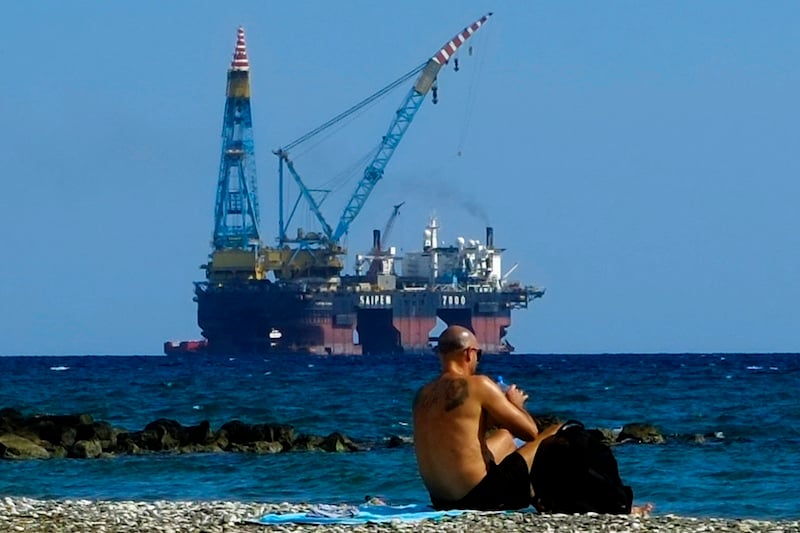
Over this period, the Greek government announced big deals with ExxonMobil and Chevron, giving them permission to lead fossil fuel exploration inside Greece’s exclusive economic zone, specifically off the coasts of Crete, Corfu and the Peloponnese.
The energy deals signaled Washington’s readiness to expand America’s footprint in the Eastern Mediterranean, a region rich in resources but bruised by longstanding Greek-Turkish fights over sea zones and islands.
Who owns what?
Since the 1990s and the boom in deepwater drilling worldwide, the Eastern Mediterranean has been eyed as a potential spot for an oil and gas bonanza. The region’s reserves, held mostly in the Levant and Nile River basins, hold at least 9.6 trillion cubic meters of natural gas, according to the U.S. Geological Survey.
That’s far from gigantic in comparison with the world’s biggest deposits, but it’s still a lot of gas, especially for a corner of the world long known for energy scarcity.
But figuring out who owns what in the Eastern Mediterranean is the hard part.
Going around the Eastern Mediterranean clockwise, the countries making up the gulf are Turkey, Cyprus, Syria, Lebanon, Israel, the U.N.- recognized Palestinian state, Egypt, Libya, Malta, Italy, Albania and Greece.
It’s an incendiary mix of rivals, enemies, friends, failed states, dictatorships, authoritarian regimes and democracies, making the region a jarringly complex and risk-filled watery chessboard.
“All this is disputed,” said Filippos Proedrou, a professor of energy geopolitics at the University of South Wales, in a telephone interview. “There are no territorial zones demarcated there. It’s up for grabs.”
At the center of the dilemma sits Turkey.
In terms of shoreline, Turkey has the longest coast of any nation along the Mediterranean’s eastern seas. But Turkey’s maritime claims are hemmed in by Greece’s string of islands in the Aegean Sea and by the island of Cyprus, which sits off Turkey’s southeastern coast.
The Aegean between Anatolia and Greece is dotted by islands and archipelagos comprising Crete, Lesbos, Naxos, Kos, Rhodes and many other rocky outcroppings, both big and small, uninhabited and inhabited.
Almost all the Aegean islands are in Greek waters, though Turkey possesses two large islands in the Northern Aegean. Turkey also occupies the northeastern chunk of Cyprus following its 1974 invasion to prevent Turkish communities on the island from falling under the control of a military junta rising to power in Athens.
The Aegean islands are woven into the Turkish coastline. For instance, Lesbos is situated inside a large Turkish bay and its closest point is only 5 miles from Turkey’s mainland. The conflict is tinged with hostility and descends occasionally into military confrontation despite the two being NATO allies.
Complicating matters, Turkey, Israel, Libya and Syria — all Eastern Mediterranean nations — have not signed the U.N. Convention on the Law of the Sea, a 1982 treaty meant to resolve spats over sea boundaries.
About two dozen of the U.N.’s nearly 200 members are not signatories to the convention. The U.S. is the sole global power that hasn’t signed the convention. However, the U.S. uses the treaty as a basis for law enforcement on the high seas.
“It’s a very, very complicated legal and geopolitical issue,” Proedrou said.
Turkey’s complaint over sea zones
Turkey’s main argument is that the territorial claims made by Greece’s islands and Cyprus unfairly impede its access to the Mediterranean Sea and stunt development of its continental shelf.
The fight goes at least back to the 1970s when oil and gas deposits were first mapped in the Aegean Sea.
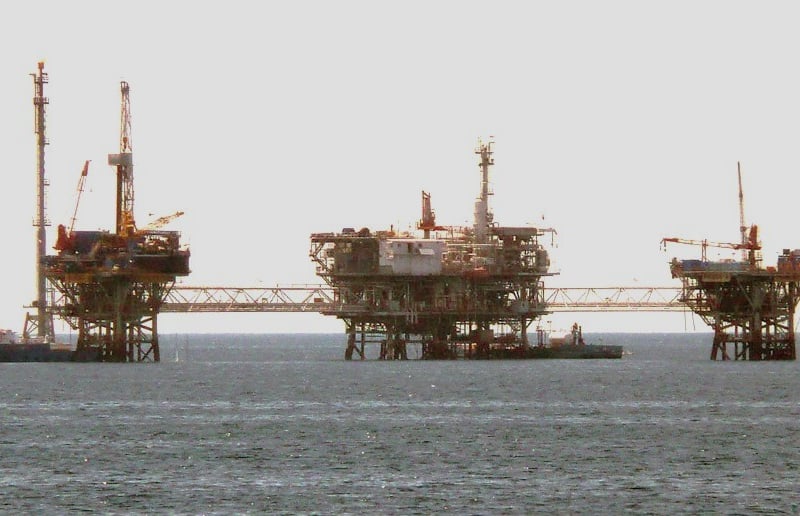
With backing from U.S. oil companies, Greece began drilling the Prinos Field in the shallow waters of the North Aegean south of Kavala. By the early 1980s, the field was active and producing oil.
Seeing the success on the Greek side, Turkey declared in 1987 it too was going to drill for oil at a site next to the Greek island of Paxos. A spat ensued, leading to a standoff.
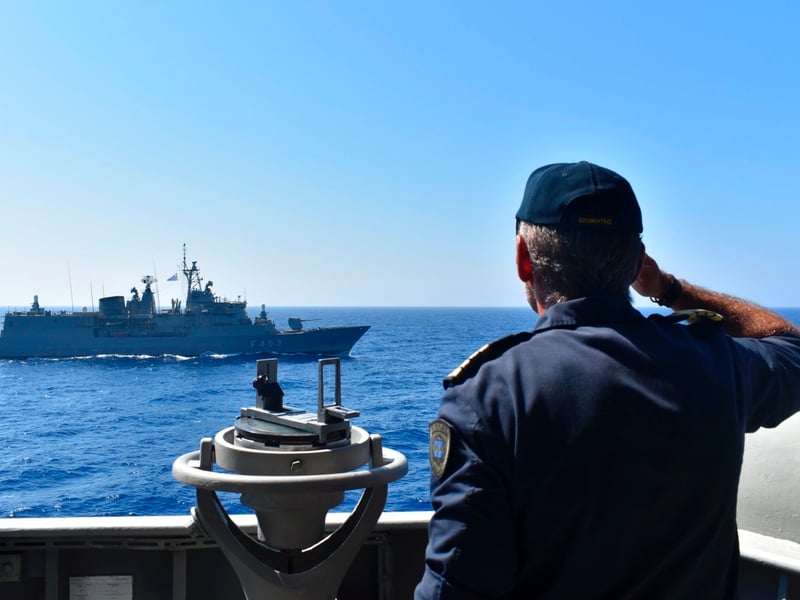
Since then, gunboat diplomacy has defined Turkish-Greek relations, with each side sending in its navy when needed to assert maritime claims.
Faced with Turkey’s animosity, the Prinos Field became Greece’s first and last oil field, delivering a modest 120 million barrels of oil over its lifespan. It ceased production about a decade ago.
The U.S.-Greece push into the Mediterranean
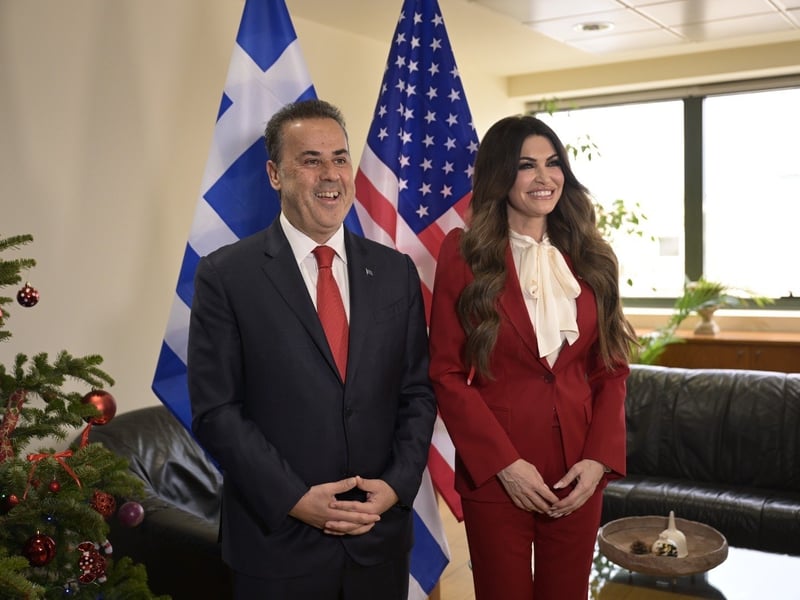
One of America’s newest diplomats, the flamboyant Kimberly Guilfoyle, is leading Washington’s charge toward the Eastern Mediterranean.
In September 2025, Trump appointed Guilfoyle as U.S. ambassador to Greece. She took her position two months later in a ceremony with Konstantinos Tassoulas, the president of the Hellenic Republic.
Guilfoyle’s colorful career includes serving as first lady to California Governor Gavin Newsom when he was mayor of San Francisco. At the time, Guilfoyle was a rising California state prosecutor.
She earned national fame with a 12-year stint on “The Five,” a popular Fox News talk show. She later rose to Washington powerbroker status after Trump tapped her to lead his 2020 presidential fundraising campaign. Until late 2024, she and Donald Trump Jr., the president’s eldest son, were in a long-term relationship.
Renowned for her flowing hair extensions, tough wit, social life and revealing dresses, Guilfoyle seems like a good fit for Greece and its nightclubs, international oligarchs, yacht-studded waters and rough-and-tumble commercial spirit.
Guilfoyle hit the ground running. Shortly after arriving in Athens, she hosted a U.S. delegation led by Interior Secretary Doug Burgum and Energy Secretary Chris Wright. They announced a string of deals at a two-day Atlantic Council energy conference.
At the conference, Greecesaid it had approved an ExxonMobil permit to lead exploration for oil and gas off the coast of Corfu, marking Greece’s resumption of fossil fuel exploration in the Ionian Sea after a hiatus of more than 40 years ago.
On the conference’s sidelines, ExxonMobil added it was ready to drill its first well in waters it has been leasing off the coast of Crete, the large Greek island dividing the Aegean from the larger Mediterranean.
ExxonMobil’s entry into the Ionian Sea came on top of a September announcement that Greece awarded a new lease to Chevron over a swath of seabed between Crete and the Peloponnese.
ExxonMobil and Chevron are both working with Greece’s national oil company, Helleniq Energy, and other smaller Greek firms.
Chevron and ExxonMobil join Italy’s Eni, France’s TotalEnergies, the British-Dutch giant Shell and British-owned BP as the biggest corporate players pursuing oil and gas in the Eastern Mediterranean. Smaller regional and national companies are active too.
At the business conference, Washington and Athens also signed a cooperation agreement strengthening ties on everything from military equipment to artificial intelligence.
The immediate commercial focus, though, is on increasing the volume of U.S. liquefied natural gas shipments Greece is able to process and distribute to the rest of Europe.
Since the cutoff of Russian gas following the outbreak of war in Ukraine, Greece has become one of Europe’s main entry points for American LNG. American LNG arrives at two Greek terminals and there are plans to build a third terminal.
“In some ways, Greece is already a hub,” said Julian Bowden, a Mediterranean expert at the Oxford Institute for Energy Studies, in an email. “It has demonstrated over the last three, four years that it can import LNG and send it on to Bulgaria.”
The longer-term plan is for Greece to become the main hub in an EU-sponsored pipeline network set to replace Russian pipelines. Known as the “Vertical Corridor,” this new line will connect the Balkans and parts of Europe, including Ukraine and Moldova, to Greece.
Its importance became even more urgent after the EU’s 27 member states finally agreed late last year to phase out all Russian gas imports by late 2027.
Hungary and Slovakia still rely on Russian gas, so it’s expected Greece will become their main supplier. In November, Ukrainian President Volodymyr Zelenskyy flew to Athens, where he signed a gas import deal with Greece.
Greece as a new energy hub
In Europe, the political stock of Mitsotakis seems to keep rising — notwithstanding egregious scandals hanging over his government.
Shortly after taking office, Mitsotakis’ reputation was deeply damaged by revelations he approved the use of an illegaldomestic surveillance operation that spied on opposition party members, government officials and even his own allies. The scandal became known as “Greek Watergate.”
More recently, members of his ruling New Democracy party were accused of abusing an EU farm subsidies program and winning millions of euros for nonexistent farms and pastures.
Despite the whiff of corruption, Mitsotakis has the backing of Brussels and Washington.
He’s mostly praised for ending Greece’s experiment with left-wing governments after the country fell into bankruptcy due to the EU’s poorly managed eurozone crisis between 2009 and 2012.
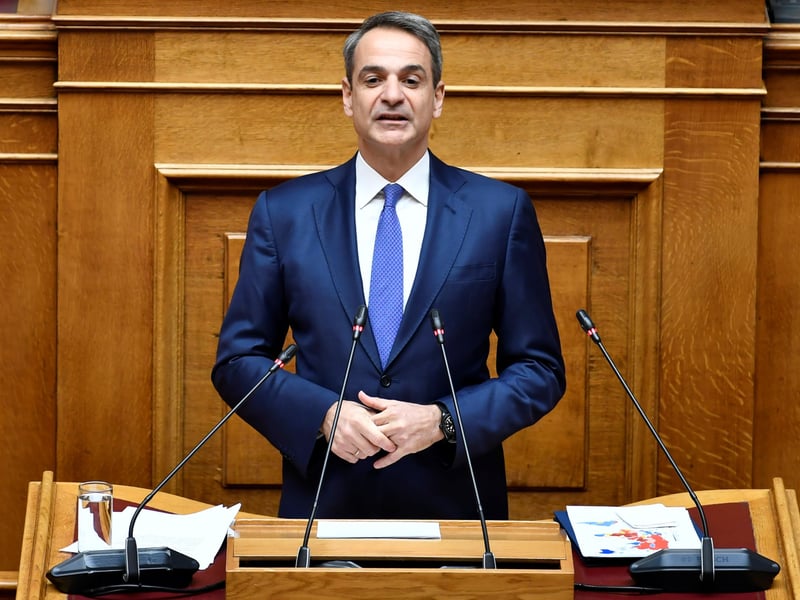
Mitsotakis’ ability to maneuver in ways that seem counter to the EU’s liberal democratic impulse was made easier after Greece’s economy turned the corner following his election.
Fortuitously, Mitsotakis took the helm in Athens at the tail end of Brussels-imposed cuts to social services, welfare benefits and pensions. Greece’s financial collapse was one of the worst economic depressions ever experienced by a modern state.
So, compared to the dark years of far-left Syriza party rule, Mitsotakis’ pro-market and pro-digital rhetoric has made sun-blessed Greece an attractive place for investors. In 2024, Greece ticked off GDP growth of about 2%, well ahead of the EU’s meek 0.2% average.
Mitsotakis reflects a growing mood in European political circles that feels the EU’s progressive liberal democratic model is outdated in a world of great power conflict.
With little negative reaction from Brussels, Mitsotakis has rebelled against the EU’s Green Deal policies, calling them extreme, and repeatedly thumbed his nose at EU human rights laws. Meanwhile, his government scandals have mostly been swept under the rug.
Mitsotakis is renowned for overseeing one of Europe’s harshest border control regimes. Greece routinely abuses migrants, with well-documented incidents showing police and coast guard using violence against migrants.
Last summer, Mitsotakis caused a controversy when he stopped processing asylum claims from migrants arriving from Libya. The move was a blatant challenge to EU law, which requires the bloc’s members to uphold the rights of refugees and asylum seekers.
Supporters praise Mitsotakis for being a decisive leader in the Trump mold. Critics worry he tends toward authoritarianism.
For now, the Athens-Washington axis looks set to strengthen. In recent weeks, Guilfoyle has begun talking about how great it would be to see Trump deliver a speech in front of the Acropolis.
All about the money
The actual amount of drilling and gas production in the Eastern Mediterranean remains minimal.
The bulk of activity is taking place along Egypt’s shores. But Israel is pushing deeper into the Mediterranean, and doing so with success. Cyprus has entered the race too, but its ambitions are stymied by Turkey and the territorial dispute over Cyprus.
Amid all the turmoil, Greece’s ability to lure ExxonMobil and Chevron to commit investment can be seen as a win, Proedrou said.
“It’s about U.S. energy giants having a stake in regions that are up for grabs,” he said.
But he added ExxonMobil and Chevron are hardly naive and they both are eager to get into the Eastern Mediterranean “because they believe they can make money.”
“These giants do it for business purposes and they will make their money,” he said.
Courthouse News reporter Cain Burdeau is based in the European Union.
 Follow @cainburdeau
Subscribe to our free newsletters
Our weekly newsletter Closing Arguments offers the latest about ongoing trials, major litigation and rulings in courthouses around the U.S. and the world, while the monthly Under the Lights dishes the legal dirt from Hollywood, sports, Big Tech and the arts.