
 Search Articles


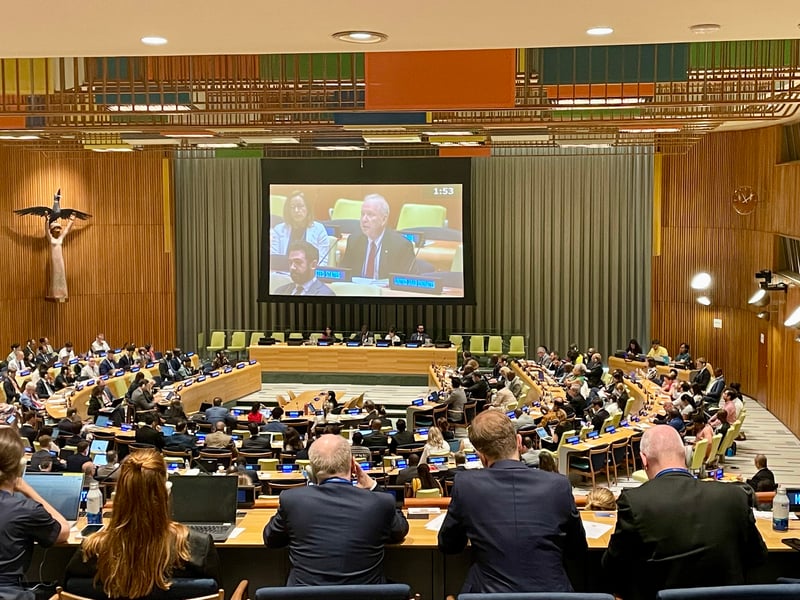
MANHATTAN (CN) — A legal adviser to the State Department addressed the International Criminal Court’s oversight body on Tuesday, breaking from fellow speakers’ diplomatic tone with a hard-line message reaffirming the United States’ hostility toward the international tribunal.
“The ICC has engaged in illegitimate and baseless actions targeting America and our close ally, Israel,” Reed Rubinstein said, citing President Donald Trump’s February executive order sanctioning the court. “It has wrongfully abused its power [and] its malign conduct threatens to infringe U.S. sovereignty and undermine our critical national security and foreign policy work.”
The ICC, formed in 1998, is the world’s only permanent court for atrocity crimes. It is legally separate from the United Nations, unlike the UN’s International Court of Justice, which was established after World War II to settle disputes between nations. Both courts are based in the Dutch city of The Hague.
In November, the ICC issued arrest warrants for Israeli Prime Minister Benjamin Netanyahu and his former defense minister, Yoav Gallant, over Israel’s devastating bombing campaign in Gaza, as well as a warrant against a senior Hamas official, citing war crimes and crimes against humanity.
U.S. sanctions followed, first in February and again in June, when U.S. Secretary of State Marco Rubio announced sanctions on four ICC judges, accusing them of “transgressions” by approving cases against the U.S. and Israel. Trump imposed sanctions against the court during his first presidency too, which President Joe Biden lifted.
Rubinstein’s comments came as the ICC’s legislative body met at the UN headquarters to discuss amending its founding treaty, known as the Rome Statute, to shore up the court’s jurisdiction over the crime of aggression — one of four crimes the court deals with, along with war crimes, genocide and crimes against humanity.
As it stands, the court can charge the crime of aggression only against the 125 countries that recognize its authority.
The U.S. legal adviser spoke as an observer during a session in which parties to the Rome Statute shared what they learned from a previous set of amendments adopted in 2010 in Kampala, Uganda, where states agreed on a definition of the crime of aggression.
“Our deep concerns regarding the Kampala amendments are longstanding and well-known,” Rubinstein said. “Expanding the ICC’s purported jurisdiction directly disregards America’s repeated objections to the Rome Statute system dating to the 1990s.”
Rubinstein said the U.S. expects its stance against the Rome Statute to be respected, adding that the June 5 sanctions “should underscore our resolve.”
“We will use all appropriate and effective diplomatic, political and legal instruments to block ICC overreach,” he said. “To be clear, we expect all ICC actions against the United States and our ally Israel — that is, all investigations and all arrest warrants — to be terminated. If not, all options remain on the table.”
The special session to review amendments to the crime of aggression will continue through Wednesday.
 Follow @NinaPullano
Subscribe to our free newsletters
Our weekly newsletter Closing Arguments offers the latest about ongoing trials, major litigation and rulings in courthouses around the U.S. and the world, while the monthly Under the Lights dishes the legal dirt from Hollywood, sports, Big Tech and the arts.