
 Search Articles


BRUSSELS (CN) — European officials confirmed Thursday they were completely excluded from a U.S. peace plan for Ukraine — learning about the framework the same way everyone else did: from news reports.
The revelation came as foreign ministers gathered in Brussels to discuss the leaked proposal, only to discover none of them had been consulted. French Foreign Minister Jean-Noël Barrot told reporters he knew only “what I was able to read yesterday afternoon, yesterday night, this morning in the press.”
Spain’s José Manuel Albares was equally blunt: His country had “nothing to do with that supposed peace plan,” which he understood was “a thing that the press says between the United States and Russia.”
Dutch Foreign Minister David van Weel said he hadn’t seen it. Germany’s Johann Wadephul said Berlin wasn’t briefed.
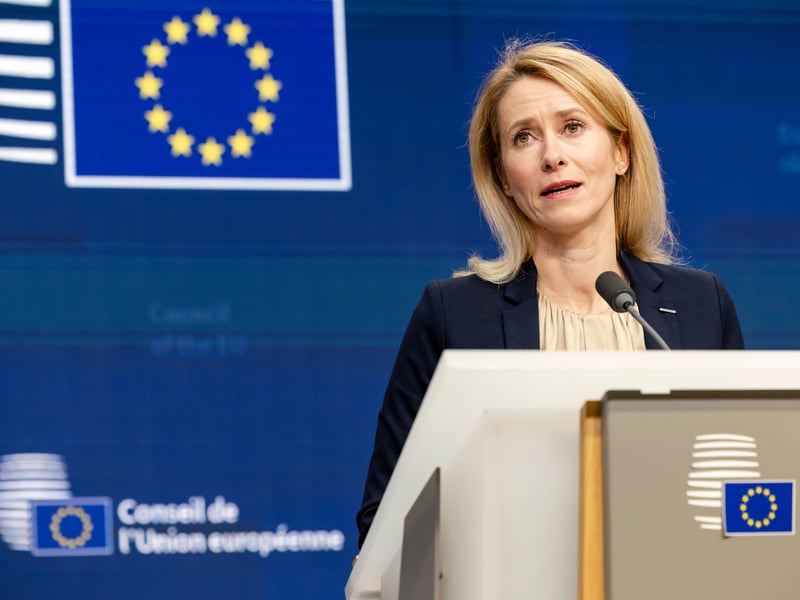
Asked whether any EU officials helped draft the proposal, top diplomat Kaja Kallas delivered a flat “not that I know of.” By day’s end, she’d checked: “Nobody reflected that they were part of it. So, no.”
The snub threatens to deepen a growing rift between Washington and Brussels over Ukraine’s future, with European officials warning that Europe’s control over sanctions and reconstruction funding gives Brussels power to either support or undermine any agreement.
A deal drafted with Moscow
The 28-point framework emerged from back-channel talks between White House special envoy Steve Witkoff and Russian officials. It would hand Russia complete control of Ukraine’s Donbas region — including about 14.5% of territory Kyiv still holds — in exchange for U.S. security guarantees.
Russian envoy Kirill Dmitriev, who worked with Witkoff on the proposal, told Axios: “We feel the Russian position is really being heard.” Qatar and Turkey also helped draft it.
Europe, which has spent over 200 billion euros ($210 billion) supporting Ukraine since 2022 — more than the roughly $85 billion from Washington — was not invited to the table.
Under the plan, the Donbas would become a demilitarized zone where Moscow can’t station troops. Battle lines in Kherson and Zaporizhzhia would freeze in place. The U.S. and other countries would recognize Crimea and the Donbas as Russian territory, though Ukraine wouldn’t have to.
Ukraine said Thursday it received the “draft plan” and would engage with Washington. President Volodymyr Zelenskyy’s office said it would “work on the plan’s points to ensure a dignified end to the war.” Zelenskyy expects to speak with Trump “in the coming days.”
Barrot rejected territorial giveaways outright. “Peace cannot be capitulation,” he said. “What we see is that, today, it’s Russia that constitutes an obstacle to peace.”
Kallas emphasized European buy-in would be essential. “For any peace plan to succeed, it has to be supported by Ukraine and it has to be supported by Europe,” she said. “If Russia really wanted peace, they would have accepted the unconditional ceasefire offer already in March.”
The exclusion appears deliberate. “This administration views the EU as kind of incomprehensible and not able to make a clear single decision,” Andrew Hyde, a senior fellow at the Stimson Center, told Courthouse News. Washington hasn’t even reached out to key individual leaders like Britain’s Keir Starmer or Germany’s Friedrich Merz, “which kind of reaffirms to me that they’re really not interested in the European Union at this point.”
The stakes go well beyond Ukraine. European officials worry that rewarding Russian aggression with territorial gains would embolden Moscow to target NATO members Poland and the Baltic states next — potentially triggering Article 5 and dragging U.S. troops into combat. A deal Europe opposes could prove unworkable anyway, with Brussels reluctant to fund reconstruction or provide security guarantees for an agreement it views as appeasement.
Yet Europe’s leverage is limited. The bloc has bankrolled Ukraine but lacks Washington’s military muscle and diplomatic clout. European leaders have repeatedly demanded a seat at the table without getting one.
Hyde said Europe’s exclusion could backfire. “The EU role could be either as a contributor or a spoiler,” he said. European sanctions on Russia remain potent, he noted, and “if Europe is not brought into it, then the leverage they would have in terms of sanctions on Russia would still be significant.”
The Washington-based Institute for the Study of War said the framework mirrors Russia’s 2022 Istanbul demands, presented when Moscow’s forces were threatening Kyiv. The plan would hand Russia critical territory “apparently for no specified compromise — sparing Russia the time, effort, and manpower” for future offensives.
Hyde said the framework “doesn’t really appear to be a credible or sustainable plan at this point, just because the security guarantees are really questionable.” Any peace agreement, he added, “almost needs to sort of assume zero trust in Russia in a way and be constructed accordingly. And this one doesn’t seem to be that.”
Not every European minister objected. Hungary’s Péter Szijjártó said Budapest remains “absolutely committed” to Trump’s peace push and stands ready to host a summit between Washington and the Kremlin.
The framework represents Trump’s latest attempt at a breakthrough after an August summit in Alaska with Russian President Vladimir Putin went nowhere. Plans for a follow-up meeting in Budapest collapsed in late October, prompting Washington to sanction Russian oil giants Lukoil and Rosneft.
Army Secretary Dan Driscoll flew to Kyiv this week to brief Ukrainian officials. A trilateral meeting planned for Wednesday in Ankara between Witkoff, Zelenskyy and Turkish Foreign Minister Hakan Fidan was postponed to an undisclosed date.
EU targets Russian oil vessels
European ministers responded by approving new economic pressure on Moscow. They agreed to pursue preboarding agreements with countries that register Russia’s shadow fleet — vessels that transport oil while dodging Western sanctions — creating a legal framework to board and search suspected ships.
Ministers also agreed to shift toward continuous listings of shadow fleet vessels rather than waiting for comprehensive sanctions packages, allowing Brussels to respond more quickly. The EU has already blacklisted more than 550 vessels.
Ministers also pushed for accelerating the reparations loan — using roughly 210 billion euros in frozen Russian assets as collateral — to sustain Ukraine’s defense.
Kallas suggested Moscow’s sudden interest in talks stems from economic strain. “I think they are afraid of this reparations loan. I think they are coming to the point where they are running out of money,” she said.
Russia’s economy has proven resilient despite sanctions, with Moscow finding workarounds through increased sales to China and India and using its shadow fleet to transport oil off the books. The EU adopted its 19th sanctions package in October, blacklisting 12 Chinese entities and three in India accused of supplying Russia with dual-use technology.
Ministers also discussed Thursday a wave of Russian sabotage across Europe, including a weekend railway bombing in Poland involving military-grade C-4 explosives. Warsaw shut Russia’s last consulate in Poland on Wednesday in response.
The disconnect between Washington and Brussels comes as Ukraine enters its fourth winter of war, with Russian forces making gradual gains in the east and European capitals increasingly anxious about Trump’s willingness to prioritize quick deals over allied unity. Ministers are expected to continue pressing for inclusion in any negotiations, though Washington has given no indication it plans to change course.
Courthouse News correspondent Yuval Molina is based in Brussels, Belgium.
Subscribe to our free newsletters
Our weekly newsletter Closing Arguments offers the latest about ongoing trials, major litigation and rulings in courthouses around the U.S. and the world, while the monthly Under the Lights dishes the legal dirt from Hollywood, sports, Big Tech and the arts.