
 Search Articles


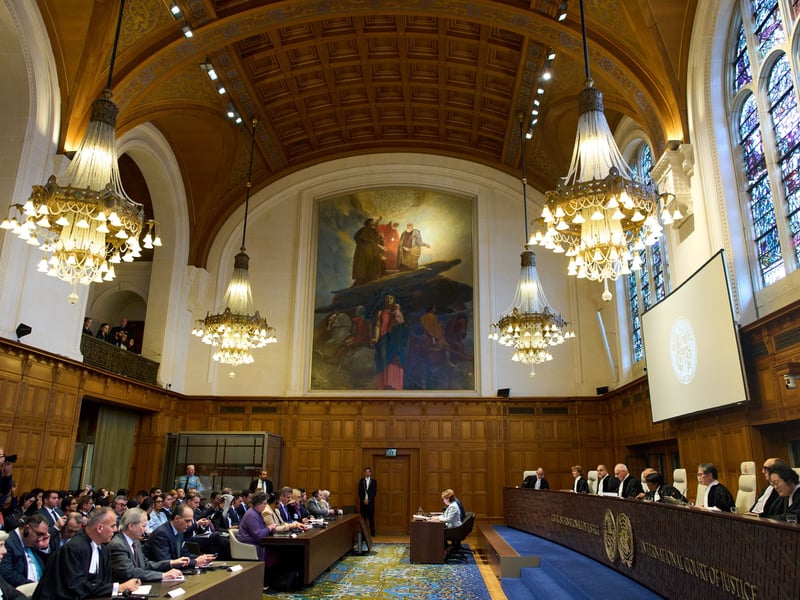
THE HAGUE, Netherlands (CN) — Israel’s broad legal duties in Gaza, and the world’s role in enforcing them, came into focus Wednesday as the United Nations’ top court issued a rare advisory opinion outlining what must be done to protect civilians and keep aid flowing across the occupied Palestinian territory.
The International Court of Justice said Israel, as Gaza’s occupying power, remains bound by humanitarian and human rights law, even as its control over the enclave has tightened since the war reignited in 2023.
The judges noted Israel must keep life-saving aid flowing — and under Article 59 of the Fourth Geneva Convention, the key treaty protecting civilians in war, it has an unconditional duty to do so. The court added that Israel “may never invoke reasons of security to justify the general suspension of all humanitarian activities in an occupied territory.”
Humanitarian lifeline under international law
The opinion, requested by the U.N. General Assembly, set out to clarify Israel’s legal duties toward the U.N., other international organizations, and third states working in and around the occupied Palestinian territory.
A key focus of the opinion was the United Nations Relief and Works Agency for Palestine Refugees, or UNRWA, which has long served as the main lifeline for Palestinians through food aid, schools and health care. Israel cut ties with the agency in 2024, accusing some of its staff of involvement in the 2023 Hamas attacks — claims that led to internal U.N. investigations and the dismissal of several employees.
Independent reviews later found Israel had provided no evidence to substantiate those claims. Against that backdrop, the court noted Israel must “agree to and facilitate relief schemes provided by the U.N. and its entities, including UNRWA,” rejecting its argument that the agency had lost its neutrality.
Protected under the U.N. Charter, the judges said, the organization’s work in the territory cannot be hindered, and Israel “may not obstruct functions of the U.N. and must provide every assistance in any action taken by the organization.” They said that obligation also means allowing U.N. staff to work safely and respecting the privileges and immunities of all humanitarian workers on the ground.
Beyond humanitarian law, the opinion stressed that Israel must respect the Palestinian people’s right to self-determination, which also means being able to eat, access medical care and have a roof overhead. Any effort to block or restrict aid, the judges said, cuts directly against that right. They made clear that using hunger as a weapon of war is flatly banned under international law.
From ceasefires to closures
The opinion lands after nearly two years of relentless destruction in Gaza. The war reignited after Hamas-led attacks on Oct. 7, 2023, when militants killed about 1,200 people in Israel and took hundreds hostage. Since then, Israel’s campaign has killed more than 60,000 people and driven nearly 1.9 million — about 90% of Gaza’s population — from their homes, according to U.N. figures.
In late 2024, Israel expelled UNRWA’s international staff from the West Bank and passed laws banning its operations. By early 2025, it had blocked aid convoys for over two months before allowing limited supplies through a private distribution system. The judges said those restrictions left Gaza’s civilians dangerously undersupplied, reinforcing Israel’s obligation to let relief flow through the U.N.’s established channels.
While the opinion isn’t legally binding, it carries serious moral and political weight. The court’s past advisory opinions have shifted global debates before. Back in 2004, it ruled that Israel’s separation barrier in the West Bank broke international law and should be dismantled. Israel ignored the finding, but the judgment changed how the world talked about the occupation and continues to shape U.N. discussions today.
Divided bench, deepening debate
Not all the judges were on the same page. Ugandan Judge Julia Sebutinde urged a more restrained approach, saying the court had gone beyond what the U.N. General Assembly asked. She warned that it was treading too close to live disputes, including one accusing Israel of genocide in Gaza, and argued that such matters should be left to political bodies.
She also questioned the fairness of the assembly’s request, saying it focused only on Israel while ignoring groups like Hamas and other countries involved. In her view, Israel’s suspension of cooperation with UNRWA could be legally justified if based on genuine security concerns since the agency’s work in Israel depends on its consent under a 1967 agreement.
The majority pushed back, saying there was no reason to reject the assembly’s request. They said their role was simply to clarify Israel’s legal duties, not decide if it had broken them, and reaffirmed that all states must protect civilians and aid workers and ensure relief gets to those who need it most.
Reactions and calls for accountability
In a statement following the court’s opinion, UNRWA chief Philippe Lazzarini said he welcomes “the unambiguous ruling,” noting that “Israel is under an obligation to agree to and facilitate relief schemes provided by the U.N. and its entities, in particular UNRWA.”
He added that “Israel’s claim that UNRWA is infiltrated by Hamas was not substantiated, nor were claims that UNRWA is not a neutral organisation,” calling for “accountability for the killing of UNRWA staff members, for the severe mistreatment of humanitarian staff in detention and for the destruction, damage and misuse of UNRWA facilities.”
Israel, for its part, took a very different line. Israel’s Foreign Ministry rejected the court’s opinion in a post on its official X account, calling it “a political attempt to impose measures against Israel under the guise of international law.” The ministry claimed that UNRWA had been infiltrated by Hamas, accusing some of its staff of involvement in the Oct. 7 attacks and asserting that Israel “will not cooperate with an organization that is infested with terror activities.”
The Palestinian Foreign Ministry, meanwhile, praised the ruling as “a landmark” that makes clear Israel “has blocked humanitarian aid to the civilian population in Gaza in violation of its obligations as an occupying Power.”
It said the court “rejected Israel’s campaign of lies against UNRWA” and stressed that the agency “cannot be replaced.” The ministry added that Israel must “immediately lift the unlawful ban on UNRWA and allow all other international organizations invited by Palestine to operate freely and safely in Gaza and the rest of the occupied Palestinian territory.”
Legal experts said the opinion draws a sharper line around Israel’s responsibilities. Arnulf Becker Lorca, a professor of public international law at the European University Institute in Florence, said the court’s split between “negative” and “positive” obligations helps make sense of what Israel must do — and avoid doing — under humanitarian and human rights law.
He added that while the opinion confirms Israel must not block aid and must actively ensure essentials reach Palestinians, it avoided weighing Israel’s claims of self-defense and sovereignty. Becker Lorca noted the judges “refused the invitation to balance conflicting rights and obligations,” likely to keep humanitarian rules above political argument.
Others saw the ruling as a turning point for global accountability. Dr. Nimer Sultany, a reader in public law at SOAS University of London, called it “a crushing defeat for Israel” that exposes “the very obligations that Israel has sought to disregard.”
He said the opinion should spur the U.N. General Assembly to act, potentially through sanctions, arms embargoes or suspending diplomatic ties. Sultany described it as “a sharp reminder of the damage that Israel has inflicted on the international legal order” and a call for real action, not just words.
Leon Seidl, a research fellow at the Max Planck Institute for Comparative Public Law and International Law in Heidelberg, reflected on the ruling’s legal weight, saying it was “commendably clear on the most crucial issues” and stayed focused on defining Israel’s obligations rather than passing judgment.
He noted that the judges reaffirmed Israel’s control over Gaza and the West Bank and that Israel “must agree to and facilitate relief provided by humanitarian organizations.” Seidl added that the court’s warning against using starvation as a weapon could also prove relevant to the International Criminal Court’s cases against Israeli Prime Minister Benjamin Netanyahu and Defense Minister Yoav Gallant.
The opinion now goes before the U.N. General Assembly. It carries great legal weight, though it isn’t legally binding, and could fuel calls for sanctions and bolster war crimes cases at The Hague. The judges have drawn the lines — it’s up to the world to act on them.
Courthouse News reporter Eunseo Hong is based in the Netherlands.
Subscribe to our free newsletters
Our weekly newsletter Closing Arguments offers the latest about ongoing trials, major litigation and rulings in courthouses around the U.S. and the world, while the monthly Under the Lights dishes the legal dirt from Hollywood, sports, Big Tech and the arts.