
 Search Articles


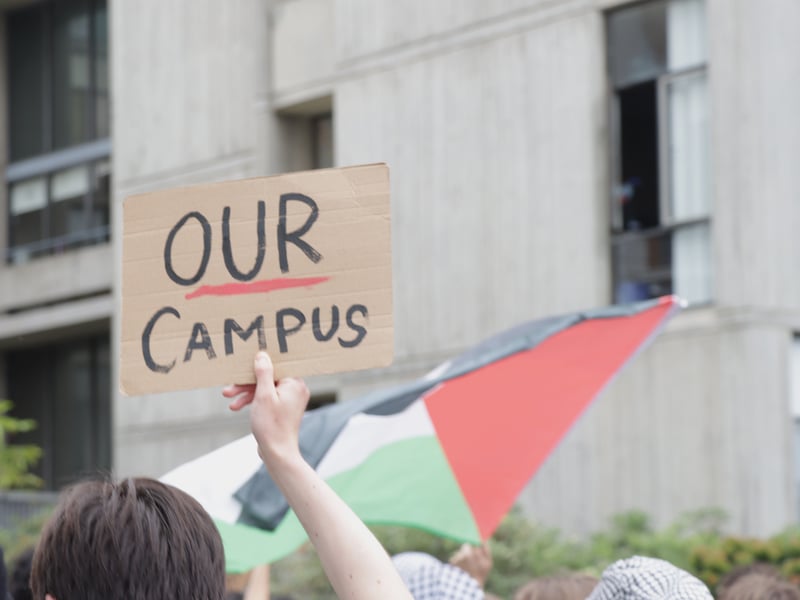
SAN DIEGO (CN) — Summer break for universities across the United States is coming up fast, with some schools having already glad-handed students and sent them on their way with empty diploma covers, but some students think protests against the Israel-Hamas war and their schools’ investments in Israeli companies may not end with the school year.
“At this university I think they have wrongly retaliated against students, faculty members and community members for participating in the encampment,” Hope, a University of California, San Diego student who declined to give a last name, said, referring to a student encampment dismantled by a coalition of riot gear-clad state and local law enforcement last week.
The raid led to arrests and law enforcement pushing and striking some students with batons as they tried to prevent a bus of arrested students from leaving campus — scenes reminiscent of responses to encampments on collegecampuses across the country.
Hope, a co-founder of UCSD’s Jewish Voice for Peace chapter and a designated media liaison for the UCSD protestors, joined a march of faculty members and students to the school’s chancellor’s house on Friday to reiterate their demands for divestment, and ask that the school not suspend students who were arrested.
Students cover their faces with masks or keffiyehs because they’re concerned their school will retaliate against them for organizing for Palestinian causes, she said.
“I don’t feel like the administration has been on their side whatsoever — has cared for their safety, for their lives, or lives in Gaza and also Palestine,” Hope said.
Courtrooms around the country are starting to litigate whether authorities discriminated against pro-Palestinian student protesters by cracking down on encampments and punishing them or if they discriminated against Jewish students by allowing protests against Israel and anti-Zionist rhetoric to cross into antisemitism.
On Thursday, a Rutgers University freshman named Rivka Schafer filed a lawsuit in New Jersey state court that claims the school fostered a hostile environment for Jewish students that culminated after the Oct. 7 Hamas-led attack on southern Israeli towns.
The school’s student body voted on a boycott, divestment, and sanctions initiative, allowed students to form a encampment, and looked the other way while Jewish students were harassed, they say in their complaint.
Schafer “was targeted by fellow students for being openly Jewish and supporting the only Jewish-nation, Israel,” they say.
Schafer, who uses they/them pronouns, claims that fellow students created a poster with a photograph of them with the phrases “free Palestine” and “vote ‘yes’ to divest’” around it and left the poster outside their door in order to intimidate Jewish students from voting against the boycott, divestment and sanction referendum.
Offensive speech isn’t necessarily wrongful conduct, said Cory Rothbort, Schafer’s attorney, but putting a student’s face on a poster and putting it next to their door constitutes “harassment, and bullying, and it’s a form of discrimination,” he said.
In November 2023, the Louis D. Brandeis Center for Human Rights Under Law filed a lawsuit against UC Berkeley for what it refers to as “long standing unchecked spread of antisemitism” on campus. Filed before the student encampments began, one of the main pieces of evidence in the suit is a decision by 23 Berkeley Law student organizations to ban Zionist speakers — which they claim not only discriminates against supporters of Israel, or supporters of Israel as a specifically Jewish state, but all Jewish students.
On May 3, the center amended their complaint to add claims of harassment and violence against Jewish and Israeli students.
“The complaint filed by the Brandeis Center paints a picture of the Law School that is stunningly inaccurate and that ignores the First Amendment," Erwin Chemerinsky, the dean of the university’s law school, said in response to the original complaint. “For example, student organizations have the First Amendment right to choose their speakers, including based on their viewpoint. Although there is much that the campus can and does do to create an inclusive learning environment, it cannot stop speech even if it is offensive.”
“And, beyond that, while most antisemitic expression is, whether we like it or not, protected by the First Amendment we know, that as a university, we must still respond if and when that expression rises to the level of individual harassment and/or discrimination,” Dan Mogulof, a spokesperson for the university, said, adding that students should report harassment to the school for investigation.
The discussion of whether anti-Zionism equates to antisemitism is hotly debated in the Jewish community.
“I felt the safest I’ve ever been around the encampment, and I think that speaks a lot. I’m a Jewish student, I’m a proud Jewish student, and I’m here with my Palestinian siblings,” Hope said about her experience at UCSD’s encampment, adding that people from all different backgrounds participated. She even organized a Jewish Shabbat service.
Attorney David Chami — representing Arizona State University students who were arrested in April at what they refer to as a “sit-in” on campus to protest the war and the university’s investment in companies that they say are profiting from it — noted that students arrested at the school were not homogeneous.
“This is not about discrimination based on them being Palestinian. The vast majority of my plaintiffs are non-Arab, non-Muslim people of conscience," he said. “These are just students opposed to providing weapons and funding for the ongoing Israeli assault. Students asking ‘why are our tax dollars, our tuition dollars making this genocide possible?’”
Those students, in their complaint filed in federal court in Arizona, claims that the school retaliated against student protesters on the basis of their protected free speech rights and deliberately targeted them while ignoring partying bystanders.
“I have zero doubt that the colleges’ — the university’s — actions violated the First Amendment. They were not viewpoint neutral restrictions on speech,” Chami said. The university deliberately tried to stifle students’ views solely because they think the university should make investments in more ethical businesses, he added.
Chami also said he’s willing to talk to and assist students in any part of the country who have similar grievances against their school, or help find competent counsel for them.
“Those who fail to learn the lessons from history are doomed to repeat them,” he said after going through a mental rolodex of student movements from anti-Vietnam War protests to Occupy Wall Street.
A spokesperson for Arizona State University declined to comment on the suit.
Representatives from Rutgers and UCSD did not immediately respond to requests for comment.
Subscribe to our free newsletters
Our weekly newsletter Closing Arguments offers the latest about ongoing trials, major litigation and rulings in courthouses around the U.S. and the world, while the monthly Under the Lights dishes the legal dirt from Hollywood, sports, Big Tech and the arts.