
 Search Articles


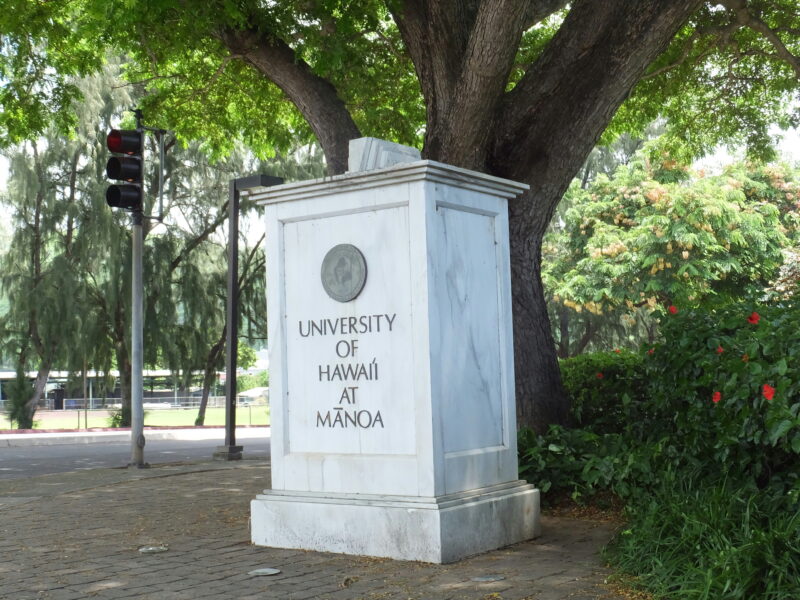
(CN) — It was February 2023, and Professor Kenneth Lawson had something to say.
A faculty meeting at the University of Hawaii’s William S. Richardson School of Law had just turned to a Black History Month event.
Lawson, who is Black, challenged Dean Camille Nelson, who is also Black, from the floor.
“When he began speaking, he asked the D.E.I. Committee why no Black people were on the panel or asked to facilitate the event. He explained that failing to include anyone of Black ancestry in the event was an example of unconscious racial bias,” Lawson wrote in a complaint filed in federal court.
He called the omission an example of “nice racism.” Days later, he followed up with an email through a university listserv calling for a boycott.
He says what followed consumed the next three years of his professional life.
The university launched a formal investigation, barred Lawson from the law school campus and restricted his use of law school listservs. It also ordered him not to contact Nelson and certain other faculty and staff.
A decision issued in December 2023 found Lawson had used language perceived as veiled threats and questioned Nelson’s “Black experience.” Nelson was born in Jamaica and went to school in Canada.
The university required him to complete mandatory training and serve a one-month suspension without pay.
Lawson sued in federal court in 2023, arguing the university violated his First Amendment rights by targeting him for criticizing the event and retaliating against him for protected speech.
On Tuesday, a federal judge ruled the three university officials he sued cannot be held personally liable.
U.S. District Judge Leslie Kobayashi granted summary judgment in favor of Nelson, UH Manoa Provost Michael Bruno, and Associate Dean Nicholas Mirkay on qualified immunity grounds, dismissing the claims against them as individuals in a 61-page order.
The ruling does not end the case. Lawson’s claims against the defendants in their official capacities are still pending.
Qualified immunity shields government officials from personal lawsuits unless they violated a clearly established constitutional right.
Lawson is co-director of the Hawaii Innocence Project and teaches criminal law, criminal procedure, evidence and professional responsibility at Richardson. He received the UH Board of Regents’ Excellence in Teaching Award in 2017 and frequently comments on high-profile Hawaii legal cases.
For the summary judgment motion, Lawson argued the court should assume he said everything the defendants attributed to him, including calling Nelson “not Black enough,” saying he was “not non-violent” and inviting a colleague to “come at me,” and still find the speech constitutionally protected.
Kobayashi accepted that framing but disagreed with the legal conclusion. She found the “not Black enough” remark about Nelson was a personal attack unrelated to the public concern at the heart of the faculty meeting and therefore not protected by the First Amendment.
“Even assuming that Lawson’s ’not Black enough’ comment was a reference to Nelson’s area of scholarship, this remark was a personal attack and not relevant to the issue of whether the event was an appropriate WSRSL function,” Kobayashi wrote.
With at least one of Lawson’s statements found to be unprotected speech, Kobayashi turned to qualified immunity. She concluded none of the three defendants had fair notice that their actions would violate Lawson’s rights.
As to Nelson and Mirkay, both of whom said their roles were limited to filing complaints and cooperating as witnesses, Kobayashi found it was not clearly established that filing a complaint, even one that triggers an investigation, can itself constitute a First Amendment violation.
“Lawson did not have a clearly established right to be free from an internal complaint and from witness cooperation in an investigation where the complaint and the investigation were based upon unprotected conduct or speech that occurred contemporaneously with protected speech,” Kobayashi wrote.
Her analysis of Bruno was more detailed. Unlike Nelson and Mirkay, Kobayashi found Bruno must be treated as at least one of the decisionmakers in the process. He launched the investigation, imposed interim restrictions, appointed the fact-finders and ultimately decided what corrective action to take.
Still, the judge concluded there was no clearly established law that would have put Bruno on notice that initiating a disciplinary process over unprotected conduct occurring alongside protected speech would violate the professor’s rights.
Kobayashi also rejected Lawson’s due process arguments. Among them was his claim that the investigation notices sent by Bruno were flawed because they never explicitly accused him of calling Nelson “not Black enough.”
The judge found the letters referred to the broader claim that Lawson had “questioned Dean Nelson’s ‘Black experience’ as someone not raised in the United States,” which she said arguably encompassed the more specific remark. She also found no clearly established law required greater precision.
Lawson represented himself in the case. Neither Lawson nor representatives for the University of Hawaii immediately responded to requests for comment.
 Follow @JeremyYurow
Subscribe to our free newsletters
Our weekly newsletter Closing Arguments offers the latest about ongoing trials, major litigation and rulings in courthouses around the U.S. and the world, while the monthly Under the Lights dishes the legal dirt from Hollywood, sports, Big Tech and the arts.
Additional Reads
 Political discrimination in Puerto Rico? July 1, 2026
 ICE must release Pakistani detainee July 1, 2026