
 Search Articles


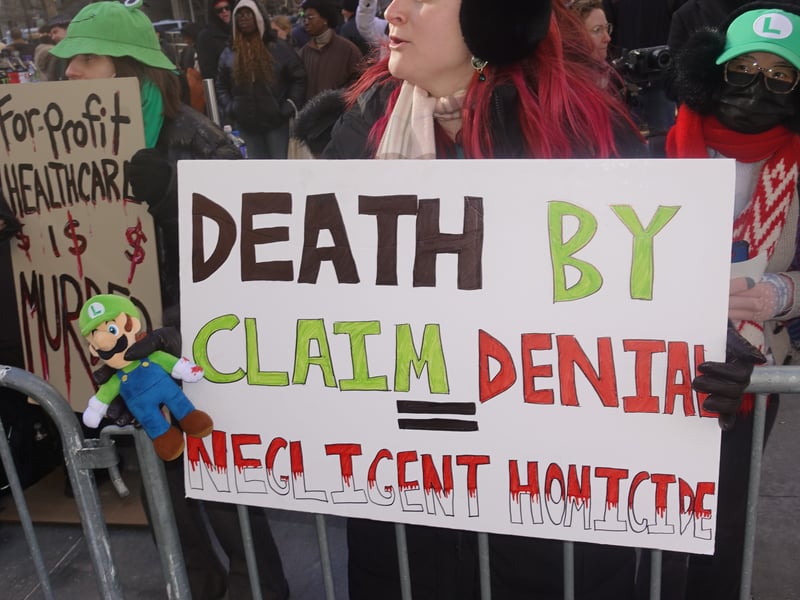
MANHATTAN (CN) — Shareholders sued health insurance giant UnitedHealth Wednesday, claiming the company misled them by not adjusting financial projections to account for change to its corporate practices following the high profile killing of top executive Brian Thompson last December.
The changes came in response to regulatory scrutiny and public outrage over high rates of claim denials after Thompson, chief executive officer of UnitedHealthcare, was fatally gunned down on a Midtown Manhattan sidewalk outside of the hotel where the company was holding its annual investor conference.
In a proposed class action filed Wednesday in the Southern District of New York federal court, investors claim UnitedHealth defrauded them after Thompson’s murder by pivoting away from profit-boosting strategies that led to higher-than-average claims denials, without disclosing the impact on profitability to shareholders.
“Specifically, defendants made false and/or misleading statements and/or failed to disclose that: UnitedHealth had, for years, engaged in a corporate strategy of denying health coverage in order to boost its profits, and ultimately, its share price; this anti-consumer (and at times unlawful) strategy resulted in regulatory scrutiny (as well as public angst) against UnitedHealth, which ultimately resulted in the murder of Brian Thompson,” the shareholders write in the complaint.
Represented by global investor rights law firm Rosen Law, the investors also name Chief Executive Andrew Witty and Chief Financial Officer John Rex as co-defendants in the complaint.
The investors seek unspecified damages for UnitedHealth shareholders from between December 3, 2024 and April 16, 2025, one day before UnitedHealth shares fell 22.4% to close at $454.11 per share on April 17, 2025., wiping out about $119 billion of market value.
Citing higher costs in its Medicare business, UnitedHealth cut its 2025 forecast for adjusted profit per share to between $26 and $26.50 from between $29.50 and $30.
“Had plaintiff and the other members of the class been aware that the market price of UnitedHealth’s securities had been artificially and falsely inflated by defendants’ misleading statements and by the material adverse information which defendants did not disclose, they would not have purchased UnitedHealth’s securities at the artificially inflated prices that they did, or at all,” the investors write.
The shareholders also note the U.S. Senate highlighted denials of coverage by UnitedHealth in the weeks prior to Thompson’s death. On October 17, 2024, the Senate Permanent Subcommittee on Investigations published a report entitled “Refusal of Recovery: How Medicare Advantage Insurers Have Denied Patients Access to Post-Acute Care.”
Representatives for UnitedHealthcare did not immediately respond to requests for comment on Wednesday afternoon.
A 27-year-old Maryland man, Luigi Mangione, has been charged in both New York state and federal courts in connection to Thompson’s murder.
Mangione has pleaded not guilty in both cases.
The death penalty is illegal in New York State, meaning that Mangione is up for a maximum of life in prison in that state case, while he faces a death penalty-eligible count in the federal case.
Some corners of the internet have hailed Mangione as a folk hero for his apparent motivations behind the killing. Mangione’s online footprint showed disdain for the for-profit health care industry.
Police also discovered the words “deny,” “defend” and “depose” printed on shell casings near the site of the shooting, seemingly a reference to a rallying cry for detractors of the industry — “delay, deny, defend” — which refers to insurers delaying payment on claims, denying claims and then defending their actions in court.
A trial date has not yet been set in either case.
 Follow @jruss_jruss
Subscribe to our free newsletters
Our weekly newsletter Closing Arguments offers the latest about ongoing trials, major litigation and rulings in courthouses around the U.S. and the world, while the monthly Under the Lights dishes the legal dirt from Hollywood, sports, Big Tech and the arts.