
 Search Articles


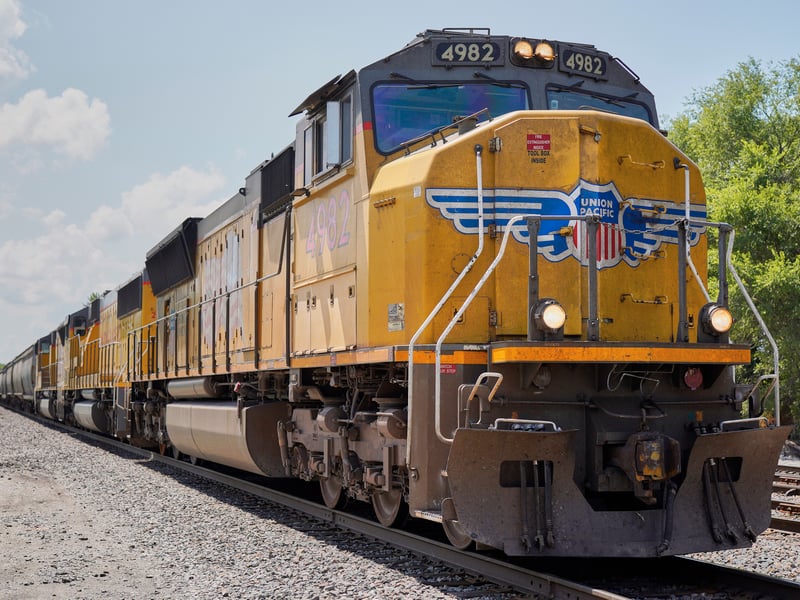
CHICAGO (CN) — Railroad giant Union Pacific filed a federal lawsuit against the Chicago suburb of River Forest on Thursday, objecting to several dozen noise complaints it has received from the town since the end of 2023.
River Forest filed 84 noise citations against Union Pacific between last December and August, according to a letter the town’s attorneys sent the railroad company in early August. River Forest blames Union Pacific’s train engines, which often idle on tracks running through it, as the source of the excessive noise.
“The Village has received numerous complaints regarding ongoing Village Code violations stemming from Union Pacific Railroad train engines located within the Village,” attorney Troy Wallace of the Chicago law firm Klein, Thorpe & Jenkins told Union Pacific in the letter.
River Forest charges noise violators between $50 and $750 per offense. Wallace told Union Pacific it will be seeking the maximum fine for each of the 84 citations.
The company, which reported a net income of $1.7 billion in the second quarter of 2024, estimates that paying for those and other noise complaints from the city would cost it about $65,000.
“That is improper,” the company wrote in its complaint. “Federal law leaves no room for River Forest to second-guess Union Pacific’s operational decisions, including whether and why a locomotive needs to idle at a given time.”
Union Pacific doesn’t deny that its locomotives idle in River Forest while en route to a freight terminal located west of the village. Still, it argues River Forest’s noise complaints are preempted by the federal Interstate Commerce Commission Termination Act of 1995.
That act establishes broad federal jurisdiction over interstate freight transport regulations. Union Pacific claims it overrules River Forest’s ability to levy its noise fines.
“In particular, ICCTA expressly or ‘categorically’ preempts ‘all state laws that may reasonably be said to have the effect of managing or governing rail transportation’ as defined in the statute,” Union Pacific argued. “It also impliedly preempts any state law or action that ‘would have the effect of preventing or unreasonably interfering with railroad transportation. Both forms of preemption apply here.”
Ron Kaminkow, a trustee on the international steering committee of the railworkers’ labor organization Railroad Workers United, said this political argument was the real motivation behind Union Pacific’s lawsuit.
“It’s peanuts. It’s chump change,” Kaminkow said of the $65,000 Union Pacific wanted to avoid paying. “It’s a political question. They don’t want any municipality or state to think they have any power to regulate how trains run.”
Union Pacific claims it has attempted to work with local authorities to minimize the impact of its idling engines. But it says that heavy traffic into the nearby freight terminal, and having to give way to commuter trains, make some idling inevitable.
The railroad company further argues that shutting off the train engines while they wait on the River Forest tracks is infeasable.
“In high or low outdoor temperatures, idling the locomotive is necessary to maintain a safe on-board temperature for the crew,” the company said. “In very low outdoor temperatures, idling is also necessary to prevent the engine itself from freezing up. Beyond that, a railroad locomotive is a substantial and complex machine that cannot be shut down and restarted on a dime.”
Kaminkow, who worked on trains for years, challenged this assertion. He granted that train engines do need to be running to keep heat or air conditioning on in extreme temperatures, but said trains that are left idling for long periods often have little to no crew working on them anyway.
“If the locomotives are sitting there and it’s ten degrees outside, yeah, you need the engine running to create heat,” Kaminkow said. “But what often happens is those trains are left there idling unmanned, so there’s no crew there to keep hot or cold.”
Kaminkow further accused the rail company of “doing goofy shit” in pursuit of profits — like running excessively long trains — that aggravates issues around train idling issues.
“Running trains three miles long, blocking roads… there are few appropriate places to leave trains,” Kaminkow said.
“It’s really frustrating for people that work on the railroads, who live next to the tracks,” he added.
Union Pacific nevertheless seeks a declaration from federal court that would bar River Forest from collecting on its noise citations, as well as an injunction barring the village from preventing Union Pacific trains from idling in town.
Besides the village itself, Union Pacific names River Forest Village President Cathy Adduci and Police Chief Jim O’Shea as defendants. Neither the village administration nor O’Shea’s office responded to a request for comment on the lawsuit.
The Chicago area is America’s busiest railroad hub, with commuter and freight trains sharing hundreds of miles of tracks.
The tracks are split between multiple private and public owners, further complicating practical and legal issues arising from rail operation. U.S. District Judge Jorge Alonso, a Barack Obama appointee, gave Union Pacific the green light to cut services on three of the area’s busiest commuter lines in September 2021, a decision the Seventh Circuit Court of Appeals affirmed in August 2023.
 Follow @djbyrnes1
Subscribe to our free newsletters
Our weekly newsletter Closing Arguments offers the latest about ongoing trials, major litigation and rulings in courthouses around the U.S. and the world, while the monthly Under the Lights dishes the legal dirt from Hollywood, sports, Big Tech and the arts.