
 Search Articles


(CN) — Countries around the world are inadequately addressing greenhouse gas emissions, leaving the planet more at risk of deadly hurricanes, droughts, heatwaves and rainstorms, according to a United Nation’s report released last month. But a new study suggests emissions of methane gas can be reduced by attaching special cleaning boxes to ventilation systems in barns and biogas and wastewater treatment plants.
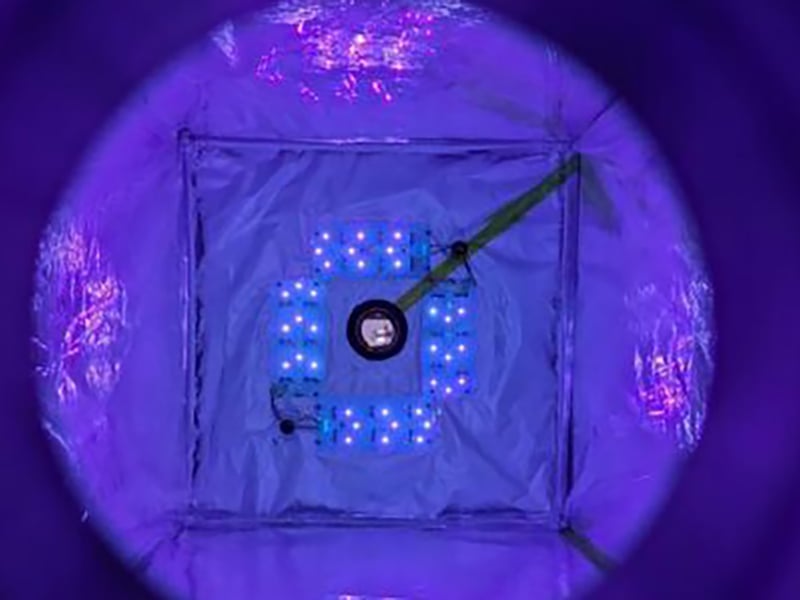
The study published in the journal Environmental Research Letters on Monday describes a group of researchers from the University of Copenhagen in Denmark’s conception and construction of a reaction chamber with chlorine molecules and an ultraviolet light in it.
Once methane gas enters the chamber, the light causes the molecules to split. The chlorine atoms then take a hydrogen atom from the methane, which causes the methane to fall apart and decompress. The byproduct of the chlorine is recycled, while the decompressed methane turns into carbon dioxide, carbon monoxide and hydrogen.
Methane is a greenhouse gas that’s emitted from natural things like wetlands, but also from human-created sources, like food production, especially cattle, pig, and other livestock farming operations, natural gas, and sewage treatment plants. More than half of emissions of methane gas are caused by byproducts of human activity. Agriculture alone accounts for approximately 40% of methane emissions.
Dubbed the Methane Eradication Photochemical System, the researcher’s chamber is able to degrade methane emissions 100 million times faster than nature does on its own. That’s a significant deal when taking into account that methane is 85 times more potent of a greenhouse gas than carbon dioxide.
“In the scientific study, we’ve proven that our reaction chamber can eliminate 58% of methane from air. And, since submitting the study, we have improved our results in the laboratory so that the reaction chamber is now at 88%,” lead author Matthew Stanley Johnson, an atmospheric chemistry professor at the University of Copenhagen, said in a press release that accompanied the study.
Higher concentrations of methane can be burned off from the air, but most human-caused emissions are below the threshold of concentration at which such burning is possible. Johnson and his team’s chamber is the first device and process that can remove lower concentrations of methane from the air.
According to the U.N.’s Intergovernmental Panel on Climate Change, methane alone is responsible for a 0.6 degrees Celsius increase in global average surface air temperature.
“We are well on our way towards breaking the 1.5 degree Celsius limit stated in the Paris Agreement. They say we have even already exceeded that limit, globally, for shorter periods." Johnson wrote in an email. “Methane may be our last best hope to avoid crossing important climate tipping points. Methane stays in the atmosphere for a decade, much shorter than carbon dioxide, so if we can stop its sources, it can be washed out of the atmosphere in the near term. This means eliminating methane at its sources. Fixing leaks should always be done, but there are a lot of methane emissions that can’t be stopped by plugging a leak, such as cow burps and biomass storage and wastewater treatment and garbage dumps. They are diffuse, low concentration sources. That’s where we come in.”
As a part of their research for the study, Johnson and his peers traveled around Denmark measuring methane leaks from cattle farms, wastewater treatment plants, and biogas plants, where they found that a significant amount of methane leaks into the atmosphere from those industries.
The researchers now hope to build a larger prototype of the device that they intend to install on ventilation systems on a dairy farm and a biogas plant to capture escaping methane.
“Today’s livestock farms are high-tech facilities where ammonia is already removed from air. As such, removing methane through existing air purification systems is an obvious solution,” Johnson wrote.
Subscribe to our free newsletters
Our weekly newsletter Closing Arguments offers the latest about ongoing trials, major litigation and rulings in courthouses around the U.S. and the world, while the monthly Under the Lights dishes the legal dirt from Hollywood, sports, Big Tech and the arts.