
 Search Articles


MANCHESTER, England (CN) — Britain will send extra troops and air defense systems to the Middle East to help protect Cyprus and Gulf allies from Iranian attacks as the government prepares to host dozens of countries this week to address the reopening of the Strait of Hormuz.
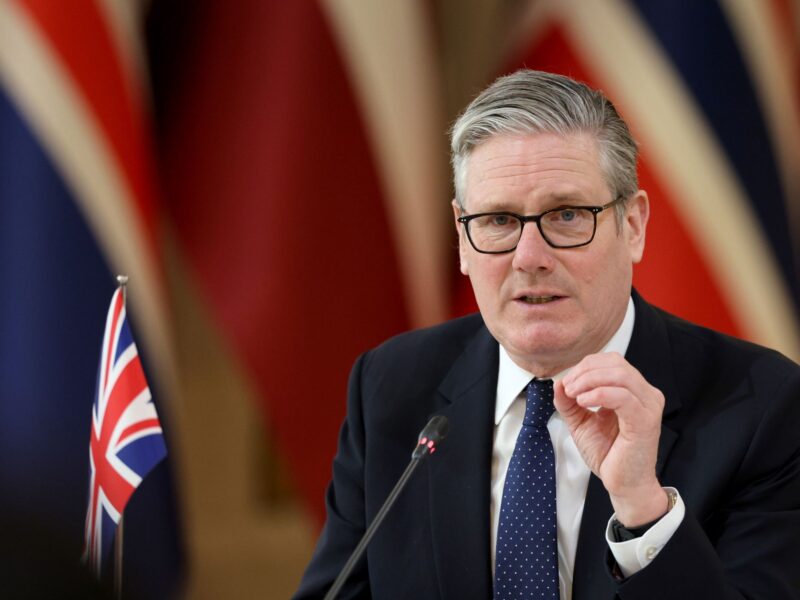
In a press conference on Wednesday morning, Prime Minister Keir Starmer announced Foreign Secretary Yvette Cooper will host a summit of international leaders to discuss plans to restore freedom of navigation in the Strait of Hormuz, a vital oil route Iran has effectively blocked after Israeli-U.S. strikes on its territory sent global energy prices soaring.
The deployment of British troops, announced yesterday during a visit to Gulf states by Defense Secretary John Healey, includes additional air defense teams and systems for Saudi Arabia, Bahrain and Kuwait.
Britain will also extend the deployment of Royal Air Force Typhoon jets based in Qatar.
Around 1,000 British military personnel are now involved in defending the Gulf and Cyprus — a former British colony where the U.K. still operates two military bases it kept after the island gained independence in 1960.
During his visit, Healey said: “My message to Gulf partners is: Britain’s best will help you defend your skies.”
The moves underline Britain’s careful stance on the U.S.-Israel war with Iran, an approach President Donald Trump has continually criticized, urging allies to take a more aggressive role.
Starmer said Monday the U.K. will not deploy ground troops in Iran. “This is not our war and we’re not going to get drawn into it,” the prime minister said.
Still, the government has allowed the U.S. to use British bases for what officials describe as defensive strikes on Iranian missile sites, after earlier denying access for the initial U.S.-Israeli attacks.
Trump rails against allies
On Tuesday, Trump singled out the U.K. in a Truth Social post, telling countries struggling with fuel shortages tied to the Strait of Hormuz disruption to “get your own oil” and said they would have to start learning to fight for themselves.
The U.K. is especially sensitive to price spikes because it imports a significant portion of its energy, making fuel costs a political issue tied to the cost of living.
Starmer framed the summit later this week partly in those terms.
“The most effective way we can support the cost of living in Britain is to push for deescalation in the Middle East, and a reopening of the strait of Hormuz, which is such a vital route for energy,” he said.
The deployments come as other European and NATO allies show growing resistance to Washington’s approach.
Italy said Tuesday it refused U.S. aircraft use of a base in Sicily, while Spain earlier closed its airspace to U.S. planes involved in attacks on Iran.
Spanish Prime Minister Pedro Sanchez has been among the most outspoken critics of the strikes.
Trump has voiced frustration with European and NATO allies in not providing support for the attacks.
Farage flip-flops
At home, the debate has shifted as the crisis deepened.
Conservative leader Kemi Badenoch initially criticized Starmer in early March for refusing to support Trump in the initial strikes against Iran after attacks on British facilities in Cyprus.
On March 4, Badenoch said in Parliament: “We are in this war whether they like it or not. What is the prime minister waiting for?”
She later said supporting allied strikes did not mean Britain should formally join the war.
Leader of Reform UK, Nigel Farage, also urged the government to back the U.S. early in the conflict. “The prime minister needs to change his mind on the use of our military bases and back the Americans in this vital fight against Iran,” he said.
However, on March 10, he declared that the U.K. should back off, stating: “If we can’t even defend Cyprus, let’s not get ourselves involved in another foreign war.”
Pressure has also come from Cyprus after a drone struck a British military base on the island.
Kyriacos Kouros, Cyprus’ high commissioner to the U.K., said residents expected a stronger British presence after attacks in the region.
“The people are disappointed, people are scared,” Kouros said following the drone attack on the island. “The least we expect is the Britons to also be present since, as I said, we are not only defending Cypriots on the island.”
For now, the U.K. is trying to balance defensive military support with diplomacy, bolstering air defenses across the Middle East while gathering allies in London later this week to reopen one of the world’s most important oil chokepoints.
Courthouse News reporter James Francis Whitehead is based in England.
 Follow @jayfranklinlive
Subscribe to our free newsletters
Our weekly newsletter Closing Arguments offers the latest about ongoing trials, major litigation and rulings in courthouses around the U.S. and the world, while the monthly Under the Lights dishes the legal dirt from Hollywood, sports, Big Tech and the arts.
Additional Reads
 Greece train crash trial resumes after courtroom chaos April 1, 2026
 Judge blocks Trump thump of NPR, PBS funding March 31, 2026