Search Articles


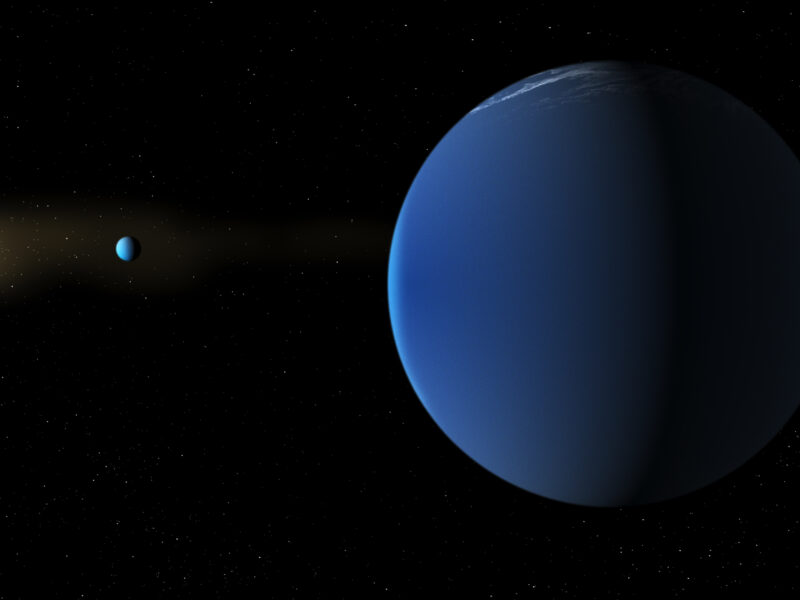
(CN) — Two giant planets discovered around a distant star are so light and fluffy that their densities are lower than cotton candy.
The newfound worlds, each roughly the size of Jupiter, rank among the least dense planets ever discovered. Researchers say the unusual pair could help explain how a rare class of planets known as “super-puffs” form and evolve.
The findings were published Wednesday in the journal Monthly Notices of the Royal Astronomical Society.
Named TOI-791 b and TOI-791 c, the planets orbit a star about 1,110 light-years from Earth in the southern constellation Volans.
Although both worlds are nearly as large as Jupiter, they contain far less material packed into their enormous volumes. TOI-791 b has a density of just 0.038 grams per cubic centimeter, while TOI-791 c has a density of 0.047 grams per cubic centimeter.
Both are less dense than cotton candy, which typically has a density of about 0.05 grams per cubic centimeter, and roughly 30 times less dense than Jupiter.
Only a handful of super-puff planets have been identified, and systems containing more than one are especially rare.
Researchers say just four other known planetary systems contain multiple super-puffs, making TOI-791 an unusual opportunity to study how the worlds develop.
“Only a handful of these super-puffy planets are known, and it is even rarer to find two in the same system,” lead author George Dransfield of the University of Oxford, said in a statement. “Their extremely low densities make them fascinating targets for understanding how planetary systems form and evolve.”
The planets are believed to have formed together from the same disk of gas and dust surrounding their young star. They also orbit in a rare gravitational arrangement known as a 5:3 resonance. For every five orbits completed by the inner planet, the outer world completes almost exactly three.
That relationship causes the planets to repeatedly tug on one another, creating small shifts in the timing of their transits across the star.
The planets were first flagged by volunteers participating in the Planet Hunters TESS citizen-science project, which searches observations from NASA’s Transiting Exoplanet Survey Satellite for signs of previously unknown worlds.
Researchers later combined observations from telescopes around the world to determine the planets’ sizes and masses.
When a planet passes in front of its star, it blocks a small fraction of the starlight, allowing astronomers to estimate its size. In the TOI-791 system, scientists also detected subtle variations in the timing of those transits caused by the planets’ gravitational interactions. By combining those measurements, they were able to calculate the planets’ remarkably low densities.
The discovery relied on eight years of observations, including data collected by the Antarctic Search for Transiting ExoPlanets, or ASTEP, telescope at Concordia Station in Antarctica.
Researchers said Antarctica’s monthslong winter darkness allowed them to observe the planets’ unusually long transits in a single uninterrupted session. Each transit lasted more than 11 hours, making them the longest continuous planetary transits ever observed in their entirety from the ground.
Exactly how super-puff planets form remains unclear. One leading explanation is that they are surrounded by enormous atmospheres rich in hydrogen and helium, making them far larger and fluffier than typical planets.
Researchers hope future observations with the James Webb Space Telescope will help determine what those atmospheres contain and reveal more about how the unusual worlds formed.
“This system offers a unique laboratory for understanding how super-puff planets form and evolve,” Amaury Triaud of the University of Birmingham, also said in the statement. “We propose to carry out space-based observations using the James Webb Space Telescope to assess if the puffy atmosphere contains carbon-, nitrogen-, and oxygen-bearing species, revealing new insight into how these unusual planets formed.”
Subscribe to our free newsletters
Our weekly newsletter Closing Arguments offers the latest about ongoing trials, major litigation and rulings in courthouses around the U.S. and the world, while the monthly Under the Lights dishes the legal dirt from Hollywood, sports, Big Tech and the arts.