
 Search Articles


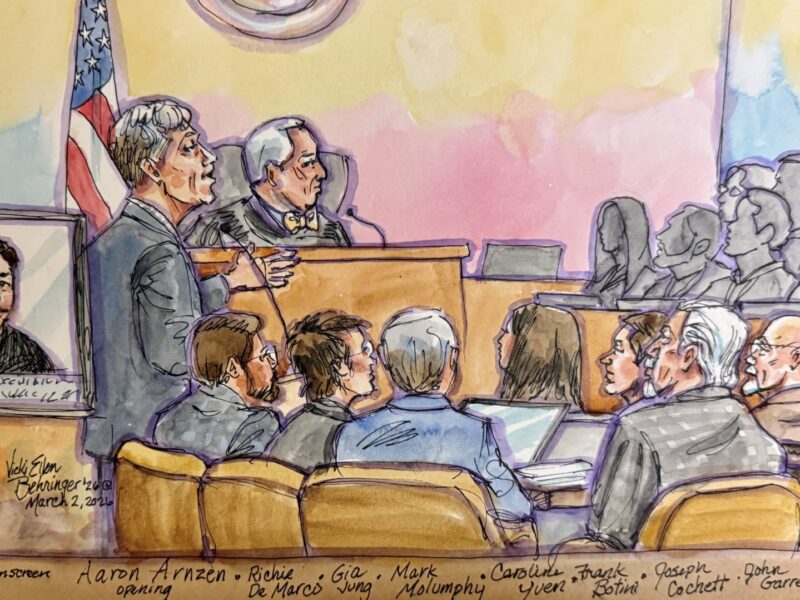
SAN FRANCISCO (CN) — A federal jury in San Francisco heard opening arguments Monday in a trial centered on Elon Musk’s $44 billion buyout of Twitter in 2022.
Investors, including lead plaintiffs Steve Garrett, Nancy Price, John Garrett and Brian Belgrave, accuse Musk of deliberately making misleading statements about the presence of spam bot accounts on Twitter to drive down the company’s stock, in hopes of backing out of the acquisition deal or renegotiating more favorably for himself.
“We are here today because Elon Musk cheated investors to save himself billions of dollars,” Plaintiffs’ attorney Aaron P. Arnzen of Bottini & Bottini told the eight-person jury.
“Musk believes he can say or do whatever he wants anytime he wants, regardless of the consequences, because the law does not make an exception for those with power or influence,” he added. “It took years to present this case to you and hold Musk accountable.”
The investors claim Musk attempted to artificially lower Twitter’s stock price after agreeing to acquire the platform in April 2022, while also failing to disclose when his Twitter stake exceeded 5% or that he had initially been invited to join Twitter’s board.
Twitter ultimately sold to Musk for $54.20 per share, only closing after the company sued Musk to force the deal to go through, while he accused the platform of hiding information about fake accounts.
Arzen spent the majority of his opening statement laying out a detailed timeline of Musk’s acquisition of Twitter, telling the jury the case is “incredibly straightforward” once they understood the background of the purchase.
“Keep your eyes on Musk, what he was doing, what he was saying,” he said.
The plaintiffs argue Musk rushed through the deal-making process, skipping traditional steps intended to give buyers more information on a company, as well as presenting a “seller-friendly” agreement, Arzen explained as “deal certainty.”
Plaintiffs claim Musk began to second-guess the deal shortly after signing on the dotted line because of issues he ran into selling shares of Tesla stock to pay for the Twitter acquisition. As Musk sold more shares, the price tanked, leading Musk to have to sell even more in order to buy the company, Arzen said.
He added that to get out of the deal, Musk decided to focus on his concerns over fake, or bot, accounts on Twitter and mount “a public spectacle to trash the company and drive stock price down,” making a series of false or misleading comments about Twitter’s bot counts to hurt the company’s stock price.
The statements at issue include a tweet from May 13, 2022, where Musk said the Twitter deal was on hold, “pending details supporting calculation that spam/fake accounts do indeed represent less than 5% of users.” A couple hours later, Musk followed up with another tweet saying he was “still committed to acquisition.”
Arzen described the effect of the initial tweet as “immediate and catastrophic,” adding Twitter stock declined over 9% on the day of the tweet.
“He tweeted to tens of millions of followers, why? That is how you pound down the stock price and pressure Twitter to negotiate,” Arzen said. “He knew that this tweet was so bad, so damaging, he had to walk it back.”
In addition to the tweets, Musk said in a May 16 comment at a conference that fake and spam accounts made up at least 20% of Twitter users at the time, and tweeting a poop emoji when then Twitter CEO Parag Agrawal commented there was no way for external parties to calculate this information. Musk tweeted the next day the deal would not be moving forward until Agrawal provided evidence of bot numbers under 5%.
Arzen told the jury Musk’s statements doubting the estimated percentage of bots on Twitter were “deeply misleading” and there was no basis for the number to be below 5%. He added that despite what Musk was representing to the public, the acquisition deal was not on hold, and Musk didn’t have a right to pause the deal due to the fast-tracked nature of the agreement.
“Now that you have a background, you can understand the scheme. Trash Twitter with his personal megaphone, punish the stock and renegotiate. That explains everything that happened after May 13,” Arzen said.
In response to plaintiffs’ accusations Musk lied in his tweets to artificially deflate Twitter’s share price, Michael T. Lifrak of Quinn Emanuel Urquhart & Sullivan, an attorney for Elon Musk, said all the statements plaintiffs claim to be false are, in fact, true.
He further claimed Musk did not want to harm Twitter or its shareholders, describing Musk’s attempts to get the truth about the number of fake accounts on the platform as a “legitimate effort.”
“As we go through the evidence, ask yourself, what Mr. Musk was doing, what is real, or was it fraud?” he told the jury. “This story has a lot to do with bots. Mr. Musk used Twitter since the beginning. He had spoken out about bots for years. It made Twitter worse for everyone who used it. His concern about bots was real, not fraud.”
Lifrak said Twitter told Musk they calculated the 5% bot number by having human reviewers analyze 100 accounts a day to determine whether or not they were bots, a process he said Musk was “stunned” by.
When Musk tried to get more information about the review process, Lifrak said Twitter stalled or refused to answer, describing their behavior as a “red flag” for Musk.
He additionally explained to the jury Musk’s May 13 tweets were a way to give all shareholders and the public “all the information they needed.” Lifrak further said Musk’s tweets in the days after sought to crowd-source information about Twitter’s bot counts and maintain transparency over what was happening.
“Musk’s concern about bots is longstanding and real. Musk’s quest for information about 5% is real. Twitter promising information he asked for and not giving it to him is real. Musk delaying closing until he got that information; that is real. His belief that bots could be 20% or more is evidence to show that this is all real, and not a fraud,” Lifrak said.
Lifrak also teased Musk’s in-person testimony in the trial, telling the jury he will “take the stand like any other witness, he will look you in the eye and tell you that this was no scheme to lower Twitter stock price to try to get a better deal in the transaction price.”
Following opening arguments, Brian Belgrave, one of the named plaintiffs in the case, testified, telling the jury he joined the lawsuit against Musk because he “felt that I got cheated, lied to, and I lost a lot of money.”
Belgrave bought 15,000 shares of Twitter stock between May and June 2022. He said he anticipated selling the stock once Musk’s acquisition deal went through at the price of $54.20 a piece. However, Belgrave said he sold his shares in July 2022 for around $33 after Musk indicated he was no longer going through with his purchase of Twitter.
“Six weeks later, he bought the company and I thought that I got screwed,” Begrave testified. “These are two opposite things. I got lied to, felt like I got cheated, that I could not turn in my shares for $54 instead of $33.”
On cross-examination, Stephen Broome of Quinn Emanuel Urquhart & Sullivan, an attorney for Musk, unsuccessfully attempted to have Belgrave impeached twice based on inconsistencies in notes Belgrave wrote when he first bought Twitter stock on May 13.
Plaintiffs also called Vijaya Gadde, Twitter’s former chief legal officer, to testify. Her testimony will continue Tuesday.
Musk is expected to take the stand on Wednesday.
U.S. District Judge Charles R. Breyer, a Bill Clinton appointee, is presiding over the trial. It is scheduled to continue through March 16.
 Follow @mhattridge_
Subscribe to our free newsletters
Our weekly newsletter Closing Arguments offers the latest about ongoing trials, major litigation and rulings in courthouses around the U.S. and the world, while the monthly Under the Lights dishes the legal dirt from Hollywood, sports, Big Tech and the arts.