
 Search Articles


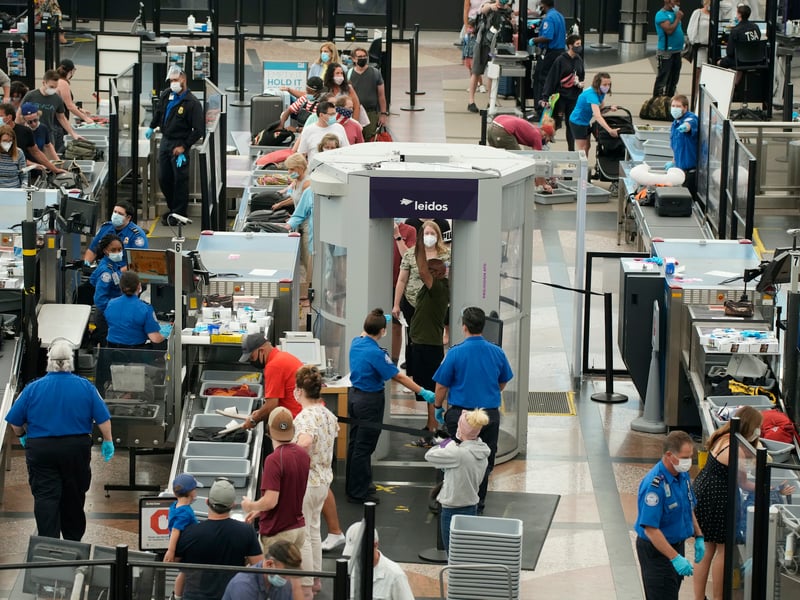
SEATTLE (CN) — The union representing tens of thousands of airport security workers asked a federal judge on Tuesday to stop the Trump administration from again trying to cancel a collective bargaining agreement after the court blocked a previous effort.
“Forcing parties to seek new injunctions anytime there’s a new rationale or decision document implementing the same policy would allow the irreparable harm to occur that the [preliminary injunction] is designed to prevent,” Alex Rowell, attorney for the American Federation of Government Employees, AFL-CIO, argued.
In March, the union sued the Department of Homeland Security and the Transportation Security Administration in March after Homeland Security Secretary Kristi Noem announced the end of the collective bargaining agreement with thousands of employees.
The collective bargaining agreement was signed in May 2024 and set to run through 2031. It provided workplace protections, grievance procedures and union representation for the officers, who historically receive lower pay and fewer protections than other federal employees.
U.S. District Judge Marsha Pechman, a Bill Clinton appointee, issued a preliminary injunction in June, blocking the government from ending the labor agreement covering around 47,000 TSA officers.
Noem framed the agreement as one that only benefited the union and harmed the security officers and the agency.
Despite an injunction requiring the Trump administration to preserve the collective bargaining agreement, the TSA informed the union in December that Noem had signed a memorandum in September terminating the collective bargaining agreement as of Jan. 18.
On Tuesday, less than a week before the implementation date of Noem’s memorandum, the union implored the court to enforce the preliminary injunction.
“We think the enforcement is not a close call,” Rowell argued, explaining that Noem’s second cancellation order largely mirrors the first. “Defendants admit it comes to the same conclusions, directs the same outcomes as the initial February determination.”
U.S. District Judge Jamal Whitehead, a Joe Biden appointee who took over the case from Pechman in October, questioned whether the court would have to modify the preliminary injunction order at all, but the union argued that it only needed to enforce it.
“Today, the motion before you is as simple ask from us, that we confirm the injunction means what it says and that because it says defendants can’t deny plaintiffs and their members … their rights under the [collective bargaining agreement],” Rowell said.
But the federal government sees the situation differently. Brian Kipnis with the U.S. Attorney’s Office argued that Noem’s second cancellation order was based on different information than the previous one and that the agency should retain its discretion to make new decisions. Additionally, since the second memorandum constitutes a new decision, the government argued that it is not bound by the preliminary injunction.
“The agency is charged with doing its job, it’s a dynamic process, the courts are there to check it and then basically release the agency to do what the agency does,” Kipnis said.
Whitehead seemed skeptical of this argument and questioned Kipnis about the timing of Noem’s second order. Noem signed the second cancellation memorandum on Sept. 29 — two days before the federal government shut down for over a month — and only disclosed it to the union and workforce on Dec. 12.
“We’ve got a workforce working without pay, and then unbeknownst to them, there’s this determination made cancelling the [collective bargaining agreement], and then they’re not told about it until mid-December,” Whitehead remarked. “How can I credit that as good faith?”
Kipnis posited that the government shutdown delayed normal operations, which could be one reason for the delay in announcing the memorandum.
The union pushed back on the federal government’s argument, noting that the implications of the logic are troubling and suggest that the agency could circumvent court orders by releasing new, identical decisions each time one is blocked.
“We don’t want to be in a ‘Groundhog Day’ situation where after getting our second preliminary injunction saying the same thing, all of a sudden the January determination comes in, and we’re right back in front of you asking for a new preliminary injunction,” Rowell said.
Also pending before the court is the government’s motion to dissolve the preliminary injunction and dismiss the union’s complaint; however, Whitehead declined to hear argument on those motions on Tuesday.
Whitehead said he intends to have a decision before the end of the week.
Subscribe to our free newsletters
Our weekly newsletter Closing Arguments offers the latest about ongoing trials, major litigation and rulings in courthouses around the U.S. and the world, while the monthly Under the Lights dishes the legal dirt from Hollywood, sports, Big Tech and the arts.