
 Search Articles


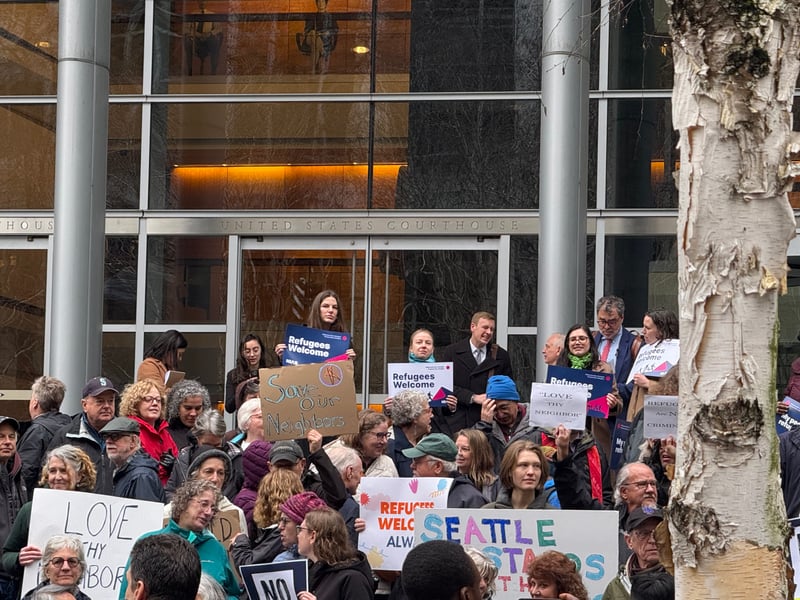
(CN) — President Donald Trump acted within his authority when he gutted the refugee admissions program hours after taking office last year, the Ninth Circuit ruled on Thursday.
“We recognize the enormous practical implications of this decision,” wrote U.S. Circuit Judge Jay Bybee, a George W. Bush appointee, noting there are over 100,000 vetted refugees who have spent years preparing for admission to the United States, who have been turned away at the last second.
“But such a result is one potential consequence of Congress’ sweeping grant of power to the president to ‘suspend the entry of all aliens or any class of aliens,’” Bybee wrote. “Whether that consequence reflects prudent policy is not a question for this court.”
The ruling is the latest turn in a winding case brought by refugees, sponsors and nonprofits seeking to preserve the U.S. Refugee Admissions Program and a decision that disappointed the plaintiffs.
“The impact of the decision to uphold the ban on refugee processing and admissions on the hundreds of thousands of refugees who were promised safety in the United States cannot be overstated,” Mevlüde Akay Alp, senior litigation attorney at the International Refugee Assistance Project, said in a statement.
After taking office, Trump signed Executive Order No. 14163, titled “Realigning the United States Refugee Admissions Program,” which suspended all “entry into the United States of refugees” under USRAP starting Jan. 27, 2025.
The move dismantled the program’s infrastructure, halting admissions, stranding applicants mid-process and cutting off funding to resettlement groups that provide services such as housing and job search assistance.
Congress established the U.S. Refugee Admissions Program through the 1980 Refugee Act, which outlines the process for admitting and resettling refugees. The legislation grants the president the authority to set the annual refugee cap, and in late 2024, former President Joe Biden set the cap at 125,000 for fiscal year 2025.
When Trump took office, over 128,000 people were conditionally approved for refugee status, and around 37,000 had already been admitted to the country.
The Ninth Circuit concluded that the plaintiffs weren’t likely to succeed in their challenges to the executive order under the Refugee Act.
“Because Plaintiffs have not shown that they are likely to succeed on the merits of their challenges to Executive Order No. 14163, the cessation of refugee processing and admissions, and the funding of refugee resettlement services abroad, we reverse those portions of the preliminary injunctions as an abuse of discretion,” Bybee wrote.
The plaintiffs — nine refugees, their sponsors and domestic nonprofits associated with the U.S. Refugee Admissions Program — filed the class action in February 2025.
U.S. District Judge Jamal Whitehead, a Joe Biden appointee, blocked enforcement of the order that same month, but the Trump administration continued to cut services. Whitehead issued a second preliminary injunction in March, blocking the federal government from terminating agreements with refugee resettlement nonprofits.
The Ninth Circuit in July then stayed the order but carved out a narrow exception for certain refugees who had already been approved, resulting in the admission of 77 refugees. In September, the appeals court blocked the preliminary injunctions in their entirety except for the provisions relating to placement services.
Reviewing Whitehead’s injunctions, the appeals court concluded Thursday that his concerns the executive order suspended the USRAP in its entirety and indefinitely are “not well taken.”
“Nothing in [the Refugee Act] suggests that the president must maintain some non-zero admissions under USRAP,” Bybee wrote. “The president has exercised authority consistent with the statute.”
The appeals court further concluded that nothing in the act prevents the president from suspending all admissions, either. Rather, the court found certain provisions set a ceiling rather than a floor and that “nothing in the statute requires the admission of a non-zero number of refugees.”
“In any event, the fact that the president decided to suspend the entry of all aliens does not wholly suspend USRAP; the program is still in place,” Bybee wrote.
As to Whitehead’s concern that the program’s suspension could be indefinite, the Ninth Circuit noted the act authorizes Trump to suspend entry for “such period as he shall deem necessary.”
Trump outlined four policy considerations that would inform the resumption of the program — national security, the ability of refugees to “fully and appropriately assimilate” into society, the preservation of taxpayer resources for U.S. citizens and the capacity for involving local jurisdictions in resettlement — which the appeals court found to be legitimate considerations.
“Whether the listed considerations are ones we would adopt is irrelevant,” Bybee wrote, noting policy choices made by the president are not up for the courts to consider.
The plaintiffs also argued the suspension of the program violated the Administrative Procedure Act, but the Ninth Circuit disagreed.
“The president’s decision to halt decisions on applications would follow logically from his determination to suspend all admissions,” Bybee wrote. “We cannot see anything in the Refugee Act that directs the president to continue to process applications while admissions have been suspended.”
Despite largely blocking the lower court’s injunctions, the Ninth Circuit did find that the plaintiffs were likely to succeed on their challenge to the defunding of services for refugees admitted to the United States.
“By terminating the cooperative agreements, the government knowingly scrapped its only means of meeting its statutory duties without any sort of contingency in place,” Bybee wrote.
As a result, thousands of refugees potentially entitled to those services have not received them, Bybee said.
While expressing disappointment with the Ninth Circuit’s overall ruling, counsel for the plaintiffs commended the decision to uphold the block on service funding terminations.
“While we welcome the court’s decision to uphold the government’s obligation to provide critical services to newly resettled refugees, it is deeply disappointing that the Ninth Circuit cut the lifeline provided by the district court’s previous order for clients like Pacito and many others to reach safety in the United States,” Alp said.
Alp said the order removes the ability for refugees who have been stranded by the ban to be safely resettled or have their cases processed.
Pacito, an anonymous refugee plaintiff from the Democratic Republic of Congo, has received particular attention during the litigation.
Pacito had previously been approved for resettlement in the U.S. before Trump’s order and was scheduled to travel to the U.S. with his family on Jan. 22, 2025. Along with his wife and infant son, he sold his belongings and gave up the lease on his home in Kenya.
However, on Jan. 21, after Trump signed the executive order targeting the admissions program, their travel was abruptly canceled, and Pacito was forced to shelter with his family in the parking lot of the American embassy in Nairobi.
Subscribe to our free newsletters
Our weekly newsletter Closing Arguments offers the latest about ongoing trials, major litigation and rulings in courthouses around the U.S. and the world, while the monthly Under the Lights dishes the legal dirt from Hollywood, sports, Big Tech and the arts.